Washington to Idaho real estate license transfer: easier than you'd expect
Idaho waives all 90 hours of pre-licensing education and the national exam for agents with an active Washington license. You’ll take a 40-question Idaho state exam, submit fingerprints and an application, and pay roughly $340 total. Most agents are licensed in six to ten weeks.
That’s the headline. The details matter, though, because Idaho’s process has a few quirks that catch Washington agents off guard — starting with the fact that your “Broker” title in Washington doesn’t mean what you think it means in Idaho.
The naming trap: Washington “Broker” is Idaho “Salesperson”
Washington renamed its license tiers in 2010. What most states call a “salesperson” or “sales agent,” Washington calls a “Broker.” What most states call a “broker,” Washington calls a “Managing Broker” or “Designated Broker.”
Idaho uses the traditional naming. So when you apply as a Washington “Broker,” IREC (the Idaho Real Estate Commission) maps you to their “Salesperson” category. This isn’t a demotion — it’s just a vocabulary difference. But if you fill out the wrong application form because you assumed your Washington “Broker” license qualifies you for Idaho’s “Broker” application, you’ll get kicked back and lose time.
Here’s the mapping:
| Washington title | Idaho equivalent | Idaho application form |
|---|---|---|
| Broker | Salesperson | REE-040 |
| Managing Broker | Broker | REE-041 |
| Designated Broker | Designated Broker | REE-041 + BCOO course |
If you’re a Washington Designated Broker applying for the same role in Idaho, you’ll need to complete Idaho’s BCOO (Business Conduct & Office Operations) course on top of everything else. Managing Brokers and standard Brokers skip that requirement.
What Idaho waives (and what it doesn’t)
Idaho doesn’t technically have “reciprocity” with Washington or any other state. What it does have is a generous waiver policy for anyone holding an active license elsewhere. The practical difference is academic — the result is the same: you skip most of the requirements that first-time applicants face.
Waived for active WA licensees:
- All 90 hours of Idaho pre-licensing education
- The national portion of the licensing exam
- Broker experience requirements (if applying as broker)
Not waived:
- The Idaho state exam (40 questions on Idaho-specific law)
- Fingerprints and FBI/state background check
- The application itself and all associated fees
- E&O (Errors & Omissions) insurance
The exam waiver isn’t automatic. You need to submit a formal Exam Waiver Request Form along with a certified license history from Washington. IREC reviews and approves the waiver before you can schedule the state-only exam. If you skip this step and just book the exam at Pearson VUE, you’ll be sitting for both the national and state portions — 120 questions instead of 40.
The Idaho state exam
The exam covers Idaho-specific real estate law, and a few topics will feel unfamiliar even to experienced Washington agents.
40 scored questions. Passing score is 70% for salespersons (28 of 40) and 75% for brokers (30 of 40). You get 90 minutes.
Topics that trip up Washington agents:
Water rights. Idaho is a prior appropriation state, and water rights are a serious part of rural property transactions. The exam tests water right types, transfer rules, and how water rights attach to (or detach from) land. Washington uses the same prior appropriation doctrine west of the Cascades, but if you’ve been selling condos in Bellevue, water rights weren’t on your radar.
Community property. Both Washington and Idaho are community property states, so this part should feel familiar. The exam still tests it heavily — know the rules around separate vs. community property in real estate transactions.
Trust deeds. Idaho uses trust deeds (deed of trust) as the primary security instrument, same as Washington. You’ll see questions about trustee sales, reinstatement periods, and the non-judicial foreclosure process.
Idaho-specific disclosures. Seller property disclosure requirements, lead-based paint rules, and Idaho’s specific agency disclosure forms differ from Washington’s in ways that matter on the exam.
Study resources: PSI (now Pearson VUE) publishes a candidate handbook with a content outline for the Idaho state portion. Read it before you start studying — it tells you exactly what percentage of questions come from each topic area. Third-party prep courses from Colibri, CompuCram, and PrepAgent cover Idaho-specific content.
What it costs
| Item | Cost |
|---|---|
| IREC application fee | $160 |
| Pearson VUE exam fee | $80 |
| Fingerprinting + background check | $61.25 |
| WA DOL certified license history | $40 |
| Total | $341.25 |
That’s before E&O insurance, which Idaho requires all active licensees to carry. Policies typically run $200 to $400 per year depending on coverage limits and your claims history. Your brokerage may provide group E&O coverage — ask before buying an individual policy.
Compare this to a state like Texas, where the education requirement alone costs $500 to $1,000. Idaho’s total out-of-pocket is among the lowest for any interstate transfer. For a full cost comparison, check the 50-state fee calculator.
Step-by-step process
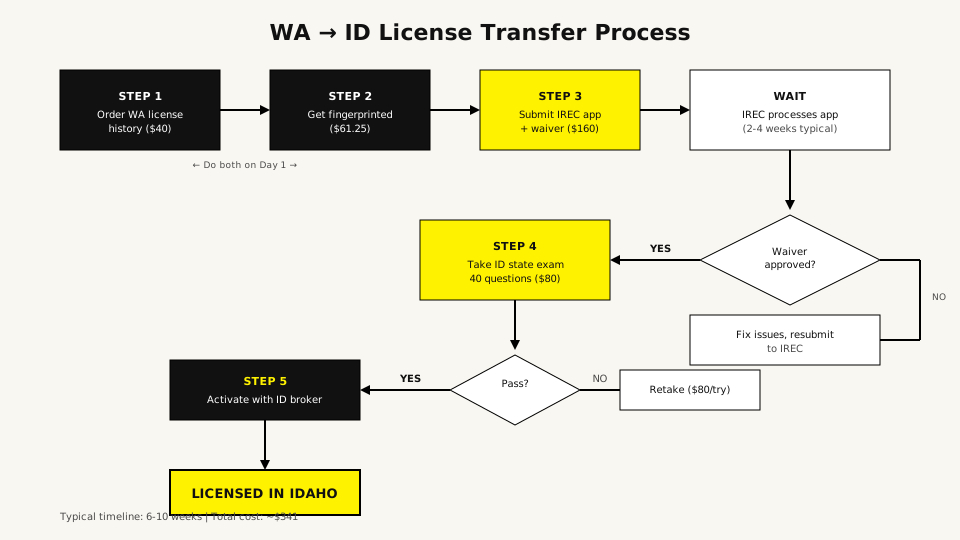
Step 1: Get your certified license history from Washington. Request it through the Washington Department of Licensing. Cost is $40. Allow ten to fourteen business days for processing — this is the step that creates the most delays because agents wait until the last minute to order it. Do this first. The certification is valid for six months.
Step 2: Get fingerprinted. Idaho requires a criminal background check under Idaho Code 54-2012. You’ll submit fingerprints to the Idaho State Police and FBI through an approved channeler. Cost is $61.25. Processing takes anywhere from one to twelve weeks, though one to two weeks is typical. Your fingerprint results need to show “RES-OK” status before IREC will process your application. These also expire after six months, so don’t get fingerprinted too far in advance.
Step 3: Submit your application and exam waiver request. File form REE-040 (salesperson) or REE-041 (broker) with IREC, along with the Exam Waiver Request Form. Include your certified license history, proof of fingerprint submission, and the $160 application fee. IREC will review the waiver request and notify you when you’re approved to take the state-only exam.
Step 4: Take the Idaho state exam. Once your waiver is approved, schedule the exam through Pearson VUE. The $80 fee is paid directly to Pearson VUE, not IREC. You’ll get your results immediately after finishing. If you don’t pass, you can retake it — just pay the $80 fee again.
Step 5: Activate your license. After passing the exam, IREC issues your license and assigns you to the brokerage you listed on your application. Make sure you’ve secured a sponsoring Idaho broker before this point. You cannot hold an active Idaho license without one.
Timeline
Best case, this takes four to six weeks. Here’s a realistic breakdown:
Week 1: Order your Washington license history and get fingerprinted. Do both on the same day.
Weeks 1-3: While waiting for the license history and fingerprint processing, start studying for the Idaho state exam. Focus on water rights, Idaho-specific disclosures, and anything in the Pearson VUE content outline that isn’t covered by Washington law.
Weeks 2-4: Submit your IREC application and exam waiver as soon as you have the certified license history and fingerprint confirmation.
Weeks 4-6: IREC processes the application and approves the exam waiver. Schedule and take the state exam.
Week 6: Pass the exam, activate your license with your Idaho broker.
The biggest variable is fingerprint processing. If the FBI background check runs long, the whole timeline stretches. Agents who’ve been fingerprinted for other professional licenses recently sometimes see faster turnaround, but there’s no way to guarantee it. Budget ten weeks to be safe.
Why this corridor matters
The Boise metro area has been one of the fastest-growing housing markets in the country for half a decade. Between 2020 and 2025, Boise’s population grew roughly 10%, driven heavily by remote workers and transplants from Seattle, Portland, and the Bay Area. The median home price in the Boise metro sits around $450,000 — less than half of Seattle’s $850,000-plus median.
Washington agents who’ve worked with Pacific Northwest buyers have a genuine edge in this market. You understand the mentality of someone trading a $900,000 split-level in Kirkland for a $425,000 house with a yard in Meridian. You speak their language. You know what a Seattle buyer means when they say “I want something with character” versus “I need turnkey.”
Coeur d’Alene and the northern Idaho panhandle are another hotspot. Spokane-area agents have been crossing the state line for years, and the WA→ID corridor runs strong through that region too. If you’re based in eastern Washington, northern Idaho might be a more natural expansion than Seattle.
Keeping both licenses active
You can hold Washington and Idaho licenses simultaneously. The ongoing costs are manageable:
- Washington renewal: $195.25 every two years, plus 30 hours of continuing education (including 3 hours of core curriculum)
- Idaho renewal: $125 every year (Idaho runs on annual renewals, not biennial), plus continuing education that’s currently undergoing regulatory changes
Between the two states, you’re looking at roughly $445 per year in renewal fees alone, plus CE course costs. If you’re actively working both markets, that’s a minor expense relative to your commission income. If one market goes quiet, consider whether keeping both licenses active is worth the cost or if you should let one go dormant.
For agents thinking about expanding beyond just two states, our guide on broker license reciprocity explains why upgrading to broker status before you move makes the whole process easier. And if you’re weighing whether to add an insurance license to serve your Idaho clients more completely, the dual-licensing strategy covers the math.
How WA→ID compares to other corridors
Idaho is one of the more forgiving destination states. Here’s how it stacks up:
- California to Nevada: Similar waiver structure for brokers (18 hours + state exam), but CA salespersons need 90 hours of Nevada education. Idaho waives education entirely.
- California to Texas: Texas has zero reciprocity and requires 180 hours of education from everyone. Idaho is dramatically easier.
- Florida to Georgia: Georgia has reciprocity with 49 states but carved out Florida as the exception. Idaho doesn’t play favorites — everyone gets the same waiver deal.
- New York to Florida: Florida’s mutual recognition program requires a 40-question law exam, similar to Idaho’s state exam. Processing times are comparable.
For the full picture of which states make transfers easy and which ones don’t, start with our reciprocity guide.
Your next move: order your Washington license history from DOL today. That ten-to-fourteen-day processing window is dead time you can’t compress, so start the clock now. While you wait, get fingerprinted and start reviewing the Pearson VUE content outline for the Idaho state exam. By the time your paperwork arrives, you’ll be ready to file.