The definitive guide to real estate license reciprocity and portability
Why agents are paying closer attention to reciprocity right now
The August 2024 NAR commission settlement changed the industry in ways that are still shaking out. One underreported consequence: agent churn. Buyer’s agents who built their business on the assumption that seller-paid commissions would always cover their side of the deal are now renegotiating their value proposition from scratch. Some are adapting. Others are leaving.
What’s left is a wave of agents relocating, restructuring, or actively exploring new markets where the dynamics are different. Some are moving to lower cost-of-living states where smaller transaction prices hurt less. Some are following their clients who relocated during COVID and never came back. Some are simply trying to expand their footprint so that a slow buyer season in one state doesn’t crater their annual income.
For these agents, reciprocity isn’t a nice-to-have. It’s a survival tactic.
LicenseLateral exists for exactly this moment. The system below is a clear-eyed guide to how real estate licensing actually works across state lines — the rules, the process, the costs, and where agents get stuck. If you’re navigating a license transfer as part of a broader career reset, you’re in the right place.
You have a real estate license in one state and you want to work in another. Maybe you’re relocating. Maybe you’re chasing deals across a border. Maybe your clients keep buying vacation property three states away and you’re tired of referring them out. Whatever the reason, you’re now staring down the barrel of state licensing bureaucracy, and the .gov websites are giving you nothing but 14-page PDFs and dead links.
I’ve transferred my license to four states over the years. The first time, I did everything wrong — applied to the wrong board, paid fees I didn’t owe, and waited eight weeks for a license I could have gotten in two. The second time, I had the process down to a system. This guide is that system.
What “reciprocity” actually means
The word gets thrown around loosely, but there are three distinct things people mean when they say “reciprocity,” and mixing them up will cost you time and money.
Full reciprocity means State B accepts your State A license with minimal paperwork. You fill out an application, pay a fee, maybe submit a background check, and you’re licensed. No additional exam. No extra coursework. This is the gold standard, and only a handful of state pairs offer it.
Partial reciprocity means State B gives you credit for some of your existing qualifications. You might skip the national portion of the exam but still need to pass the state-specific section. Or your pre-licensing education transfers but you need a few extra hours of state-specific courses. Most state-to-state agreements fall into this bucket.
Mutual recognition is Florida’s term (and a few other states use similar language). It’s a formal agreement between specific states that says “we’ll recognize your license if you pass our law exam.” It sounds like reciprocity, but the mechanics are different — you’re not transferring a license, you’re earning a new one through an abbreviated process. More on Florida’s system in our Florida mutual recognition guide.
The distinction matters because your application process, fees, and timeline change dramatically depending on which category your state pair falls into.
How states actually break down
Forget alphabetical lists. Here’s how to think about real estate reciprocity in terms of what actually affects your life.
The “full reciprocity” states
These are the easy ones. If you hold an active license in a state with a full reciprocity agreement, you can get licensed in the partner state without taking any exam. You’re looking at an application, a fee, and a background check. That’s it.
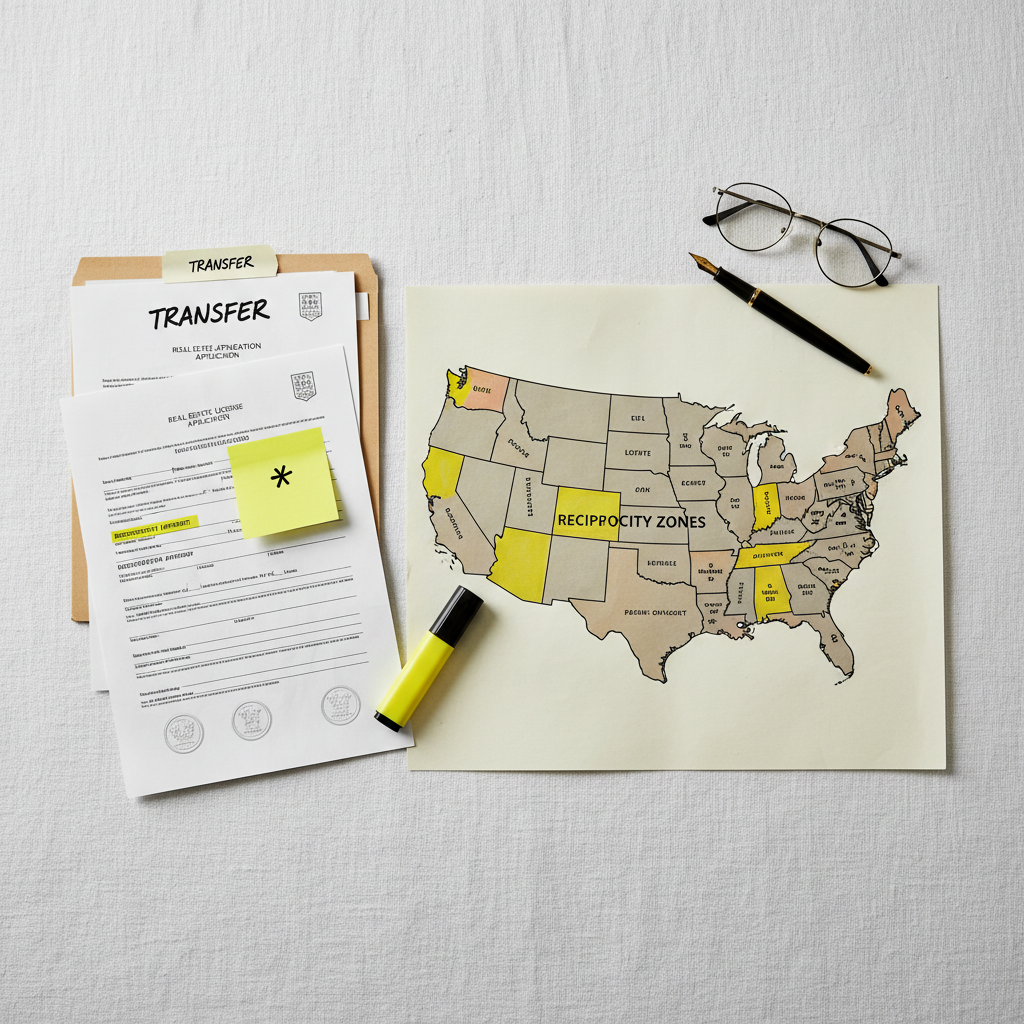
The list is short. States like Colorado, Alabama, and a handful of others have agreements that come close to true full reciprocity, though the specifics vary. Colorado is particularly generous — they’ll accept an active license from any state as long as you’ve held it for at least two years and can prove you’ve completed equivalent education.
Expect to pay $100 to $200 in application fees and wait two to four weeks for processing.
The “partial reciprocity” states
This is the biggest group, and where most agents end up. States like Pennsylvania, Virginia, and Georgia will give you credit for the national portion of your licensing requirements but require you to pass their state-specific exam. Some also require additional state-specific education hours.
The state exam is the sticking point for a lot of transferring agents. You know real estate. You’ve been doing this for years. But the state portion tests you on that state’s specific laws, contract forms, disclosure requirements, and commission rules. It’s a different animal than the national section, and plenty of experienced agents fail it the first time because they underestimate it. We cover this in depth in our state portion exam prep guide.
Fees in this category run $150 to $300 when you add up the application fee, exam fee, and background check. Timeline: three to six weeks from application to license in hand.
The “hard” states
Then there are states where reciprocity basically doesn’t exist. Texas is the poster child. You can have 20 years of experience in New York, and Texas will still require you to complete their full 180 hours of pre-licensing education and pass both portions of their exam. Your existing license gets you almost nothing.
Other states in this category include North Carolina, which has no reciprocity agreements at all, and California, which has its own education requirements that rarely align with other states’ curricula.
If you’re transferring to a hard state, budget $300 to $400 in fees, plus the cost of pre-licensing courses ($200 to $500 depending on the provider). Timeline: six to eight weeks minimum, often longer.
Reciprocity vs. portability: they’re not the same thing
This trips up a lot of agents. Reciprocity is about licensing — getting a license in a new state based on your existing one. Portability is about working — whether you can physically conduct real estate business across a state line without a second license.
Some states allow limited cross-border activity under specific conditions. You might be able to refer a client, attend an inspection, or even show property in a neighboring state without holding that state’s license, as long as you’re working with a licensed cooperating broker in that state. This is sometimes called “co-brokerage” or “cooperative brokerage.”
But the rules are wildly inconsistent. New York agents can do certain things in Connecticut that would get them fined in New Jersey. Some states are strict “turf states” that consider virtually any real estate activity by an out-of-state agent to be practicing without a license.
The safe play: if you’re going to conduct regular business in another state, get licensed there. Co-brokerage arrangements work for occasional cross-border deals, but they’re not a substitute for a real license if you’re doing it regularly. Read our reciprocity vs. portability breakdown for the full picture on where the legal lines are.
The general process for transferring your license
Regardless of which category your state pair falls into, the process follows the same basic structure.
Step 1: Verify your current license is active and in good standing. This sounds obvious, but your destination state will check. If you have any disciplinary history, outstanding CE requirements, or inactive status, fix it before you apply. A license that’s technically “active” but has a complaint pending can stall your application for months.
Step 2: Check the destination state’s specific requirements. Go directly to the state real estate commission’s website. ARELLO (the Association of Real Estate License Law Officials) maintains a directory of every state commission at arello.org, and it’s the most reliable starting point. Don’t rely on third-party sites that may be outdated.
Step 3: Gather your documents. Most states require a certified license history from your home state, proof of errors and omissions insurance, a completed application form, and fingerprints for a background check. Some states accept electronic fingerprints through a service like IdentoGO. Others still want ink cards mailed in. Check before you schedule.
Step 4: Submit your application and fees. Fees vary from $100 to $400 depending on the state. Some states accept online applications; others require physical mail. A few states still want a cashier’s check. Yes, in 2026.
Step 5: Pass any required exams. If your destination state requires the state portion exam, schedule it through the state’s testing provider (usually Pearson VUE or PSI). Don’t wait until your application is approved to start studying — the state portion covers material you probably don’t know, even if you’ve been licensed for years.
Step 6: Affiliate with a broker. Most states require you to have a sponsoring broker before they’ll issue your license. Line this up before your application is approved so you’re not sitting on an approved application with nowhere to hang your license.
Fees and timelines: what to actually budget
Here’s the honest breakdown of what this costs and how long it takes.
| Category | Application fee | Exam fee | Background check | Total cost | Timeline |
|---|---|---|---|---|---|
| Full reciprocity | $100-$200 | $0 | $30-$75 | $130-$275 | 2-4 weeks |
| Partial reciprocity | $100-$200 | $50-$100 | $30-$75 | $180-$375 | 3-6 weeks |
| No reciprocity | $100-$200 | $50-$100 | $30-$75 | $180-$375 + education costs | 6-8+ weeks |
These numbers don’t include pre-licensing education if your destination state requires it. Online courses from providers like Colibri or The CE Shop run $200 to $500 depending on the state and the number of hours required.
ARELLO: your primary data source
ARELLO — the Association of Real Estate License Law Officials — is the organization that tracks reciprocity agreements between states. Their website (arello.org) publishes a member directory of every state real estate commission, and they maintain data on licensing requirements across jurisdictions.
When you’re researching a specific state transfer, start with ARELLO’s directory to find the correct state commission, then go directly to that commission’s website for current requirements. State websites are clunky and often buried three levels deep, but the information there is authoritative. Third-party sites (including education providers) sometimes publish outdated reciprocity information because they’re not updating it in real time when states change their agreements.
Common mistakes that slow you down
Applying before your home state license is fully clear. Any pending complaints, overdue CE, or inactive status will delay your application. Clean house first.
Assuming “reciprocity” means “no exam.” In most cases, you’ll still take the state portion. Partial reciprocity just means you skip the national section and some education requirements.
Using outdated information. Reciprocity agreements change. States add and drop agreements regularly. What was true two years ago might not be true today. Always verify with the destination state’s commission directly.
Underestimating the state exam. The state portion covers local law, and you haven’t studied local law for a state you’ve never practiced in. Give yourself at least two weeks of focused study. Practice exams are the single best tool here.
Waiting to find a sponsoring broker. Start networking with brokerages in your destination state while your application is processing. Having a broker lined up means you can start working the day your license arrives.
Where to go from here
This guide gives you the framework. For specifics, start with the state pair that matters to you.
If you’re headed to Florida, read our Florida mutual recognition guide — Florida’s system is unlike any other state’s, and the “law exam loophole” can save you serious time.
For a specific state-to-state transfer like NY to PA, we break down the exact forms, fees, and exam requirements.
And if you’re facing a state exam as part of your transfer, our state portion exam prep guide covers exactly why the state section trips up experienced agents and how to beat it.
If you’re on the insurance side, the process is different enough to warrant its own guide. Head to our non-resident insurance licensing playbook for the NIPR-based workflow that insurance producers use to stack licenses across state lines.