Broker license reciprocity: why upgrading makes moving easier
If you’re planning to move to another state and you currently hold a salesperson license, upgrading to a broker license before you move could be the single smartest thing you do for your career. In multiple states, brokers get reciprocity shortcuts that salespersons don’t — waived education requirements, skipped exams, and faster processing times.
That’s the core argument of this article. Below is the full breakdown: which states reward broker status, what the upgrade costs, and how to time it so you’re earning commissions in your new state as fast as possible.
The broker advantage is real (and underused)
Most agents planning an interstate move focus on one question: “Does my new state have reciprocity?” That’s the wrong first question. The better question is: “Does my new state have reciprocity for brokers that it doesn’t offer salespersons?”
The answer, in a surprising number of states, is yes.
State licensing boards view brokers as more qualified. They’ve logged more transaction hours, completed more education, and passed a harder exam. When it comes to reciprocity agreements, several states treat that extra qualification as a reason to streamline the transfer. A salesperson applying from the same state might face full education requirements and a two-part exam. A broker from that same state might walk in with a fee and a state law quiz.
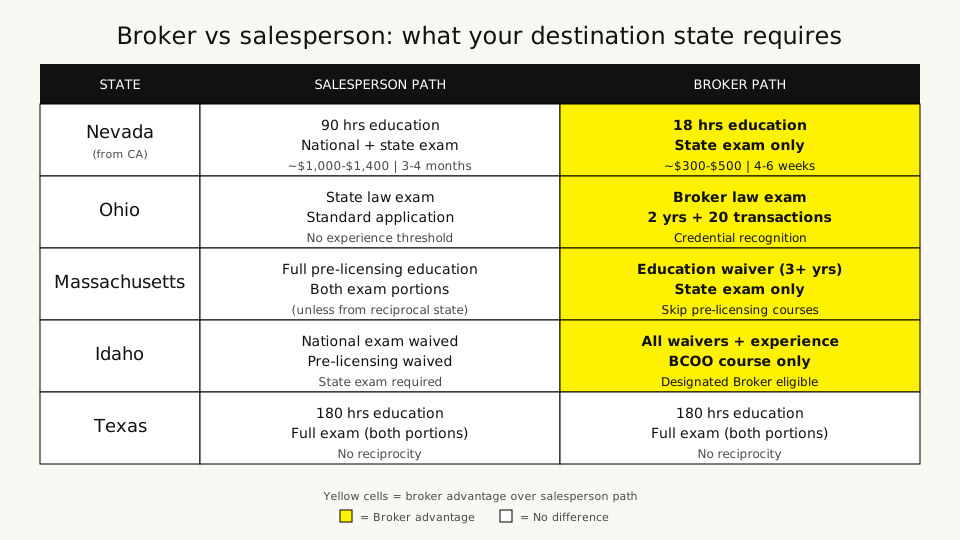
This isn’t theoretical. We documented the gap in our California to Nevada transfer guide: Nevada’s Real Estate Division offers Tier 2 reciprocity to California brokers, requiring only 18 hours of education and the state exam. California salespersons get no reciprocity at all — they’re looking at 90 hours of pre-licensing coursework and both parts of the exam. That’s a 72-hour education gap based solely on license level.
States where broker status opens doors
Not every state differentiates between brokers and salespersons for reciprocity. But several do, and the differences are significant enough to change your entire transfer strategy.
Nevada
The clearest example. Nevada’s tiered reciprocity system explicitly rewards broker status. California brokers qualify for an expedited path: 18 hours of Nevada-specific education, the state exam, and you’re in. California salespersons? Start from scratch with 90 hours of education and the full exam. If you’re a California agent with 2+ years of experience and you’re eyeing Las Vegas or Reno, upgrading to broker before you apply to Nevada will save you roughly $1,500 in coursework and three to four months of study time.
Ohio
Ohio’s Senate Bill 131, which went into effect at the end of 2023, created separate pathways for salespersons and brokers. Out-of-state salespersons need to pass the state law portion of the licensing exam. Out-of-state brokers must show they’ve been acting as a broker for at least two years, completed at least 20 transactions as a broker, and pass the Ohio broker law exam. The broker path has higher experience thresholds but acknowledges your existing credentials in a way the salesperson path doesn’t.
Ohio also signed a memorandum of understanding with Kentucky in 2024 to reinstate reciprocity between the two states. For brokers working the Cincinnati corridor, this is significant.
Idaho
Idaho has no formal reciprocal agreements with any state, but it offers generous waivers that effectively function as broker-friendly reciprocity. If you hold an active license in another state, Idaho will waive the national exam, pre-licensing education, and — if applicable — broker experience requirements. The catch: you need to submit your certified license history before scheduling your exam, and that paperwork takes three to six weeks.
For brokers, there’s one additional requirement. To serve as an Idaho Designated Broker, you must complete the Business Conduct and Office Operations (BCOO) course. But that’s a single course, not 90 hours of pre-licensing.
Massachusetts
Massachusetts offers reciprocity with 13 states, but the real story is their educational waiver system. Brokers licensed for three or more years can apply for an educational waiver and sit for only the Massachusetts state exam — skipping pre-licensing education entirely. For agents from states without a reciprocity agreement, this experience-based waiver is often the fastest path to a Massachusetts license, and it’s only available to brokers.
Colorado
Colorado is already one of the friendliest states for reciprocity, accepting licenses from any state with a reciprocal agreement. But Colorado’s system specifically requires a 12-month “broker activation” period for managing brokers. If you’re transferring as a broker and you plan to run your own office, having your broker license in hand before applying saves you from a separate upgrade process after you’ve already moved.
Where broker status doesn’t help
Some states don’t care whether you’re a broker or a salesperson. Texas is the most notable example. Texas has zero reciprocity with any state, regardless of license level. Every applicant completes 180 hours of qualifying education, passes both portions of the exam, and starts from the beginning. Broker status from your home state won’t shave a single hour off those requirements.
North Carolina is similarly indifferent. The state has limited reciprocity agreements, and whether you’re a broker or salesperson, you’re going through essentially the same process.
Before you invest in upgrading, verify that your destination state actually distinguishes between license levels for reciprocity purposes. Our reciprocity guide covers each state’s general framework, and the individual corridor articles drill into the specifics.
What it actually takes to upgrade
Upgrading from salesperson to broker isn’t a weekend project. But if you’re an experienced agent with several years under your belt, you’re closer than you think.
The requirements vary by state, but most follow a similar pattern:
Experience. The most common requirement is two to three years of active, full-time experience as a licensed salesperson. California requires two years. Illinois requires two years with at least $1 million in transactions or 20 transactions. New York requires two years. Some states count part-time experience at a reduced rate — four years of part-time might equal two years of full-time.
Education. Additional coursework beyond what you completed for your salesperson license. California requires eight 45-hour courses (360 total hours), though salespersons have typically already completed three of them. New York requires 120 hours of approved education. Washington requires 90 hours of managing broker education plus the 90 hours of broker education. Many states fall in the 60-120 hour range.
Exam. A separate broker licensing exam, which is generally longer and more difficult than the salesperson exam. It covers brokerage management, trust accounts, agency law at a higher level, and state-specific broker responsibilities.
Cost. The total out-of-pocket for upgrading typically runs between $1,000 and $3,000, depending on the state and how you complete the education (online vs. classroom, budget provider vs. premium). That includes coursework, exam fees, and application fees. In California, expect to pay roughly $1,500-$2,500 for the five additional courses plus exam and application fees.
The math: upgrade cost vs. transfer cost
Here’s where the decision gets interesting. The question isn’t “can I afford to upgrade?” It’s “can I afford not to?”
Consider a California agent moving to Nevada. Without a broker license, the transfer path includes 90 hours of Nevada pre-licensing education ($800-$1,200), both portions of the licensing exam ($150), and three to four months of study time during which you’re earning zero Nevada commissions. Total direct cost: roughly $1,000-$1,400, plus the opportunity cost of months without income.
With a broker license, the transfer path is 18 hours of Nevada education ($200-$400), the state exam only ($75), and maybe four to six weeks of prep. Direct cost: roughly $300-$500.
The broker upgrade in California costs $1,500-$2,500. But you can do that coursework while you’re still earning commissions in California, before you ever start the Nevada transfer. And the broker license doesn’t just help with Nevada — it travels with you for the rest of your career. If you move again five years from now, that upgrade pays for itself a second time.
The real cost of getting a transfer wrong goes beyond tuition. E&O coverage gaps, lost pending commissions, and broker affiliation timing mistakes can add thousands to your move. Upgrading to broker gives you more control over the transfer timeline and reduces the variables that cause those expensive mistakes.
The “associate broker” distinction matters
Not all broker licenses are created equal. Some states distinguish between an “associate broker” (or “broker associate”) and a “managing broker” (or “designated broker”). The difference matters for reciprocity.
An associate broker holds broker-level credentials but works under another broker’s supervision, similar to a salesperson. You’ve done the education and passed the exam, but you’re not running an office.
A managing broker (called “designated broker” in some states, including Idaho and Washington) is authorized to operate a brokerage, supervise agents, and hold trust accounts.
For reciprocity purposes, the distinction matters because some states require specific broker experience for their transfer pathway. Ohio’s SB 131, for example, requires that you’ve been “acting as a broker” with at least 20 transactions. An associate broker who functioned primarily as a producing agent might not meet that threshold.
Washington adds another layer: the state uses a three-tier system (broker, managing broker, designated broker), each with different education and experience requirements. If you’re transferring to Washington and want managing broker status, make sure your home state credentials map to their tier system before you apply.
The safest play is to upgrade to the highest broker tier your home state offers before transferring. This gives the destination state the least room to downgrade your credentials or impose additional requirements.
Timing the upgrade
The ideal sequence looks like this:
- Decide on your destination state and research whether broker status affects reciprocity there.
- Start your broker coursework now, while you’re still earning in your current state. Most states allow online completion at your own pace.
- Pass the broker exam in your home state and activate your broker license. Keep your salesperson transactions running during this period — most states allow a seamless upgrade without interrupting your practice.
- Apply for reciprocity in your destination state as a broker, not a salesperson.
- Handle the logistics — exam waivers, state law prep if required, and broker affiliation in the new state.
The biggest mistake agents make is waiting until they’ve already moved to start thinking about licensing. By then, you’re in a new state with no income, paying for an apartment, and scrambling through coursework you could have finished months ago.
If your destination state offers better reciprocity for brokers and you have the experience to qualify for the upgrade, start the process six to twelve months before your planned move. The coursework investment pays for itself in reduced transfer requirements and a faster path to earning.
Your next step: check whether your destination state differentiates between broker and salesperson reciprocity. If it does, pull up your home state’s broker upgrade requirements tonight. The sooner you start, the smoother the move.