California to Texas real estate license transfer: no shortcuts, but a clear path
Texas does not offer reciprocity with California. It doesn’t offer reciprocity with anyone. If you hold a California DRE license and want to practice in Texas, TREC (the Texas Real Estate Commission) treats you nearly identically to someone who has never sold a house. You’ll complete 180 hours of Texas-specific coursework, pass the state exam, find a sponsoring broker, and pay roughly $750 to $1,250 all in.
That’s the short version. The longer version involves some genuinely useful shortcuts for experienced California agents, a migration corridor that’s reshaping the Texas market, and a first-renewal requirement that blindsides almost everyone.
Why California education doesn’t transfer
California’s pre-licensing education totals 135 hours (three 45-hour courses). Texas requires 180 hours across six 30-hour courses. The problem isn’t just the hour count — it’s that TREC mandates specific course titles from TREC-approved providers, and none of your California DRE-approved coursework counts.
The six required courses:
- Principles of Real Estate I (30 hours)
- Principles of Real Estate II (30 hours)
- Law of Agency (30 hours)
- Law of Contracts (30 hours)
- Promulgated Contract Forms (30 hours)
- Real Estate Finance (30 hours)
That last one — Promulgated Contract Forms — is uniquely Texan. Texas is one of the few states that requires agents to use specific, commission-approved contract forms rather than attorney-drafted or association forms. It’s the single biggest reason your California experience doesn’t buy you a waiver. You literally need to learn a different way of writing contracts.
There are two narrow exceptions worth checking. If you hold a law degree (JD) from an accredited school, TREC may waive some or all of the education requirement. If you have a bachelor’s degree or higher in real estate from an accredited university, TREC will evaluate your transcripts for course-by-course substitution. For everyone else — including a California broker with 20 years of production — you’re doing all 180 hours.
The one shortcut that actually works: the national exam exemption
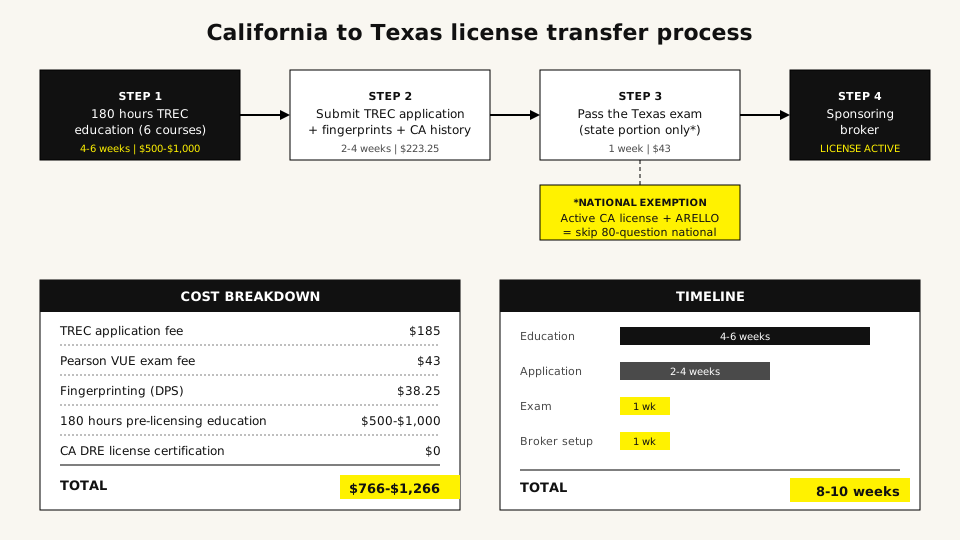
Your California license does help you in one concrete way. If you hold an active CA license and California participates in the ARELLO (Association of Real Estate License Law Officials) national exam accreditation program, TREC can exempt you from the national portion of the licensing exam.
The Texas exam has two sections:
- National portion: 80 questions, 150 minutes. Covers general real estate principles, practices, and math.
- State portion: 40 questions, 90 minutes. Covers Texas-specific law, TREC rules, and promulgated forms.
Getting the national exemption cuts your test day roughly in half. You only sit for the 40-question state section, which means you can focus all your study time on Texas law rather than reviewing concepts you’ve known for years.
To claim this exemption, submit a license history from the California DRE with your TREC application. You can pull your license certification through the DRE’s eLicensing portal at no cost. TREC evaluates these on a case-by-case basis, so submit the documentation and let them confirm — don’t assume.
What it costs
| Item | Cost |
|---|---|
| TREC application fee | $185 |
| Pearson VUE exam fee | $43 per attempt |
| Fingerprinting (DPS background check) | $38.25 |
| 180 hours of pre-licensing education | $500-$1,000 |
| CA DRE license certification | $0 (via eLicensing) |
| Total | ~$766-$1,266 |
The biggest variable is which education provider you choose. Aceable Agent, Colibri, The CE Shop, and Champions School of Real Estate are the most common options. Champions is Texas-based and has a strong reputation for exam prep. Online self-paced courses sit at the lower end of the price range; live virtual or in-person classes cost more but keep some agents more accountable.
The timeline
Here’s what a realistic timeline looks like for a California agent who treats this as a priority:
Weeks 1-5: Complete the 180 hours of qualifying education. Every major provider offers self-paced online courses, so the bottleneck is your own reading speed and how many hours per day you can dedicate. Motivated agents finish in four weeks. Agents working full-time and studying evenings and weekends typically need five to six.
Week 5-6: While wrapping up coursework (or right after), submit your TREC application with the $185 fee, fingerprints ($38.25), and your California license history. Request the license certification from the CA DRE eLicensing portal — it’s instant and free.
Weeks 6-8: TREC reviews your application. Processing times fluctuate, but two to four weeks from a complete submission is typical. Use this time to study for the state exam.
Week 8-9: Schedule and take the Pearson VUE exam ($43). If you received the national exemption, you’re sitting for 40 questions in 90 minutes. Results are immediate.
Week 9-10: Activate your license by associating with a Texas sponsoring broker.
Total: eight to ten weeks from enrollment to active license. Some agents push through faster; twelve weeks is more realistic if you’re balancing a full California workload during the process.
Finding a sponsoring broker from California
TREC won’t issue your license until a broker sponsors you. This isn’t a formality — you literally cannot hold an active Texas sales agent license without one.
If you’re relocating, start talking to Texas brokerages in week three or four of your education. Most large brokerages (Keller Williams, eXp, Compass, local independents) are experienced with out-of-state transfers and won’t hesitate to sponsor a productive California agent. Your CA production history is your strongest recruiting tool.
If you’re planning to work Texas remotely or part-time while keeping your California practice active, confirm the brokerage supports that arrangement. Not every Texas broker is set up for remote agents, and some have policies requiring physical presence in their market area.
The first-renewal trap
This catches every out-of-state agent off guard, and nobody talks about it during the application process.
Your first Texas license renewal (two years after issuance) requires 270 total qualifying hours — not just the initial 180. That means an additional 90 hours of Sales Apprentice Education (SAE) courses, plus TREC Legal Update I (4 hours) and Legal Update II (4 hours), plus a 30-hour Real Estate Brokerage course.
After that first renewal, the ongoing requirement drops to 18 hours of continuing education every two years, which is far lighter than California’s 45 hours every four years on a per-year basis. But that first renewal is a wall. Budget the time and roughly $200 to $400 in course fees for it.
Keeping both licenses active
Nothing prevents you from holding California and Texas licenses simultaneously. Whether you should is a math question.
Between renewal fees, CE hours, and MLS/association dues in two states, carrying both licenses costs roughly $1,500 to $3,000 per year. If you’re actively closing deals in both states — say, managing California investment clients while building a Texas buyer practice — the dual license pays for itself. If you relocated to Texas and your California business has dried up, let the CA license lapse and save the money.
If you’re thinking about operating across state lines, our snowbird agent strategy covers the logistics. And if you’re weighing whether the broker upgrade path could help you in other states, see our piece on broker license reciprocity.
Why this corridor matters right now
Roughly 100,000 Californians move to Texas every year, making it the single largest state-to-state migration corridor in the country. California accounts for over 14% of all inbound moves to Texas. One in five of those California transplants comes from the Los Angeles metro area alone.
The math driving this migration is hard to argue with. The median home price in Texas sits around $334,000. In California, it’s north of $900,000. A California agent who relocates to the DFW metroplex or Austin doesn’t just get cheaper housing — they get a client base full of former Californians who want an agent who understands 1031 exchanges from Bay Area rental properties, California capital gains exclusion rules, and the sticker shock of Texas property taxes (which run 1.6% to 2.2% of assessed value, compared to California’s Prop 13-capped rates).
That’s a genuine competitive advantage over Texas-native agents who’ve never dealt with California’s regulatory environment. The licensing process is a pain. The market opportunity on the other side of it is enormous.
How this compares to other corridors
Texas is what licensing people call a “hard” state — no reciprocity, no waivers, full education required. If you’re exploring multiple options, here’s how CA→TX stacks up against other popular California agent migration paths:
- California to Nevada: CA brokers get a reciprocal shortcut (18 hours + state exam). CA salespersons still need 90 hours. Much faster than Texas.
- Texas vs. other “no reciprocity” states: North Carolina is similarly rigid. Florida offers mutual recognition for qualifying states (California included) but still requires a law exam. See our full reciprocity states guide for the easy options.
- Timeline comparison: Our license transfer timeline guide breaks down processing times across all 50 states. Texas falls in the middle — not the fastest, not the slowest, but the education requirement adds weeks that other states don’t.
For a complete picture of costs across every state, check the 50-state fee calculator.
Your next step: enroll in the 180-hour TREC education package this week. While you’re working through coursework, request your California DRE license certification and start conversations with Texas brokerages. The sooner you start, the sooner you’re earning in a market where 100,000 of your former neighbors are looking for a California-savvy agent.