California to Nevada real estate license transfer: what NRED actually requires
If you hold a California real estate license and you’re trying to get licensed in Nevada, the first thing you need to know is that your path depends entirely on what level of license you hold. California brokers and broker-associates get a genuine shortcut. California salespersons do not. Nevada treats these two groups completely differently, and most “reciprocity guide” websites gloss over this distinction.
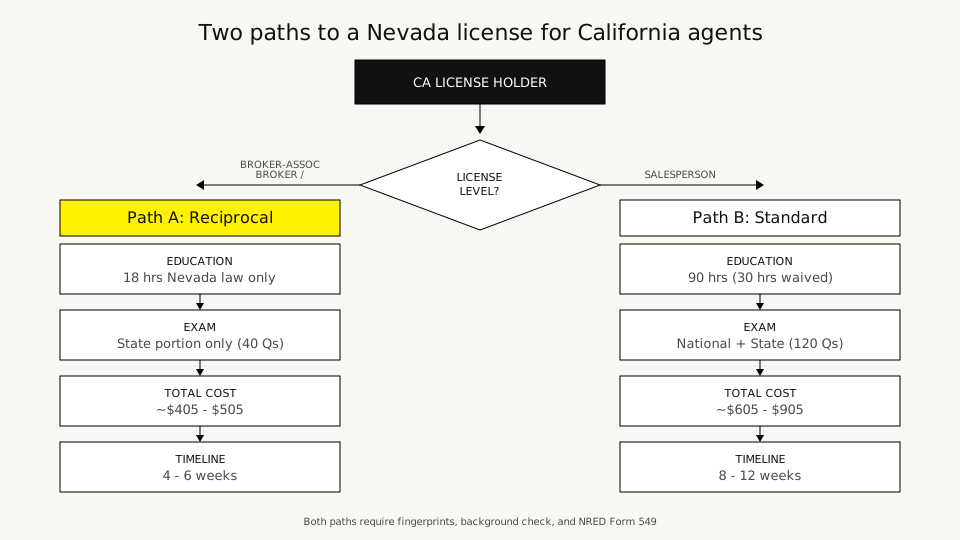
Here’s the short version: if you hold a CA broker or broker-associate license, you qualify for Nevada’s reciprocal licensing path. You skip the 120 hours of pre-licensing education and only need 18 hours of Nevada law plus the state exam. If you hold a CA salesperson license, you’re treated like a near-new applicant — 90 hours of pre-licensing education (you get a small waiver on two courses), the full exam, and nearly the same process a first-timer goes through.
That’s not a typo. Same state, same profession, two very different paths based on your California license level. Let me walk you through both.
Why California salespersons don’t get reciprocity
Nevada’s reciprocity system has two tiers, and most agents don’t realize this until they’re already on the NRED website trying to figure out why nothing matches what they read on a blog.
Tier 1 — salesperson reciprocity. Nevada grants education waivers to salesperson licensees from Arizona, Colorado, Delaware, Idaho, Kentucky, Louisiana, Minnesota, Texas, Utah, and West Virginia. California is not on this list.
Tier 2 — broker reciprocity. Nevada grants education waivers to agents holding a broker, broker-associate, or broker-salesperson license from a much wider list of states. California is on this list, alongside Connecticut, DC, Florida, Maine, Maryland, Michigan, New Jersey, New Mexico, New York, Ohio, Pennsylvania, Rhode Island, and Virginia.
The practical effect: a CA salesperson with 15 years of experience gets no education waiver. A CA broker with two years of experience gets the waiver. It’s about the license level, not how long you’ve been practicing.
If you’re a CA salesperson seriously considering the move to Nevada, upgrading to a broker license in California before applying in Nevada could save you 100+ hours of coursework. Whether that math works depends on how close you are to meeting California’s broker requirements (two years of salesperson experience plus additional coursework). More on this below.
Path A: CA broker or broker-associate (the shortcut)
If you hold a current California broker, broker-associate, or broker-salesperson license, here’s your checklist.
Education
Complete 18 hours of Nevada real estate law. This is the only education requirement for reciprocal applicants. The course covers NRS Chapter 645 (Nevada’s real estate licensing statute), NRED administrative codes, trust account requirements, and Nevada-specific disclosure rules. Several schools offer this course online, including Colibri, The CE Shop, and Key Realty School. Budget $100 to $200 for the course.
You are also waived from the national portion of the licensing exam. You only take the Nevada state portion.
The exam
The Nevada state exam is administered by Pearson VUE. It’s 40 scored questions (plus 5-10 unscored pretest items), and you have 90 minutes to complete it. You need a 75% to pass — that’s 30 out of 40.
What it covers:
- NRS 645 and the Nevada Administrative Code governing real estate
- Nevada agency relationships and disclosure requirements
- Trust account handling per NRED rules
- Nevada-specific contract provisions and forms
- Property tax rules, HOA regulations (big in Las Vegas), and environmental disclosures
- Advertising and license law violations specific to Nevada
The HOA content is worth calling out. Nevada has some of the most detailed HOA statutes in the country, and Las Vegas is one of the most HOA-dense markets in the US. If you’ve been practicing in rural California where HOAs are rare, study this section carefully.
Application and fees
| Item | Cost |
|---|---|
| NRED application fee (Form 549) | $140 |
| Pearson VUE exam fee | $100 |
| Fingerprint processing (DPS background check) | ~$40 |
| Fingerprinting vendor fee | ~$25 |
| 18-hour NV law course | $100-$200 |
| CA DRE license certification | $0 (free via eLicensing) |
| Total | ~$405-$505 |
Submit your application on Form 549, available on the NRED website (red.nv.gov). You’ll also need Form 656 (Consent to Service of Process) if you’re a non-resident. Mail both forms with your licensing fee to NRED’s Las Vegas office at 3300 W. Sahara Ave., Suite 350.
You’ll need a certified license history from the California DRE. California makes this easy — you can request a certification letter through the DRE’s eLicensing system at no cost. The certification must be dated within 90 days of your Nevada application.
Timeline
Weeks 1-2: Enroll in and complete the 18-hour Nevada law course. Request your CA DRE license certification. Get fingerprinted at an approved vendor.
Week 3: Schedule and take the Pearson VUE state exam. Results are immediate.
Weeks 3-4: Submit your completed Form 549 with all supporting documents.
Weeks 4-6: NRED processes your application. Processing times vary, but two to four weeks from a complete application is typical.
Total: four to six weeks if you pass the exam on your first attempt and submit a clean application. The biggest delay is usually NRED processing — their queue length varies throughout the year.
Path B: CA salesperson (the long way)
If you hold a California salesperson license, Nevada treats your application the same as a first-time applicant with one exception: you’re waived from the contracts and agency courses (30 hours combined). You still need 90 hours of coursework.
Education
You must complete 90 hours of approved pre-licensing education:
- 45 hours of Real Estate Principles
- 45 hours of Real Estate Law (must include 18 hours of Nevada-specific law)
The contracts course (15 hours) and agency course (15 hours) are waived for licensed out-of-state applicants. That’s the only break you get.
These courses are available online through Colibri, The CE Shop, Kaplan, and several Nevada-based schools. Budget $300 to $600 depending on the provider and package. At a comfortable pace, expect four to eight weeks to complete the coursework.
The exam
You take the full Nevada real estate exam — both the national portion (80 questions, 150 minutes) and the state portion (40 questions, 90 minutes). You need 75% on each section to pass.
The national section should be straightforward if you’ve been practicing. The state section is where you need to focus your study time. See the exam content breakdown under Path A.
Application and fees
| Item | Cost |
|---|---|
| NRED application fee (Form 549) | $140 |
| Pearson VUE exam fee | $100 |
| Fingerprint processing (DPS background check) | ~$40 |
| Fingerprinting vendor fee | ~$25 |
| 90 hours of pre-licensing education | $300-$600 |
| CA DRE license certification | $0 |
| Total | ~$605-$905 |
That’s roughly double the cost of the broker path, and most of the difference is education.
Timeline
Weeks 1-6: Complete 90 hours of pre-licensing education. This is the bottleneck. If you’re working full-time, plan for six weeks at a steady pace. Some agents power through it in three to four weeks.
Weeks 5-6: While finishing coursework, get fingerprinted and request your CA license certification.
Week 7: Schedule and take the Pearson VUE exam.
Weeks 7-8: Submit your application with all supporting documents.
Weeks 8-10: NRED processes your application.
Total: eight to ten weeks minimum. Realistically, most agents working full-time are looking at ten to twelve weeks.
The broker upgrade cheat code
If you’re a CA salesperson with at least two years of full-time experience, upgrading to a California broker license before applying in Nevada might save you time and money.
California requires eight college-level courses (or equivalent) to qualify for the broker exam. If you already have some of those courses from your salesperson education, the gap might be smaller than you think. The CA broker exam is harder than the salesperson exam, but if you pass it, you immediately qualify for Nevada’s reciprocal path — 18 hours of Nevada law instead of 90 hours of pre-licensing education.
Do the math for your specific situation. If you’re within one or two courses of qualifying for the CA broker exam, upgrading first could shave six weeks and $200+ off your Nevada licensing timeline. If you need five or more courses, it’s probably faster to just do the Nevada pre-licensing education directly.
Post-licensing: the surprise requirement
Here’s something that catches every out-of-state agent off guard: Nevada requires a 30-hour post-licensing course within your first year. This isn’t continuing education — it’s a separate requirement for all new licensees, regardless of experience.
The post-licensing course must be completed through live instruction (not online self-paced). Nevada has limited exceptions for agents in rural areas. If you’re in Las Vegas or Reno, you’re attending class.
Your first license renewal happens one year after your license issue date, not on a fixed calendar cycle like California. If you don’t complete the 30-hour course before that anniversary, your license goes inactive. No extensions, no grace period.
After your first renewal, you transition to Nevada’s standard continuing education cycle: 36 hours every two years, with at least 18 of those hours through live instruction. That’s significantly more than California’s 45 hours every four years — roughly the same annual load but with stricter delivery requirements.
Keeping both licenses active
Nothing stops you from holding California and Nevada licenses simultaneously. Many agents working the CA/NV border corridor (especially the Reno-Tahoe and Las Vegas markets) maintain dual licenses.
The practical question is whether the cost of maintaining both licenses justifies the business opportunity. Between renewal fees, CE hours, and association dues in two states, you’re looking at $1,500 to $2,500 per year in carrying costs. If you’re consistently doing deals in both states, that’s a rounding error. If you moved to Nevada and rarely work California transactions, let the CA license lapse and save the money.
If you’re thinking about operating in both states, our snowbird agent strategy covers the logistics of splitting your practice across state lines.
Why this corridor matters right now
Nearly 39,000 Californians moved to Nevada in 2024 alone — about 106 people per day. Since 2020, over 158,000 Californians have relocated to Nevada, making up 43% of the state’s new residents. The median home price in the Las Vegas Valley sits around $465,000, compared to over $1 million in Los Angeles and $1.1 million in San Jose.
Those transplants need agents who understand both markets. A California agent who can speak fluently about 1031 exchanges from a Bay Area investment property into a Las Vegas rental portfolio has a built-in competitive advantage over a Nevada-only agent. The licensing hassle is real, but the market opportunity on the other side of it is enormous.
For a broader look at how state-to-state transfers work, see our real estate reciprocity guide. If you want to understand which states make this process easy and which ones make it painful, check our breakdown of the full reciprocity states. And if you’re coming from a different state, our 50-state fee calculator can help you estimate costs before you start.
Your next step: check what level of California license you hold. If it says “Salesperson” on your DRE record, do the math on whether upgrading to a broker license makes sense before you start the Nevada process. If you already hold a broker license, start the 18-hour Nevada law course today.