How long does a real estate license transfer actually take?

The short answer: it depends entirely on where you’re going. Colorado can activate your license in 48 hours. California will take three to six months. Most states land somewhere in between, with the average transfer running two to six weeks from complete application to license in hand.
The longer answer involves fingerprint backlogs, paper-versus-online submission, and the difference between “application processing time” and “total time until you can legally sell a house.” Those two numbers are often weeks apart, and most state board websites only advertise the first one.
The timeline that matters isn’t the one they advertise
State real estate commissions publish processing times for applications. What they don’t tell you is that the application is often the shortest part of the process. The real timeline looks like this:
- Pre-application work — education requirements, exam scheduling, fingerprint card submission
- Application processing — the state reviews your paperwork
- Background check clearance — the part nobody warns you about
- Broker affiliation — you can’t activate your license without one
Most “how long does it take?” answers only cover step 2. That’s like asking how long a flight takes and only counting the time from takeoff to landing, ignoring the two hours at security and the 45-minute wait at baggage claim.
The fast states (under two weeks)
A handful of states have built genuinely efficient licensing systems. If you’re choosing where to transfer based partly on speed, these are your best options.
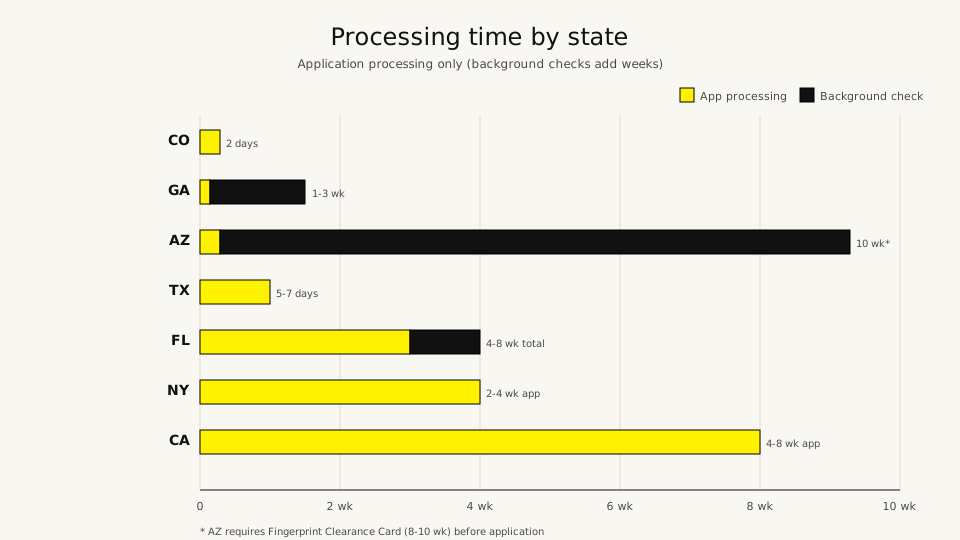
Colorado is the gold standard. DORA (the Division of Real Regulatory Agencies) processes online applications in 24 to 48 hours. Colorado has full reciprocity with every state, meaning no additional education or exams. Submit your application online, pay $195, and you could be affiliated with a Colorado broker by the end of the week. The caveat: if DORA flags your application for a fingerprint background check, that can add up to 10 weeks. Clean record? Two days. Any criminal history at all? Clear your calendar.
Georgia runs online transfers through the GREC portal. If you hold a license from any state other than Florida, it’s an application-only process with no exam. Same-day approvals happen. Realistically, plan for one to three weeks. Florida agents face an extra step — the Georgia Supplement Exam — which adds exam scheduling time but doesn’t slow the application itself.
Arizona processes clean online applications in under two days through ADRE. But here’s the catch that blindsides people: Arizona requires a Fingerprint Clearance Card before you can even apply. That card takes eight to ten weeks to process through the Arizona Department of Public Safety. So the “two-day processing time” is real, but the two months you spent waiting for your clearance card don’t show up in that number.
Texas launched the REALM Portal in 2025, moving the entire licensing process online. Application processing runs five to seven business days for a standard transfer. No reciprocity though — Texas requires full education and testing regardless of where you’re licensed. The total timeline from “I want a Texas license” to “I have one” is more like two to four months when you factor in 180 hours of coursework and exam scheduling.
The slow states (six weeks or longer)
Some states move slowly because they don’t have reciprocity. Others move slowly because their bureaucracies are genuinely behind. A few manage both.
California is the extreme case. The DRE has zero reciprocity with any state, so every out-of-state agent starts from scratch: 135 hours of California-specific pre-licensing education, both national and state exams, and an application that takes four to eight weeks to process after submission. Total timeline from first day of coursework to license in hand? Three to six months. There’s no expedite option. Moving from California is easier than moving to it.
New York doesn’t offer general reciprocity either. You’ll need 77 hours of pre-licensing education, the state and national exams, and an application that takes two to four weeks to process. Mail-based submissions add roughly two weeks compared to online filing. Total timeline: two to four months.
North Carolina has a “limited nonresident commercial license” option and a provisional broker license for experienced out-of-state agents. But the total process — education verification, background checks, and application review — runs 50 to 60 days in practice. The application review itself only takes five to ten business days. Everything around it takes two months.
Arkansas deserves a special mention for fingerprint processing alone. The combined FBI and Arkansas State Police background check can take one to six months. One to six. That range isn’t a typo — it’s the actual variance agents report.
The hidden bottleneck: fingerprints
If there’s one universal slowdown in the license transfer process, it’s fingerprint-based background checks. Every state requires one. How fast they process it varies wildly.
The fastest: Florida gets FBI fingerprint results back in three to five days. Georgia’s online system processes background checks within its standard application window.
The slowest: Arizona’s Fingerprint Clearance Card takes eight to ten weeks. Colorado’s DORA fingerprint processing runs up to ten weeks for flagged applications. Arkansas is the worst at one to six months.
This is the single biggest variable in your transfer timeline, and it’s the one you have the least control over. Two things that help:
Get fingerprinted early. In states that accept fingerprints before the full application (Arizona’s Fingerprint Clearance Card, for example), submit those prints the day you decide to move. Don’t wait until you’ve finished your coursework.
Use a Livescan provider when possible. Electronic fingerprint submission processes faster than physical FD-258 cards in every state that accepts it. If you’re mailing ink-on-paper fingerprint cards, you’re adding days to the process just for postal transit, plus the risk of smudged prints requiring resubmission.
Can you work while your transfer is pending?
Mostly no. This is the part that hurts.
California, New York, Florida, and Texas all require your license to be fully issued and active before you conduct any real estate activity in the state. No provisional permits. No temporary licenses. You can’t show houses, negotiate contracts, or even hold an open house while your application processes.
A few states offer relief:
North Carolina issues a Provisional Broker License to out-of-state agents with three or more years of active licensing experience. You can work immediately under the provisional license while your full license processes.
Missouri has a temporary work permit under Statute 339.040(7). If your application appears to meet all requirements, Missouri can issue a permit allowing you to practice while the formal review wraps up.
Colorado’s 48-hour turnaround effectively eliminates the “waiting period” problem. You’re not technically working while pending — you’re just not pending for long.
For everyone else, the gap between “submitted my application” and “received my license” is dead time. No income from that state. This is why the timeline question matters so much — it’s not just about convenience. It’s about how many weeks of lost income you’re signing up for.
How to compress your timeline
You can’t speed up a state’s internal processing, but you can eliminate the delays you control.
Submit online, always. States that accept both paper and online applications consistently process online submissions faster. New York agents report a two-week difference. Oklahoma explicitly deprioritizes paper applications.
Submit a complete application. The number-one reason for processing delays, according to nearly every state commission website, is incomplete applications. Missing attachments, unanswered questions, failure to disclose past legal issues. Every incomplete application gets kicked back to the end of the queue.
Order your certified license history early. Your current state needs to certify that your license is active and in good standing. Some states generate this in a day. Others take a week or more. Order it as soon as you know where you’re going.
Schedule your exam before you finish your education. Test center availability can add weeks to your timeline. In some states, Pearson VUE and PSI exam slots book out three to four weeks in advance. Check availability and reserve a date while you’re still finishing your coursework. You can reschedule if needed.
Stack your steps. Fingerprinting, education, and license history requests can all happen simultaneously. Don’t treat this as a linear checklist where each step waits for the previous one. The only truly sequential steps are “pass the exam” and “submit the application.”
The real timeline for common corridors
Here’s what the total process actually looks like for the migration corridors agents ask about most, counting from your first action (signing up for a course or requesting fingerprints) to license in hand:
| Corridor | Education needed? | Exam? | Realistic total timeline |
|---|---|---|---|
| Any state to CO | No | No | 1-2 weeks |
| Most states to GA | No | No (except FL) | 1-3 weeks |
| CA broker to NV | 18 hrs NV law | State only | 3-6 weeks |
| CA salesperson to NV | 90 hrs | Full | 2-4 months |
| Any state to FL | None (mutual recognition) | 40-question law exam | 4-8 weeks |
| Any state to TX | 180 hrs | Full | 2-4 months |
| Any state to NY | 77 hrs | Full | 2-4 months |
| Any state to CA | 135 hrs | Full | 3-6 months |
These timelines assume a clean criminal record and a complete application submitted online. Add two to four weeks for any background check complications, and add another week or two if you’re submitting anything by mail.
If you’re in the middle of a transfer right now and wondering what’s taking so long, the 50-state fee calculator has the application contacts for every state commission. Sometimes a phone call to the right office moves things faster than refreshing your application status page.
Your next move: pick your destination state from the table above, then read the specific corridor guide to see exactly what education, exams, and paperwork you need. The faster you get complete, the faster you get licensed — and the sooner the income gap closes.