The 50-state real estate license fee calculator
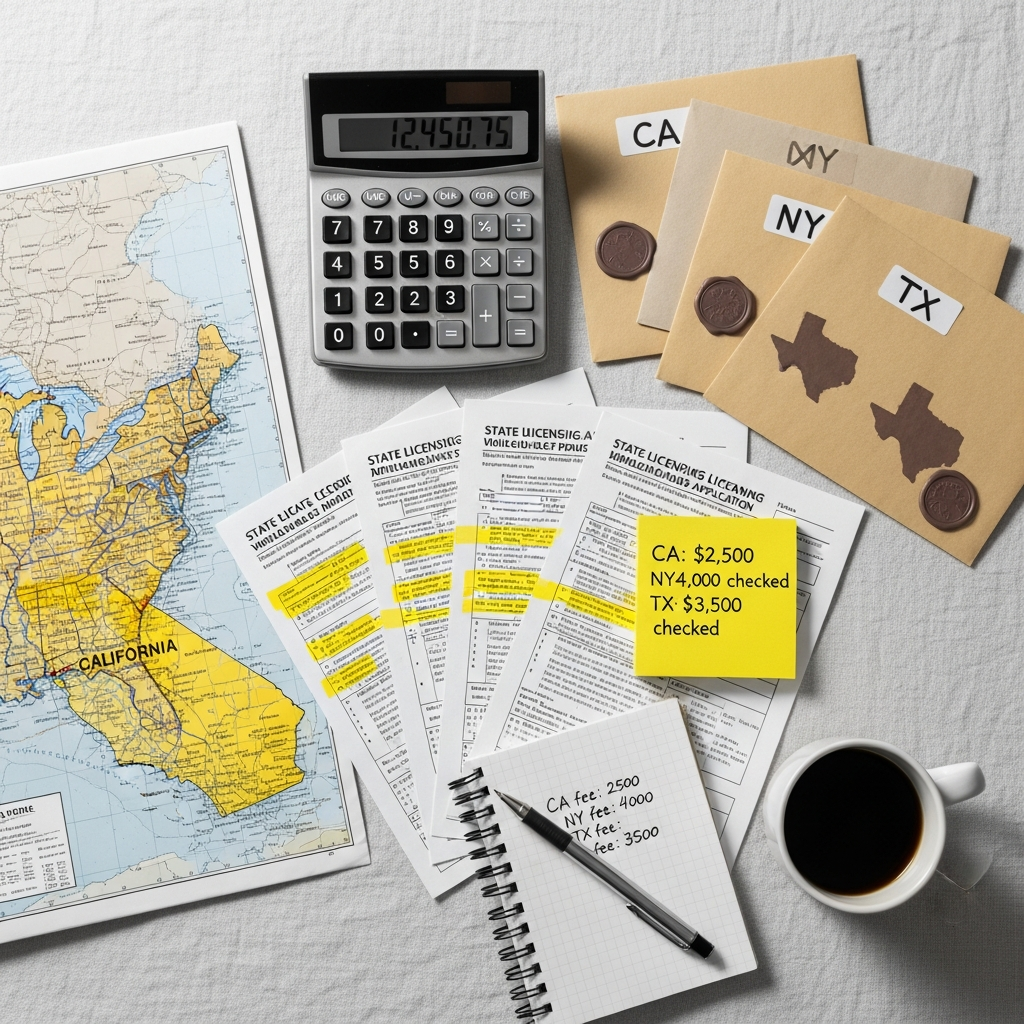
Getting a real estate license costs somewhere between $266 and $1,502 depending on your state. That’s not a typo. Michigan will get you licensed for less than the cost of a nice dinner out. South Dakota will charge you more than a month’s rent.
I’ve pulled the actual fee schedules from all 50 state real estate commissions and combined them with current course pricing from major education providers. The table below shows what you’ll actually pay — application fee, exam fee, fingerprinting, pre-licensing coursework, and mandatory E&O insurance where states require it. No ranges-within-ranges, no “contact your state for details.” Just the numbers.
How to read this table
Each state’s total includes five cost categories:
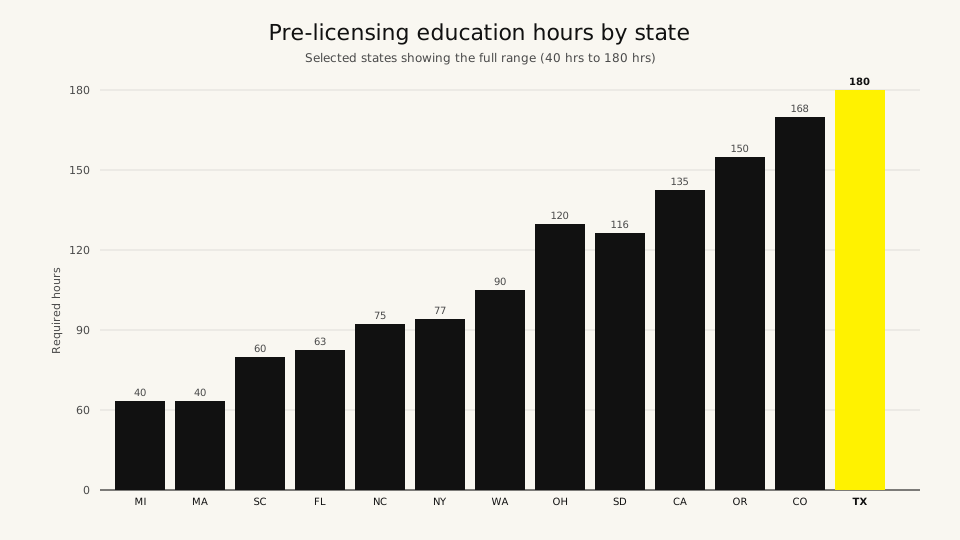
- Pre-licensing course — The education hours your state requires before you can sit for the exam. This is almost always the biggest single cost, and it varies wildly: 40 hours in Michigan versus 180 hours in Texas.
- Exam fee — What PSI, Pearson VUE, or your state charges per attempt. This is for one attempt only. If you fail (and roughly 40-50% of first-time test-takers do), you’ll pay again.
- Application/license fee — The state commission’s processing fee. Some states roll this into one fee, others split it into an application fee plus a separate license issuance fee.
- Fingerprinting/background check — Most states require Live Scan or ink card fingerprinting. A few don’t.
- Mandatory E&O insurance — Fifteen states require errors and omissions insurance before you can activate your license. If your state isn’t one of them, your brokerage will probably require it anyway, but it won’t show up in the state’s official cost.
The course costs use mid-range pricing from Colibri, The CE Shop, Kaplan, and Aceable Agent. You can find cheaper options (RealEstateU starts around $99 in some states) or pay more for premium packages with exam prep bundles. The rest of the fees are fixed by the state.
The full table
Least expensive states
| State | Pre-licensing course | Exam fee | Application fee | Fingerprints | E&O (if required) | Estimated total |
|---|---|---|---|---|---|---|
| Michigan (40 hrs) | $99-$300 | $79 | $88 | — | — | $266-$467 |
| New York (77 hrs) | $179-$500 | $15 | $55 | $35 | — | $284-$605 |
| South Carolina (60 hrs) | $149-$400 | $63 | $75 | — | — | $287-$538 |
| Florida (63 hrs) | $100-$400 | $36 | $83 | $52 | — | $271-$571 |
| Indiana (90 hrs) | $149-$400 | $53 | $60 | $76 | — | $338-$589 |
| Wisconsin (72 hrs) | $199-$400 | $65 | $75 | — | — | $339-$540 |
| Vermont (40 hrs) | $149-$300 | $110 | $100 | — | — | $359-$510 |
| Maryland (60 hrs) | $149-$400 | $44 | $90 | $108 | — | $391-$642 |
| Missouri (72 hrs) | $149-$400 | $52 | $55 | $42 | — | $298-$549 |
| North Carolina (75 hrs) | $200-$500 | $64 | $100 | $40 | — | $404-$704 |
Mid-range states
| State | Pre-licensing course | Exam fee | Application fee | Fingerprints | E&O (if required) | Estimated total |
|---|---|---|---|---|---|---|
| Alabama (60 hrs) | $200-$500 | $74 | $210 | $44 | — | $528-$828 |
| Alaska (40 hrs) | $199-$400 | $100 | $275 | $60 | $540 | $1,174-$1,375 |
| Arizona (90 hrs) | $149-$400 | $75 | $60 | $67 | — | $351-$602 |
| Arkansas (60 hrs) | $149-$350 | $75 | $50 | $40 | — | $314-$515 |
| California (135 hrs) | $199-$500 | $100 | $350 | $49 | — | $698-$999 |
| Colorado (168 hrs) | $350-$600 | $44 | $485 | $40 | $239 | $1,158-$1,408 |
| Connecticut (60 hrs) | $199-$500 | $65 | $590 | $80 | — | $934-$1,235 |
| Delaware (99 hrs) | $249-$500 | $69 | $163 | $67 | — | $548-$799 |
| Georgia (75 hrs) | $149-$450 | $64 | $170 | $45 | — | $428-$729 |
| Hawaii (60 hrs) | $349-$600 | $62 | $95 | $30 | — | $536-$787 |
| Idaho (90 hrs) | $249-$500 | $75 | $160 | $35 | $200 | $719-$970 |
| Illinois (90 hrs) | $149-$500 | $55 | $150 | $50 | — | $404-$755 |
| Iowa (60 hrs) | $149-$350 | $95 | $125 | $50 | $144 | $563-$764 |
| Kansas (60 hrs) | $149-$350 | $71 | $100 | $47 | — | $367-$568 |
| Kentucky (96 hrs) | $249-$500 | $100 | $80 | $42 | $126 | $597-$848 |
| Louisiana (90 hrs) | $250-$500 | $65 | $210 | $37 | $200 | $762-$1,012 |
| Maine (55 hrs) | $249-$400 | $73 | $121 | — | — | $443-$594 |
| Massachusetts (40 hrs) | $149-$350 | $54 | $103 | — | — | $306-$507 |
| Minnesota (90 hrs) | $249-$500 | $63 | $111 | — | — | $423-$674 |
| Mississippi (60 hrs) | $249-$400 | $75 | $110 | $36 | $200 | $670-$821 |
| Montana (60 hrs) | $249-$400 | $80 | $125 | $33 | $168 | $655-$806 |
| Nebraska (66 hrs) | $249-$450 | $75 | $165 | $49 | $125 | $663-$864 |
| Nevada (90 hrs) | $199-$450 | $100 | $125 | $42 | — | $466-$717 |
| New Hampshire (40 hrs) | $249-$500 | $67 | $90 | $25 | — | $431-$682 |
| New Jersey (75 hrs) | $149-$650 | $45 | $160 | $66 | — | $420-$921 |
| New Mexico (90 hrs) | $349-$600 | $95 | $270 | $59 | $349 | $1,122-$1,373 |
| North Dakota (90 hrs) | $400-$649 | $131 | $181 | $40 | $187 | $939-$1,188 |
| Ohio (120 hrs) | $500-$949 | $63 | $81 | $70 | — | $714-$1,163 |
| Oklahoma (90 hrs) | $249-$400 | $75 | $330 | $60 | — | $714-$865 |
| Oregon (150 hrs) | $299-$600 | $75 | $300 | $61 | — | $735-$1,036 |
| Pennsylvania (75 hrs) | $299-$500 | $49 | $107 | $22 | — | $477-$678 |
| Rhode Island (45 hrs) | $249-$400 | $63 | $165 | — | $200 | $677-$828 |
| South Dakota (116 hrs) | $700-$949 | $98 | $225 | $43 | $187 | $1,253-$1,502 |
| Tennessee (90 hrs) | $149-$400 | $63 | $91 | $35 | $150 | $488-$739 |
| Texas (180 hrs) | $500-$1,624 | $43 | $205 | $38 | — | $786-$1,910 |
| Utah (120 hrs) | $399-$600 | $59 | $147 | $12 | — | $617-$818 |
| Virginia (60 hrs) | $99-$400 | $60 | $210 | $52 | — | $421-$722 |
| Washington (90 hrs) | $400-$700 | $210 | $223 | $44 | — | $877-$1,177 |
| West Virginia (90 hrs) | $300-$500 | $59 | $100 | $47 | — | $506-$706 |
| Wyoming (70 hrs) | $299-$400 | $160 | $300 | $39 | $225 | $1,023-$1,124 |
Most expensive states
| State | Pre-licensing course | Exam fee | Application fee | Fingerprints | E&O (if required) | Estimated total |
|---|---|---|---|---|---|---|
| Texas (180 hrs) | $500-$1,624 | $43 | $205 | $38 | — | $786-$1,910 |
| Colorado (168 hrs) | $350-$600 | $44 | $485 | $40 | $239 | $1,158-$1,408 |
| South Dakota (116 hrs) | $700-$949 | $98 | $225 | $43 | $187 | $1,253-$1,502 |
| Alaska (40 hrs) | $199-$400 | $100 | $275 | $60 | $540 | $1,174-$1,375 |
| New Mexico (90 hrs) | $349-$600 | $95 | $270 | $59 | $349 | $1,122-$1,373 |
What these numbers don’t include
The table above covers what it costs to get the license in your hand. It doesn’t cover what it costs to actually start working. Those are two very different numbers.
Once you’re licensed, the meter starts running on a whole separate set of fees that most new agents don’t budget for:
MLS access: $500-$1,000+ per year. You can’t list or search properties without MLS access. Most boards bill this quarterly. It’s non-negotiable — without it, you’re a licensed agent who can’t see inventory.
NAR, state, and local association dues: $500-$1,500 per year. NAR dues alone are $156 for 2026, plus a $45 special assessment. Then add your state association ($100-$300) and local board ($200-$500). These are required if you want to call yourself a REALTOR and access the MLS in most markets.
E&O insurance in non-mandatory states: $200-$600 per year. Even if your state doesn’t require it, your brokerage almost certainly will. Group policies through your broker are usually cheaper than individual policies, but make sure you understand what happens to your coverage if you leave that brokerage.
Brokerage fees: $0-$500 per month. Some brokerages charge desk fees (flat monthly rate) instead of or on top of commission splits. A 70/30 split with no desk fee is common at traditional brokerages. A 100% commission model with a $500/month desk fee is common at cloud brokerages. The math is different depending on your production level.
Lockbox, technology, and marketing: $200-$600 per year. SUPRA key access, CRM subscriptions, and basic marketing materials add up fast.
Add it all together, and most new agents should budget $2,000-$5,000 beyond the license itself for their first year. That’s the real number nobody tells you at the orientation seminar.
The five biggest cost drivers, state by state
1. Pre-licensing education hours
This is the single biggest variable. Texas requires 180 hours of coursework — six mandatory 30-hour courses that TREC won’t let you substitute, even if you have 20 years of experience in another state. At the other end, Michigan, Massachusetts, Vermont, and New Hampshire get you to the exam in 40 hours.
More hours means more money and more time. A 40-hour online course typically runs $99-$300. A 180-hour Texas package runs $500-$1,624 depending on whether you want the bare minimum or a premium bundle with exam prep.
2. Application and license fees
Connecticut charges a $590 “license activation fee” that makes every other state look reasonable. Colorado’s $485 application fee is the second-highest. Meanwhile, South Carolina charges $25 to apply and $50 for the license. Same credential, 10x the price difference.
These fees are set by state legislatures and real estate commissions, and they change without much warning. California raised multiple fees in July 2024 (the first increase since the late 2000s), bumping renewal fees 43-50% overnight via Senate Bill 164. Illinois increased its broker application fee to $150 and renewal to $200 starting January 2024.
3. Mandatory E&O insurance
Fifteen states require you to carry errors and omissions insurance before your license is active. This adds $125 to $540 to your upfront costs depending on the state. Alaska is the most expensive at roughly $540 per year. Kentucky’s state group plan is the cheapest at about $126.
The mandatory states are: Alaska, Colorado, Idaho, Iowa, Kentucky, Louisiana, Mississippi, Montana, Nebraska, New Mexico, North Dakota, Rhode Island, South Dakota, Tennessee, and Wyoming.
If your state isn’t on this list, don’t assume you can skip E&O. Most brokerages require it as a condition of hanging your license, and you should absolutely carry it regardless. We covered what happens when you don’t in our article on the $5,000 mistake.
4. Exam fees
Washington charges $210 per exam attempt. New York charges $15. Most states fall between $45 and $100.
This matters more than you think because of retakes. If the national first-time pass rate is roughly 50-60%, a meaningful number of test-takers are paying that exam fee twice or three times. At $210 per shot in Washington, failing once adds real money to your total. At $15 in New York, it’s a rounding error.
5. Fingerprinting and background checks
Most states charge $30 to $75 for Live Scan fingerprinting and a background check. Maryland is the outlier at $108. A handful of states (Michigan, Vermont, Wisconsin) don’t require fingerprinting for an initial license at all.
States that recently changed their fees
If you’re using a fee comparison chart from 2023 or earlier, it’s already wrong. Several states adjusted their fee schedules in 2024 and 2025:
California (July 2024): The DRE’s first fee increase since the late 2000s. Salesperson exam fee went to $100 (retake $60). Renewal fees jumped 43-50%. This was pushed through via Senate Bill 164, signed June 29, 2024, and took effect two days later.
Illinois (January 2024): IDFPR raised broker application fees to $150, renewals to $200, and managing broker applications to $250. The transfer fee went to $35.
Texas (December 2025): TREC restructured its fee schedule, adding a 3% Texas Online Fee on provider and course applications while eliminating some other fees for license holders.
West Virginia (February 2025): Exam fee increased from $55 to $59.
These changes tend to come in waves. States that haven’t adjusted fees in a decade are sitting on outdated revenue assumptions, and when they do adjust, the increases can be steep (see California’s 43-50% jump). Check your state commission’s current fee schedule before budgeting.
Post-NAR settlement: did licensing costs change?
Short answer: no. The August 2024 NAR commission settlement didn’t directly affect what any state charges for a real estate license. State commissions set their own fees independently of NAR.
But the settlement changed the math on whether getting licensed is worth the cost. With buyer representation agreements now mandatory before showing homes and seller-paid buyer commissions no longer guaranteed through the MLS, new agents face a higher bar to actually earn income after they’re licensed. The licensing fees are the same. The return on that investment is less certain.
Commission rates haven’t actually dropped much — the average buyer agent commission was 2.43% in 2025, slightly up from 2.35% before the settlement. But the mechanics of getting paid are more complicated, especially for new agents who don’t yet have a referral network.
If you’re weighing the cost of a license against your expected first-year income, factor in the new reality: you’ll need a signed buyer agreement before you can tour a single property with a client. That’s a sales conversation many veteran agents are still figuring out.
The cheapest path in any state
Regardless of which state you’re in, here’s how to minimize what you spend:
Shop course providers. The same state-approved coursework varies by hundreds of dollars across providers. RealEstateU and Aceable Agent tend to be the cheapest. Colibri and Kaplan offer better exam prep bundles but at higher prices. All providers run discounts regularly — check for promo codes before paying full price.
Pass the exam the first time. Retake fees range from $15 to $210. Buy a dedicated exam prep course ($50-$200) in addition to your pre-licensing education. The prep course pays for itself if it saves you even one retake.
Check for exam waivers. Attorneys, certain degree holders, and agents transferring from full reciprocity states can sometimes skip the national exam portion entirely.
Don’t buy the premium package unless you need it. Most education providers offer basic, mid, and premium tiers. The basic package gets you the same state-approved coursework. The premium adds exam prep, study guides, and instructor support. If you’re a disciplined self-studier, save the money.
Your next step: find your state in the table, add $2,000-$5,000 for first-year operating costs, and that’s your honest startup budget. No one said getting into real estate was cheap. But at least now you know exactly how much it costs.