Holding a real estate and insurance license: the dual-income strategy
Yes, you can hold both licenses in all 50 states. No state prohibits it. The real question isn’t legality — it’s whether you can pull it off without violating RESPA, spreading yourself too thin, or annoying your brokerage. This guide covers the compliance rules, the income math, and the honest trade-offs of running a dual-licensed practice.
If you’ve read our post-NAR pivot guide, you already know the case for insurance as a career alternative. This is the other play: don’t leave real estate. Add insurance to it.
Why dual licensing makes more sense now than five years ago
The August 2024 NAR settlement didn’t destroy buyer-agent commissions (they’ve recovered to about 2.43%, per Redfin data). But it did something worse for a lot of agents: it introduced uncertainty. Buyer representation agreements, negotiable commissions, and the slow erosion of the “seller pays both sides” assumption have made pure real estate income feel less predictable.
NAR membership dropped from 1.6 million at its 2022 peak to roughly 1.45 million by mid-2025. That’s 150,000 agents who left. The ones still standing are handling more transactions per person — and every one of those transactions is an insurance cross-sell opportunity.
Here’s the math that makes dual licensing compelling: the average U.S. homeowners insurance premium is $2,543 per year. A new policy commission runs 10-18% of that premium. Renewal commissions — the money that keeps showing up every year without you doing much — run 8-15%.
An agent closing 12 sales per year who cross-sells homeowners insurance on half of them (six policies) at a 15% commission rate earns $2,286 in year one. Not life-changing. But those policies renew. By year five, assuming 80% client retention and six new policies each year, you’re looking at $8,000-$10,000 per year in passive renewal income. That’s money that arrives whether or not you close a single deal that month.
In high-premium states, the numbers get more interesting. Florida’s average homeowners premium is $7,136 per year. A 15% commission on a single Florida policy is $1,070. Louisiana sits at $5,986 per year ($898 per policy). Oklahoma: $5,010 ($752).
The compliance rules you cannot afford to ignore
This is where dual licensing gets tricky. Two federal and state-level frameworks govern how you operate, and getting them wrong carries real penalties.
RESPA: the federal guardrail
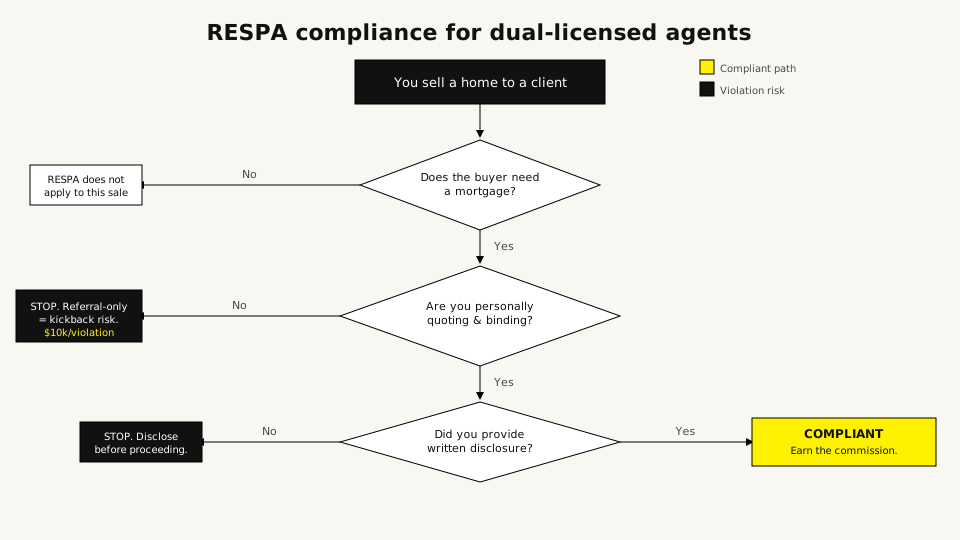
The Real Estate Settlement Procedures Act applies to your insurance sales because homeowners insurance is a “settlement service” — lenders require proof of coverage before closing a federally related mortgage loan. That means RESPA Section 8’s anti-kickback rules are directly relevant.
What you can do: Earn a legitimate insurance commission by actually performing the work of an insurance agent — quoting, comparing carriers, binding coverage, servicing the policy. The compensation must be for services you actually rendered.
What you cannot do: Receive any fee, kickback, or thing of value solely for referring your real estate client to an insurance provider (including your own insurance business). The “thing of value” definition is extremely broad: cash, trips, commissions, stock, or even “the opportunity to participate in a money-making program.”
The penalty: Up to $10,000 per violation and up to one year imprisonment. The CFPB enforces this, and they investigate.
Affiliated Business Arrangement disclosures
If you own or have a financial interest in the insurance agency you’re referring clients to, RESPA’s Affiliated Business Arrangement (AfBA) rules kick in. Three conditions must all be met:
- Written disclosure at or before the time of referral, identifying the affiliated relationship and your ownership percentage
- No required use — the client must be free to shop elsewhere for insurance
- No per-referral compensation — you can receive profit distributions proportional to your ownership share, but not payments tied to the volume of referrals you send
That third point trips people up. If you own 40% of an insurance agency and receive 40% of its annual profits regardless of who generated the business, you’re compliant. If your “profit share” suspiciously tracks with how many clients you referred, you’re not.
State-level disclosure
Beyond RESPA, most states require written disclosure when you have a financial interest in recommending a specific service provider. The safest practice: tell every client, in writing, that you hold both licenses, that you may offer insurance services, and that they are under no obligation to use you for insurance. Keep that disclosure in your client file.
One important distinction that confuses people: “dual agency” (representing both buyer and seller in a real estate transaction) is banned in eight states. That has nothing to do with “dual licensing” (holding both RE and insurance licenses). Different concept entirely.
Which insurance lines actually make sense
Not every insurance product pairs well with real estate work. Here’s the honest breakdown.
The natural cross-sells
Homeowners insurance (P&C) is the obvious winner. Every buyer needs it. Lenders require it before funding. You’re already in the conversation at exactly the right moment. This is where most dual-licensed agents start, and where most of the recurring revenue comes from.
Flood insurance is a high-value add if you work in FEMA-designated flood zones. Clients in these areas are required to carry it, and many standard homeowners policies exclude flood damage. Specialized knowledge here builds trust.
Umbrella policies layer on top of homeowners coverage and carry higher premiums, which means higher commissions. Selling these alongside homeowners insurance is a natural upsell.
Landlord and rental property insurance fits if your book includes investors. If you’re already helping someone buy a rental property, writing the landlord policy is a logical next step.
The longer reaches
Life insurance pays significantly higher first-year commissions (40-115% of the annual premium, depending on the policy type). But the sales process is different. You’re selling something people know they need but actively avoid thinking about. It’s a harder conversation than “you need homeowners insurance before the bank will close your loan.” Some agents successfully weave life insurance into a broader “wealth protection” discussion with homebuyers, particularly those with families. But it takes a different skill set.
Title insurance is directly connected to closing but carries the heaviest RESPA scrutiny of any ancillary service. It also requires separate specialized licensing in most states. Unless you’re building a full settlement services operation, skip it.
The income model: what dual licensing actually looks like over five years
Real estate income is transactional. You close a deal, you get a check. You don’t close a deal, you don’t eat. Every January 1st, your income resets to zero.
Insurance renewals change that equation. Here’s what the math looks like for an agent closing 12 home sales per year and cross-selling insurance on half of them:
| Year | New policies | Total book (80% retention) | New commissions | Renewal income | Total insurance income |
|---|---|---|---|---|---|
| 1 | 6 | 6 | $2,286 | $0 | $2,286 |
| 2 | 6 | 11 | $2,286 | $2,794 | $5,080 |
| 3 | 6 | 15 | $2,286 | $3,810 | $6,096 |
| 4 | 6 | 18 | $2,286 | $4,572 | $6,858 |
| 5 | 6 | 20 | $2,286 | $5,080 | $7,366 |
These numbers assume a $2,543 average premium, 15% new business commission, 10% renewal rate, and 80% annual client retention. Your actual numbers will depend on your state’s premiums, your carrier appointments, and how aggressively you cross-sell.
The floor under your income matters more than the ceiling. By year three, your renewal income alone covers a car payment. By year five, it covers rent. That floor exists whether you close zero real estate deals that month or twenty.
For comparison, an agent who pivots entirely to insurance can build a larger book faster by focusing full-time, but dual licensing lets you keep the real estate income flowing while the insurance book compounds in the background.
Getting the insurance license: faster than you think
If you survived real estate pre-licensing, insurance education will feel familiar but shorter. P&C pre-licensing ranges from 20 to 90 hours in most states — significantly less than the 60-180 hours you put in for your real estate license.
A few states have eliminated pre-licensing entirely: Texas, Pennsylvania (as of April 2025), Arizona, and Washington D.C. are exam-only. California dropped from 52 hours to 12 hours in January 2026. The trend is toward lower barriers.
Total cost: $200-$600 in most states, covering coursework, exam fee, and the license application. That’s less than a year of MLS dues.
The exam itself is real, though. P&C pass rates average 50-60% nationally. The material — liability, casualty, underwriting, policy language — is different from anything on the real estate exam. Budget 2-4 weeks of focused study time.
For multi-state expansion, insurance licensing is dramatically easier than real estate. The National Insurance Producer Registry (NIPR) gives you a single online portal for every state, and the insurance license compact means adding non-resident states often requires no additional exam. Compare that to the state-by-state real estate reciprocity maze and you’ll appreciate how much friendlier the insurance regulatory infrastructure is.
Captive vs. independent: choose your model
You have two structural options for your insurance practice, and the choice matters.
Captive agents (State Farm, Allstate, Farmers) represent one carrier exclusively. You get training, leads, branding, and sometimes a base salary. Commission rates are lower: 8-12% on new business, 5-10% on renewals. The main drawback for dual-licensed agents: some captive carriers expect full-time commitment, which conflicts with running a real estate practice simultaneously.
Independent agents represent multiple carriers. You set your own schedule, work from your existing office, and offer clients more options. Commission rates are higher: 12-18% on new business, 10-15% on renewals. The cost is more administrative overhead and no carrier-provided leads.
For most real estate agents, independent is the better fit. You already have leads (your real estate clients). You already have an office. You need schedule flexibility, not structured training. And higher commission rates compound faster in your renewal book.
One middle path worth considering: partner with an existing independent insurance agency and split commissions rather than building your own from scratch. Multiple agents on insurance forums recommend this approach. You bring the leads, they handle the servicing and carrier relationships. You earn less per policy, but you avoid the administrative burden of running two businesses simultaneously.
The six mistakes that sink dual-licensed agents
1. Treating insurance as a “referral fee” from real estate
This is the RESPA violation that catches people. You must be actually performing insurance agent work — quoting, comparing, binding, servicing — to earn the commission. If you’re just routing your real estate clients to “your” insurance agency and collecting a check, the CFPB considers that a kickback. Structure it wrong and you’re looking at $10,000 per violation.
2. Not disclosing the dual relationship
Put it in writing. Every time. Tell the client you hold both licenses, that you may offer insurance services in connection with their transaction, and that they have no obligation to use you. Keep the signed disclosure in your file. This is cheap insurance against expensive complaints.
3. Spreading yourself too thin
Forum after forum, the same warning: “People do better when they focus on one thing and do it well.” The agents who succeed at dual licensing typically build one practice to a stable level before layering on the second. Don’t try to learn insurance sales while simultaneously scaling your real estate business. Start the insurance license when your RE practice is stable enough to run on autopilot for a few hours a week.
4. Mining your database without building new channels
Your existing client list is your biggest advantage — for about 12 months. After that, you’ve contacted everyone. If you haven’t built referral partnerships, digital marketing, or other prospecting channels for insurance by then, the pipeline dries up.
5. Ignoring the CE burden
Two licenses means two sets of continuing education requirements. In most states, you’re looking at 30-70 hours per two-year cycle across both licenses. The courses don’t overlap — real estate CE and insurance CE are completely separate curricula administered by different state agencies. Calendar your deadlines or you’ll end up with a lapsed license at the worst possible time. For CE efficiency, read our Colibri vs. CE Shop comparison — both platforms let you manage multi-license CE from a single dashboard.
6. Commingling your fiduciary duties
Your job as a real estate agent is to act in your client’s best interest on the real estate transaction. Your job as an insurance agent is to find them the best coverage at a fair price. Those duties don’t conflict in most cases, but they can. Don’t let the prospect of an insurance commission influence your real estate advice. If a client’s best move is a home that generates a smaller insurance premium for you, so be it. E&O claims for breach of fiduciary duty can run into six figures in defense costs alone, even if you win.
The “buyer agreement” opening
Here’s a practical angle that didn’t exist before the NAR settlement. Now that buyer’s agents must sign written representation agreements before showing homes, you have a natural moment to introduce your full service offering.
The representation agreement conversation is already awkward. You’re explaining your value, justifying your commission, and formalizing a relationship that used to be informal. Adding “and I can also help you secure your homeowners insurance, which will save you time at closing” positions you as a more complete advisor. It gives the buyer a concrete additional benefit that softens the sting of committing to your commission.
Some agents report that the dual-license pitch actually makes the buyer agreement conversation easier. Instead of defending your fee, you’re expanding your value proposition: “I don’t just help you find and close on the house. I help you protect it.”
The bottom line on the dual-license play
Dual licensing won’t make you rich overnight. Year one insurance commissions on a part-time cross-sell basis are in the $2,000-$3,000 range. That’s not replacing anybody’s income.
But the compound effect of renewal commissions is the real play. After five years of consistent cross-selling, you’ve built a passive income floor of $7,000-$10,000 per year that exists independent of your real estate production. After ten years? That floor could be $15,000-$20,000 per year — money that shows up whether you’re closing deals, on vacation, or having a slow quarter.
The agents who thrive at this treat insurance as a second business that happens to share a client base with their first one. They don’t half-do it. They get properly licensed, learn the products, stay RESPA-compliant, and build real expertise. The agents who fail are the ones who treat it as an easy add-on that requires no effort.
Your next move: check your state’s P&C pre-licensing requirements, budget $200-$600 and 2-6 weeks of study time, and take the exam while your real estate practice is still running. Build the insurance book alongside your RE deals. Track both pipelines. And if you haven’t already, read our non-resident insurance licensing playbook for expanding to additional states once you’re ready.