Florida to Georgia real estate license: crossing the state line
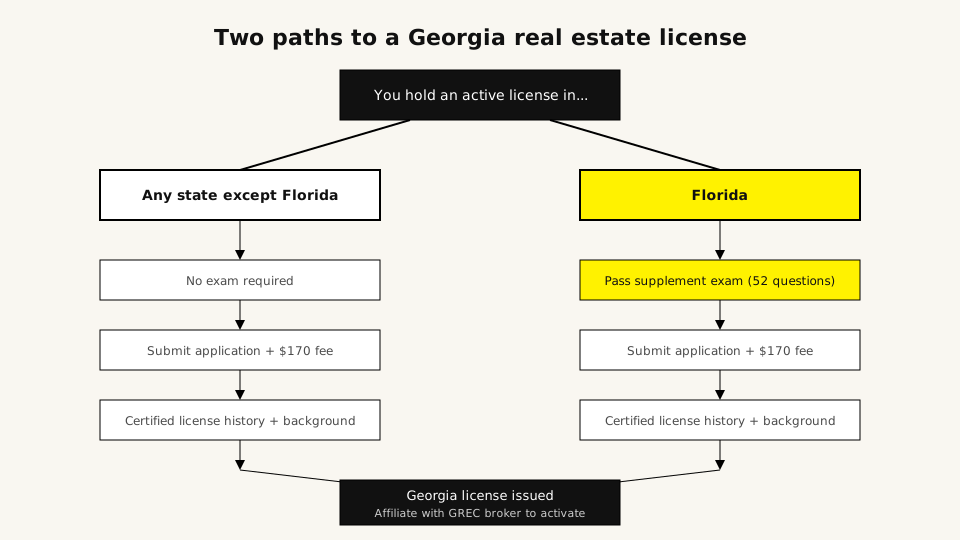
Georgia accepts real estate licenses from 49 states with no exam required. Florida is the one state that doesn’t get that deal. If you hold a Florida license and want to work in Georgia, you’ll need to pass the Georgia Supplement Exam — a 52-question test on Georgia-specific law and practice. No additional education, no pre-licensing courses, just the exam and an application. It’s not a full restart, but it’s not the free pass that agents from 49 other states get either.
Here’s why that exception exists, what the supplement exam actually covers, and how to get through the process without burning time or money on mistakes.
Why Florida is the one exception
Georgia’s licensing code (O.C.G.A. 43-40-9) includes a mirror clause. If another state doesn’t offer Georgia licensees a streamlined path to reciprocal licensing, Georgia won’t offer that state’s licensees one either.
Florida doesn’t have reciprocity with anyone. What Florida has is mutual recognition — a system where agents from eight specific states (Georgia included) can earn a Florida license by taking a 40-question Florida law exam. It’s easier than starting from scratch, but it’s not the “apply and go” process that true reciprocity states offer.
Georgia looks at that arrangement and says: you make our agents take a test? Fine. Your agents take a test too.
The result: an agent from Ohio, Illinois, or California can get a Georgia license by submitting an application, a certified license history, and a $170 fee. No exam. A Florida agent — even one with 20 years of experience and a spotless record — has to sit for the Georgia Supplement Exam first.
It’s not personal. It’s bureaucratic symmetry. But it means Florida agents face a step that agents from every other state skip entirely.
What you actually need to do
The good news is that the process is straightforward once you know the steps. There’s no additional education requirement. You don’t need to take a pre-licensing course. You don’t need to redo the national exam. You take the Georgia Supplement Exam, submit your application, and affiliate with a Georgia broker.
Here’s the step-by-step.
Step 1: schedule and pass the Georgia Supplement Exam
The supplement exam is administered by PSI at testing centers throughout Georgia and online. It consists of 52 scored questions covering Georgia-specific real estate law and practice, plus a handful of unscored pretest questions. You have two hours to complete it. Passing score is 75% — that’s 39 out of 52.
The exam fee is $119, paid directly to PSI when you schedule.
What it covers:
- Georgia Real Estate Commission rules and procedures
- Georgia agency relationships and disclosure requirements
- Georgia-specific contract provisions (GAR forms, not the Florida FAR/BAR forms you’re used to)
- Property ownership and transfer laws under Georgia code
- Georgia landlord-tenant law and property management regulations
- Georgia land use controls, zoning, and environmental disclosures
- License law violations and disciplinary procedures specific to Georgia
The questions that trip up Florida agents most often are the ones on GAR contract forms and Georgia’s approach to agency relationships. Florida uses transaction broker as the default relationship. Georgia uses designated agency under a different framework. If you’ve spent your entire career working within Florida’s disclosure rules, Georgia’s system will feel unfamiliar.
Step 2: gather your documents
Before you submit your application, you need:
Certified license history from FREC. Request this through the Florida DBPR’s myfloridalicense.com portal. The certification must show your license is current and in good standing. Georgia requires this to be dated within one year of your application. Florida generates these quickly — usually within a few business days.
Criminal background report. Since you’re a non-resident, you need a criminal background report from a law enforcement agency in your state of residence (Florida). This must be dated within 60 days of your application. Florida residents can use a local law enforcement background check or go through a third-party service that runs a state-level check.
Lawful presence verification. Georgia requires a notarized Lawful Presence Verification form (a Georgia-specific requirement). You’ll find this form included with the GREC Reciprocal Application packet.
Step 3: submit your application and fee
The GREC Reciprocal Application is available on the Georgia Real Estate Commission’s website (grec.state.ga.us). Submit it with your certified license history, background report, lawful presence form, and the $170 application fee.
One critical deadline: submit your application within 90 days of passing the supplement exam. If you wait longer than 90 days, the application fee doubles to $340. After 12 months, your exam results expire entirely and you’d have to retake the exam. Don’t sit on this.
Payment methods: cashier’s check, money order, or credit/debit card. GREC does not accept personal checks, company checks, or cash.
Step 4: affiliate with a Georgia broker
Your Georgia license won’t be active until you affiliate with a broker licensed by GREC. This can be a resident Georgia broker or a non-resident broker who holds a Georgia license. All salespersons and associate brokers must have a sponsoring broker on file — no exceptions.
If you’re planning to work the North Florida/South Georgia corridor, some brokerages operate in both states. Ask your current Florida broker if they have a Georgia office or a referral relationship. National brokerages like Keller Williams, RE/MAX, and eXp Realty typically have Georgia offices that can facilitate the affiliation.
If you lose your broker affiliation after getting licensed, you have 30 days to affiliate with another GREC-licensed broker or place your license on inactive status. After 30 days without a broker, your license is automatically terminated.
The costs
| Item | Cost |
|---|---|
| PSI supplement exam fee | $119 |
| GREC reciprocal application fee | $170 |
| Criminal background report | ~$40-$52 |
| FREC certified license history | $0 (free via myfloridalicense.com) |
| Total | ~$329-$341 |
Compare that to the cost of getting a Georgia license from scratch as a new applicant: 75 hours of pre-licensing education ($300-$600), the full 152-question exam ($119), the application fee ($170), fingerprinting and background check ($40-$52), plus whatever you spend on exam prep. You’re looking at $630 to $940 minimum. The reciprocal path, even with the supplement exam, saves you hundreds of dollars and weeks of coursework.
The 25-hour post-license surprise
Here’s the part that catches every out-of-state agent off guard, not just Florida agents: Georgia requires all new salesperson licensees to complete a 25-hour post-license course within their first year. This is not optional. This is not continuing education. This is a separate requirement, and missing it turns your license inactive.
The post-license course includes its own exam — you need a 70% to pass. Several providers offer it online, including Colibri, The CE Shop, and Georgia-based schools like Barney Fletcher. Budget $100 to $200.
The silver lining: 9 of those 25 hours count toward your first CE renewal cycle. Georgia requires 36 hours of continuing education every four years (due by the last day of your birth month in your renewal year). Since 9 hours are already banked from post-license, you only need 27 additional CE hours for your first renewal.
If you miss the one-year deadline, there’s a narrow window: if you’ve enrolled in the post-license course before the deadline, you get a six-month extension to complete it. But if you haven’t even enrolled by your anniversary date, your license goes inactive, and you’ll need to go through GREC’s reinstatement process to get it back.
How long the whole thing takes
Week 1: Study for the Georgia Supplement Exam. If you’re an experienced agent, a week of focused study using a Georgia exam prep course is typically enough. The concepts aren’t foreign — you know real estate. You just need to learn Georgia’s specific rules, forms, and procedures.
Week 2: Take the supplement exam. Request your certified license history from FREC and get your background report done in parallel.
Week 2-3: Submit your GREC reciprocal application with all supporting documents.
Weeks 3-5: GREC processes your application. Processing times vary, but two to four weeks from a complete application is standard.
Total: three to five weeks if you pass the exam on your first attempt and submit a clean application. The biggest variable is GREC processing time, which fluctuates seasonally.
Why this corridor matters
North Florida and South Georgia aren’t just neighboring markets — they’re functionally one housing region. Jacksonville is 30 minutes from the Georgia border. Agents working the Fernandina Beach and Amelia Island market regularly get inquiries about St. Marys and Cumberland Island on the Georgia side. Agents in Valdosta, Georgia serve clients who work at Moody Air Force Base but live on either side of the state line.
Georgia added nearly 70,000 net new residents through domestic migration in 2024. Some of those are Florida transplants heading north for lower property taxes and insurance costs — Florida’s homeowner’s insurance crisis has pushed premiums to an average of over $4,000 per year, roughly triple the national average. For agents who’ve built a book of business in North Florida, being licensed in Georgia means you don’t lose the client when they cross the state line.
The math on maintaining dual licenses is worth doing. Between Georgia’s renewal fee ($125 every four years), CE hours (36 every four years), and the initial post-license course, the carrying cost is modest. If you’re closing even one or two Georgia deals a year, the license more than pays for itself.
Study tips for the supplement exam
The supplement exam is passable with focused preparation, but don’t walk in cold. Georgia’s exam has a reputation for being one of the harder state portions in the country, and the questions aren’t just “what does the law say” — they test application of Georgia-specific rules to real scenarios.
Focus your study time on these areas:
GAR contract forms. Florida uses FAR/BAR forms. Georgia uses GAR (Georgia Association of REALTORS) forms. The terminology, contingency structures, and default provisions are different enough to trip you up if you’re running on Florida muscle memory.
Agency relationships. Georgia’s approach to dual agency, designated agency, and seller/buyer representation differs from Florida’s transaction broker model. Know Georgia’s disclosure requirements inside and out.
License law specifics. Georgia’s trust account rules, advertising requirements, and commission dispute procedures have their own quirks. The GREC has enforcement powers that differ from FREC’s. Study the disciplinary sections of Georgia Code Chapter 43-40.
Property transfer and ownership. Georgia is a “lien theory” state for mortgages. Georgia uses security deeds rather than mortgages with a power of sale, meaning foreclosures don’t require judicial proceedings. If you’ve only worked in Florida (a “title theory” judicial foreclosure state), this is a significant conceptual shift.
Exam prep resources: PSI sells an official Georgia study guide on their website. Colibri, The CE Shop, and PrepAgent all offer Georgia-specific exam prep courses. Budget $50 to $150 depending on the format. For a broader look at tackling state exams as a transferring agent, see our state portion exam prep guide.
The co-brokerage alternative
If you don’t want to get a full Georgia license but occasionally have a deal that crosses the border, there’s another option. Georgia Code 43-40-9(d) allows a licensed broker from another state to enter into a written co-brokerage agreement with a Georgia-licensed broker to conduct real estate business in Georgia without first obtaining a Georgia license. The Georgia broker is responsible for all brokerage acts performed under the agreement.
This is a narrow exception. It works for the occasional cross-border referral or co-listed property. It doesn’t work if you’re planning to actively farm a Georgia market or build a Georgia client base. For that, you need your own license.
If you’re weighing whether to get a Georgia license or just set up referral agreements, our reciprocity vs. portability guide breaks down the pros and cons. And if you’re considering operating in both states seasonally, our snowbird agent strategy covers the logistics of splitting your practice across state lines.
For a broader look at how reciprocity works across all 50 states, start with our real estate reciprocity guide. And if you want to compare the total cost of getting licensed in Georgia versus other states you’re considering, check our 50-state fee calculator.
Your next step: register for a Georgia supplement exam prep course and schedule your PSI test date. The exam is the only barrier between you and a Georgia license, and most Florida agents who study for a week pass it on the first try.