New York to Florida real estate license: no shortcut, but a clear path
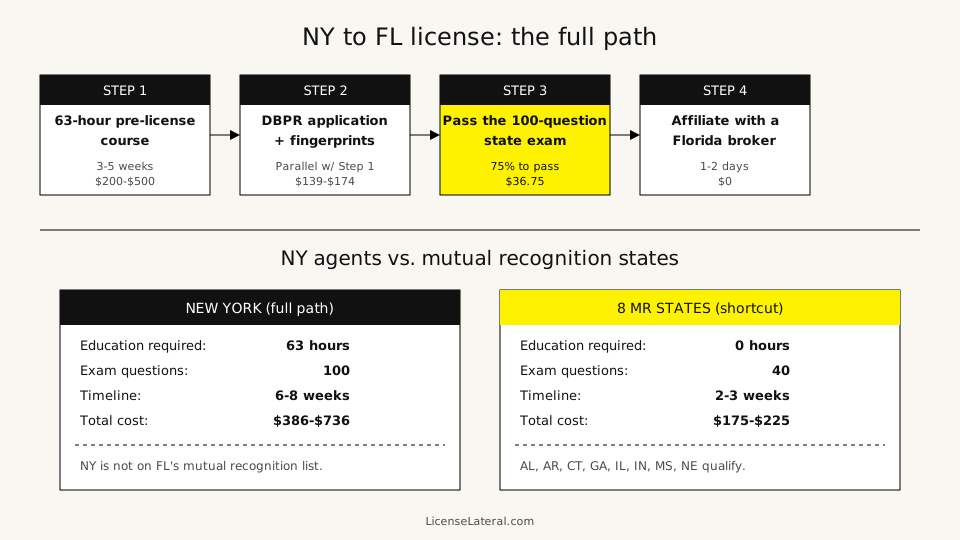
If you hold a New York real estate license and want to work in Florida, here’s the bad news upfront: Florida does not have a reciprocity agreement with New York. It doesn’t have reciprocity with anyone. What Florida has is “mutual recognition” with eight specific states, and New York isn’t one of them. That means you’re going through the full licensing process — 63 hours of pre-licensing education, a 100-question state exam, fingerprinting, and a DBPR application.
The good news: the process is straightforward, the costs are modest by New York standards, and you can knock it out in six to ten weeks while still working your New York deals. Let me walk you through it.
Why New York doesn’t get the shortcut
Florida’s mutual recognition program lets agents from eight states earn a Florida license by taking a 40-question law exam instead of the full 100-question exam. Those states are Alabama, Arkansas, Connecticut, Georgia, Illinois, Indiana, Mississippi, and Nebraska. If you hold a license in one of those states, our Florida mutual recognition guide covers that abbreviated path.
New York isn’t on the list because mutual recognition requires a bilateral agreement — both states have to sign on. New York’s Department of State doesn’t offer Florida agents a streamlined path into New York, so Florida doesn’t offer one to New York agents either. It’s bureaucratic symmetry, not a judgment on your qualifications.
Connecticut is on the list, though. If you hold dual NY/CT licenses (common for agents working the Westchester-Fairfield corridor), you could apply through mutual recognition using your Connecticut license. That drops the 100-question exam down to 40 questions and eliminates the 63-hour education requirement. Worth checking if it applies to you.
The full licensing path: step by step
Since New York agents don’t qualify for mutual recognition, you’ll go through the same process as a first-time Florida applicant. The only practical difference is that you already understand real estate — the national portion of the exam should feel like a refresher, not new material.
Step 1: complete 63 hours of pre-licensing education
Florida requires a 63-hour FREC-approved pre-licensing course. No exceptions, no waivers for experienced agents. Your 75-hour New York pre-licensing education doesn’t transfer. Neither does your continuing education. Florida wants its own approved curriculum, from its own approved schools.
The course covers Florida Statutes Chapter 475 (the real estate license law), FREC rules, Florida contract forms, property rights and homestead exemption, and real estate math. If you’ve been practicing in New York for any length of time, most of the national concepts will be familiar. The Florida-specific material is where you need to focus.
Several FREC-approved schools offer the 63-hour course online, which means you can complete it from your apartment in Manhattan while still closing deals in New York. Budget $200 to $500 depending on the provider and package. Colibri, The CE Shop, Gold Coast Schools, and Aceable Agent all offer the course. At a comfortable pace of one to two hours per day, expect three to five weeks to finish.
You must pass the course final exam with a 70% or higher. The course certificate is valid for two years from completion, so you have time to schedule the state exam without rushing.
Step 2: submit your DBPR application
Apply through the Florida Department of Business and Professional Regulation’s online portal at myfloridalicense.com. Select “Non-Florida Resident” as your application type and fill out the RE 1 Sales Associate Application.
The application fee is $89. DBPR accepts online payments.
You don’t need to wait until you’ve finished your pre-licensing course to submit the application. Filing early can save you time because DBPR will begin processing your background check while you’re still completing coursework.
Step 3: get fingerprinted
Florida requires electronic fingerprinting through a LiveScan vendor. The ORI number for real estate salesperson applicants is FL920010Z — you’ll need this when you visit the fingerprinting site.
If you’re still in New York, you can get fingerprinted at an approved LiveScan provider in-state. The results transmit electronically to the Florida Department of Law Enforcement (FDLE) for processing. Budget $50 to $85 depending on the vendor.
Get fingerprinted at least five days before submitting your application, so FDLE and the FBI have time to process your prints before DBPR reviews your file.
Step 4: pass the Florida state exam
The Florida Sales Associate exam is 100 multiple-choice questions administered by Pearson VUE. You have 3.5 hours to complete it. Passing score is 75%.
The exam covers both national and Florida-specific content across 19 topic areas. The heaviest sections:
- Real estate contracts — 12% of the exam. Florida uses its own contract forms (Florida Realtors/Florida Bar contracts), not the forms you’re used to in New York.
- Brokerage activities and procedures — 12%. FREC has its own rules about trust accounts, escrow deposits, and broker supervision.
- Residential mortgages — 9%. Standard national content, but Florida’s homestead exemption rules are tested here too.
- Property rights and ownership — 8%. Florida’s homestead exemption is a $50,000 property tax exemption that doesn’t exist in New York. Know the structure cold.
- Real estate appraisal — 8%. Mostly national concepts.
The exam fee is $36.75, paid directly to Pearson VUE when you schedule. Testing centers are available throughout Florida, and Pearson VUE also offers online proctored testing from home.
One number worth knowing: the first-time pass rate for the Florida exam hovers around 47%. That’s not because the exam is impossibly hard — it’s because most first-time takers are genuinely new to real estate. As a licensed New York agent, the national content should be a formality. Your risk area is the Florida-specific material, which makes up roughly 45% of the questions.
Results are immediate. You’ll know if you passed before you leave the testing center.
Step 5: activate your license with a Florida broker
Once DBPR approves your application and your exam results are on file, they’ll issue your Florida license in inactive status. You can’t practice until you affiliate with a Florida-licensed broker.
If you’re planning to work South Florida (and most New York transplants are), start talking to brokerages before you finish the licensing process. Keller Williams, Compass, Douglas Elliman, and eXp Realty all have significant Florida operations. Some national brokerages will let you affiliate with their Florida office while maintaining your New York affiliation under a different office.
Your sponsoring broker activates your license using the DBPR RE 11 form. This usually happens within a day or two of your broker submitting the paperwork.
The costs
| Item | Cost |
|---|---|
| 63-hour pre-licensing course | $200-$500 |
| DBPR application fee (RE 1) | $89 |
| Pearson VUE exam fee | $36.75 |
| LiveScan fingerprinting | $50-$85 |
| NY DOS license certification | ~$10-$25 |
| Total | ~$386-$736 |
That’s roughly the cost of one month’s parking in Midtown. And it’s significantly less than the cost of licensing in New York was in the first place.
If you fail the exam, retakes cost $36.75 each. You must wait at least 24 hours before rescheduling.
The 45-hour post-license requirement
Here’s the part that catches every out-of-state agent off guard: Florida requires all new sales associate licensees to complete a 45-hour post-license course before their first license renewal. This is separate from continuing education. It’s a standalone requirement, and missing the deadline has serious consequences.
Your first renewal date falls on either March 31 or September 30, depending on when you passed your exam. That gives you 18 to 24 months to complete the post-license course. Sounds like plenty of time. It’s not as much as you think if you get busy with a Florida practice and forget about it.
If you miss the deadline, you don’t just pay a late fee. You have to start the entire licensing process over — retake the 63-hour pre-licensing course and pass the state exam again. Florida doesn’t offer extensions or grace periods on this.
Budget $100 to $200 for the post-license course. Several providers offer it online.
After your first renewal, continuing education drops to 14 hours every two years: 3 hours of core law, 3 hours of ethics and business practices, and 8 hours of specialty education. That’s far less than New York’s 22.5 hours of CE every two years.
How long the whole thing takes
Weeks 1-4: Complete the 63-hour pre-licensing course online. Submit your DBPR application and get fingerprinted in parallel.
Week 5: Schedule and take the Pearson VUE exam. Study the Florida-specific material hard during weeks 3-4.
Weeks 5-6: DBPR processes your application (assuming your background check and fingerprints are already cleared).
Week 6-8: Affiliate with a Florida broker and activate your license.
Total: six to eight weeks if you’re focused and pass the exam on your first attempt. If you’re doing this part-time while still working New York deals, budget eight to ten weeks. The bottleneck is almost always the 63-hour course — everything after that moves quickly.
Study tips for New York agents
The national content on the Florida exam will feel familiar. Property ownership, contracts, agency, financing, appraisal — you know this material. Don’t waste study time reviewing things you already understand.
Spend your study hours on the Florida-specific sections. Three areas trip up New York agents most often:
Homestead exemption. New York has the STAR program. Florida has the homestead exemption, which knocks up to $50,000 off the assessed value for property tax purposes. The structure is specific: the first $25,000 applies to all property taxes, the next $25,000 is a zero-benefit gap, and the next $25,000 applies to non-school taxes only. Exam writers love testing the details of this exemption.
Florida contract forms. New York agents are used to working with attorney-drafted contracts or standardized forms from their local board. Florida uses the Florida Realtors/Florida Bar contract forms, with specific escrow deposit timelines, default remedies, and inspection contingency structures that differ from what you’ve seen in New York. The exam tests the details of these forms.
FREC disciplinary procedures. Florida’s license law (Chapter 475) spells out specific penalties for violations — automatic suspensions, administrative fines up to $5,000 per offense, and circumstances under which FREC can deny a license application. The exam tests these specifics, not general concepts.
For a broader look at tackling state exams as a transferring agent, see our state portion exam prep guide.
Keeping both licenses active
You can hold New York and Florida licenses simultaneously. Many agents working the NY-FL corridor do exactly this, especially agents whose clients split time between the two states.
The carrying cost of maintaining both licenses is manageable. New York renewal is $50 every two years plus 22.5 hours of CE. Florida renewal is roughly $65 every two years plus 14 hours of CE after your first renewal. Between both states, you’re looking at maybe $600 to $1,000 per year in total carrying costs when you factor in CE courses and association dues.
If you’re consistently doing deals in both states, that’s a rounding error on your commission income. If you moved to Florida permanently and aren’t doing New York deals, let the New York license lapse. You can always reactivate it later if you need it.
For agents planning to split time between states, our snowbird agent strategy covers the logistics of running a practice across two markets.
Why this corridor still matters
The pandemic-era flood of New Yorkers into Florida has slowed. In 2023, over 71,000 people moved from New York to Florida. By 2024, that number dropped to about 52,000 households. But even with the slowdown, New York remains the single largest source of domestic migration into Florida, and Florida remains the number one destination for New Yorkers leaving the state.
Those transplants still need agents. A New York agent who understands co-op boards, transfer taxes, and Manhattan closing customs has a built-in advantage when helping a New Yorker buy their first Florida condo. You speak their language. You understand the anxiety of someone who’s only ever dealt with NYC’s insane real estate process suddenly confronting Florida’s comparatively streamlined system. That context can’t be taught in a 63-hour course.
The South Florida market, in particular, is practically a New York satellite. Palm Beach, Broward, and Miami-Dade counties receive the largest share of New York transplants, with Nassau County, Suffolk County, and Manhattan being the top origin counties. If you have a client book full of Long Island or Westchester families eyeing Florida, getting your Florida license turns those referrals into your own deals.
For a broader look at how state-to-state transfers work, start with our real estate reciprocity guide. If processing times are a concern, our license transfer timeline breakdown compares how fast different states move. And if you want to estimate the total cost of getting licensed in Florida versus other states, our 50-state fee calculator has the numbers.
Your next step: enroll in a 63-hour FREC-approved pre-licensing course and submit your DBPR application the same week. Those two things can happen in parallel, and starting both now puts you six weeks from a Florida license.