Florida real estate mutual recognition: the "law exam" loophole
Updated February 2026. The information in this article reflects current FREC mutual recognition agreements and exam requirements as of February 2026. FREC adjusts mutual recognition agreements periodically — states can be added or removed from the eligible list. Before making any decisions based on this article, verify the current list of eligible states directly with the Florida Real Estate Commission (FREC) at myfloridalicense.com.
If you’ve been searching for “Florida real estate reciprocity,” you’ve probably noticed something frustrating: Florida doesn’t have reciprocity. Not with any state. What Florida has is “mutual recognition,” and the difference between those two terms is the difference between a simple transfer and a 40-question exam.
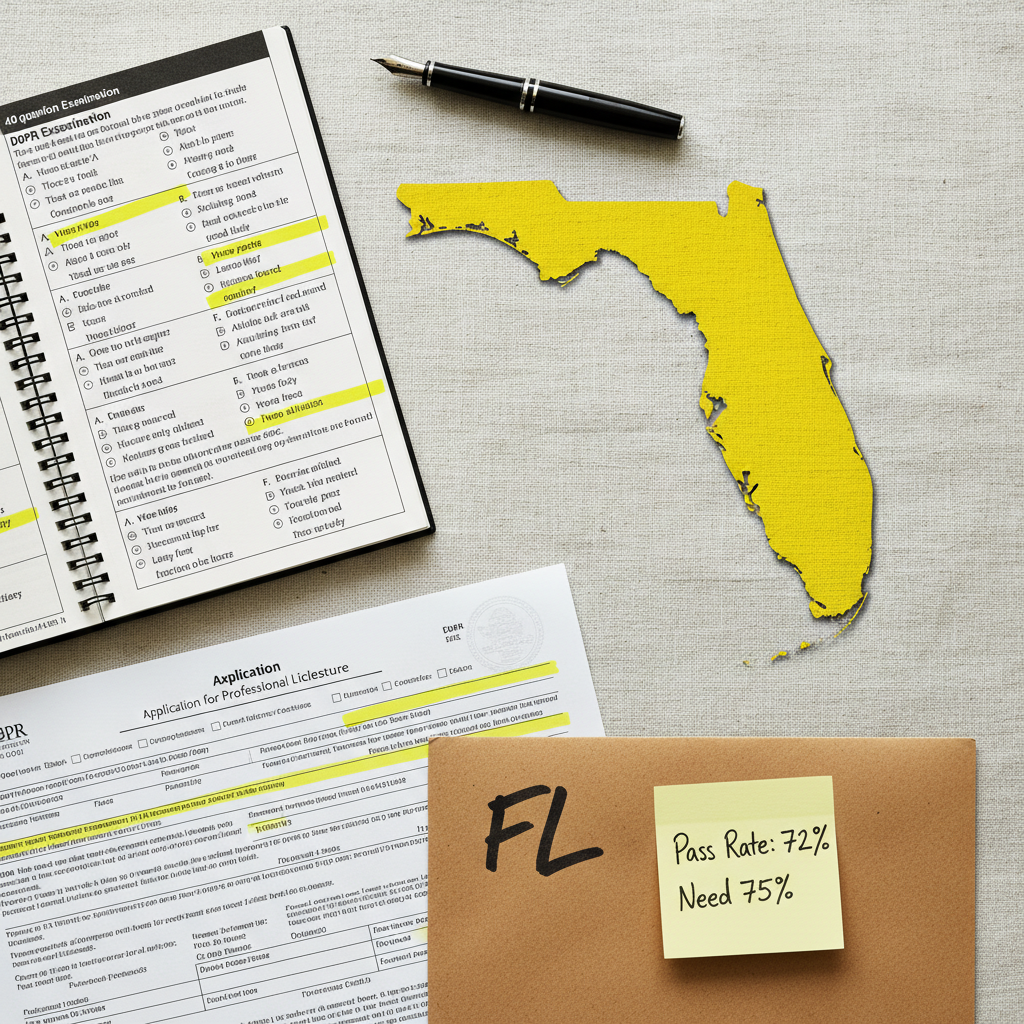
The good news: the mutual recognition path is dramatically easier than getting a Florida license from scratch. You skip 63 hours of pre-licensing education and the full 100-question state exam. Instead, you take a 40-question law exam that covers Florida-specific statutes and rules. If you already hold an active license in one of eight qualifying states, this is your shortcut. And it’s a significant one.
Mutual recognition vs. reciprocity: why the words matter
Reciprocity, in the real estate licensing world, typically means one state accepts another state’s license with minimal or no additional requirements. You apply, pay a fee, and you’re done.
Florida’s mutual recognition system doesn’t work that way. Florida has signed bilateral agreements with eight specific states. These agreements say: “If you hold an active license in our partner state, we’ll let you earn a Florida license through an abbreviated process.” You’re not transferring your license. You’re earning a new Florida license. You just get to skip most of the education and testing requirements that a first-time applicant would face.
This distinction matters for your expectations. You will take an exam. You will apply to the Florida Department of Business and Professional Regulation (DBPR). You will pay fees. But the total effort is a fraction of what it would be without a mutual recognition agreement.
The 8 qualifying states
Florida currently has mutual recognition agreements with:
- Alabama
- Arkansas
- Connecticut
- Georgia
- Illinois
- Indiana
- Mississippi
- Nebraska
If your active license is in one of these eight states, you’re eligible. If it’s not, mutual recognition doesn’t apply to you, and you’ll need to go through the standard Florida licensing process (63 hours of pre-licensing education, full state exam, the works).
One important detail: your license in the qualifying state must be active and in good standing. If it’s expired, suspended, or inactive, you don’t qualify for mutual recognition.
Also worth noting: these agreements are bilateral, meaning they work both ways. If you hold a Florida license and want to get licensed in Alabama, Georgia, or any of the other seven states, those states have their own abbreviated process for Florida licensees. The specific requirements vary by state, but the principle is the same.
The 40-question law exam
This is the core of the mutual recognition process. Instead of taking Florida’s full licensing exam (which is 100 questions and covers both national and state-specific content), you take a 40-question exam that covers only Florida-specific law and rules.
What the exam covers
The 40 questions focus on Florida real estate statutes and DBPR rules. Expect questions on:
- Florida license law (Chapter 475, Florida Statutes). This is the big one. The rules governing real estate licensees in Florida, including broker and sales associate requirements, license categories, and disciplinary procedures.
- Florida Real Estate Commission (FREC) rules. How the commission operates, its authority, and the specific regulations it enforces.
- Florida contract law. State-specific provisions in the Florida Realtors/Florida Bar contract forms, including escrow deposit rules, default remedies, and required disclosures.
- Florida property taxes and homestead exemption. The homestead exemption is a big deal in Florida and a common exam topic. Know the $50,000 exemption structure and how it applies to primary residences.
- Florida-specific disclosure requirements. Radon gas disclosure, lead paint (federal but tested), energy efficiency, and property tax disclosure requirements.
How it compares to the full exam
The full Florida state exam has 100 questions, with a mix of national content and Florida-specific material. The mutual recognition exam has 40 questions, all Florida-specific. You need a 75% (30 out of 40) to pass, which is the same passing percentage as the full exam.
Here’s the honest assessment: the 40-question exam is not a cakewalk. It’s shorter, yes, and you’re skipping the national portion entirely. But the questions are focused entirely on Florida law, which means every question is testing material you probably haven’t studied before. If you’ve been practicing real estate in Georgia for ten years, you know Georgia law inside and out. You don’t know Florida’s homestead exemption rules or the specific DBPR disciplinary procedures.
That said, the pass rate for mutual recognition candidates is significantly higher than for first-time test-takers on the full exam. You already understand how real estate works. You just need to learn the Florida-specific details.
Scheduling and taking the exam
The mutual recognition exam is administered by Pearson VUE, the same testing company that handles most state real estate exams nationwide.
How to schedule: Go to pearsonvue.com and search for “Florida DBPR.” You’ll create an account (or log into an existing one if you’ve taken a Pearson VUE exam before), select the “Mutual Recognition Sales Associate” or “Mutual Recognition Broker” exam, choose a test center location, and pick a date.
The exam fee is $36.75. That’s it. Paid directly to Pearson VUE when you schedule. This is separate from the DBPR application fee.
Test center locations. Pearson VUE has testing centers throughout Florida and in some other states. If you’re planning to take the exam before you move, check whether there’s a testing center in your current state. Many candidates take the exam while they’re still living in their home state. Pearson VUE also offers an online proctored option for this exam — you can test from home with a webcam and a stable internet connection. The experience is identical to a test center: same time limit, same lockdown browser, same score report delivered immediately at the end.
What the format actually looks like. The exam is computer-based. Questions are multiple-choice with four answer choices. No partial credit. The 40 questions are not adaptive — you’ll see all 40 regardless of how you’re doing. You can flag questions to review and revisit them before submitting. You have 90 minutes, which is enough time for almost everyone — the challenge is comprehension, not speed.
What to bring. Two forms of valid identification, including one government-issued photo ID. Your confirmation email from Pearson VUE. That’s all you need — personal items, phones, and notes aren’t allowed in the testing room.
Results are immediate. You’ll know whether you passed before you leave the testing center (or before you close the test window, if testing online). Pearson VUE gives you a printed score report on the spot, or a downloadable report if you tested remotely.
The full application process
Here’s the step-by-step for getting your Florida license through mutual recognition.
Step 1: Verify your eligibility. Confirm that your current license is in one of the eight qualifying states and that it’s active and in good standing.
Step 2: Apply to the DBPR. Submit your application through the Florida DBPR’s online portal (myfloridalicense.com). You’ll select the mutual recognition pathway. The application fee is $89 for a sales associate license.
Step 3: Submit your background check. Florida requires electronic fingerprinting through an approved vendor. The fingerprinting fee is around $50 to $75 depending on the vendor. Livescan (electronic) fingerprints are accepted at various locations throughout Florida and some other states.
Step 4: Request a license certification from your home state. Your home state real estate commission needs to send a certification directly to the Florida DBPR confirming that your license is active and in good standing, with no disciplinary actions. Some states charge a fee for this ($10 to $25). Some states send it electronically. Others mail it. Ask your home state commission how they handle certifications and how long it takes.
Step 5: Schedule and pass the 40-question law exam. You can do this before or after submitting your DBPR application. I’d recommend scheduling it early so you’re not waiting on exam results after everything else is already processed.
Step 6: Activate your license with a Florida broker. Once DBPR approves your application and your exam results are on file, you’ll receive your Florida license. You’ll need to affiliate with a Florida broker before you can practice.
Total costs
| Item | Cost |
|---|---|
| DBPR application fee | $89 |
| Pearson VUE exam fee | $36.75 |
| Fingerprinting | $50-$75 |
| Home state certification | $0-$25 |
| Total | $175-$225 |
Compare that to the standard licensing path, which adds 63 hours of pre-licensing education ($200 to $400) and a tougher 100-question exam. The mutual recognition route saves you both money and time.
How to study for the law exam
Don’t overthink this, but don’t skip it either. The 40 questions are all Florida-specific, and you need 30 correct to pass.
Focus your study on Florida Statutes Chapter 475 (the real estate license law) and the FREC administrative rules. These two sources cover the vast majority of what’s on the exam. You can find both on the DBPR website and the Florida Legislature’s online statute database.
Practice exams are the most effective study tool for this test. Several prep providers offer Florida-specific practice question banks. Two to three days of focused practice with a good question bank, combined with reading through Chapter 475, should be enough for most experienced agents.
The biggest mistake mutual recognition candidates make is assuming the exam will be easy because they’re already licensed. You know real estate. You don’t know Florida real estate law. Spend the time.
For broader exam prep strategy, see our state portion exam prep guide, which covers the approach that works best for agents who are already licensed in another state and need to pass a state-specific exam quickly.