Illinois to Wisconsin real estate license transfer: the Midwest's easiest border crossing
If you hold an active Illinois real estate license and want to work in Wisconsin, you’re looking at one of the smoothest reciprocity paths in the country. Wisconsin has a formal reciprocity agreement with Illinois (and Indiana — those are the only two states that get this treatment). Active IL licensees skip all pre-licensing education and go straight to the state exam.
No coursework. No waiting on transcript evaluations. Just schedule the test, pass it, and apply. Most agents have their Wisconsin license in hand within three to four weeks.
That said, the details matter. The path differs depending on whether your Illinois license is active, recently lapsed, or long expired. And if you want a Wisconsin broker license instead of a salesperson license, the process is less generous. Let me break down each scenario.
Active Illinois salesperson or managing broker
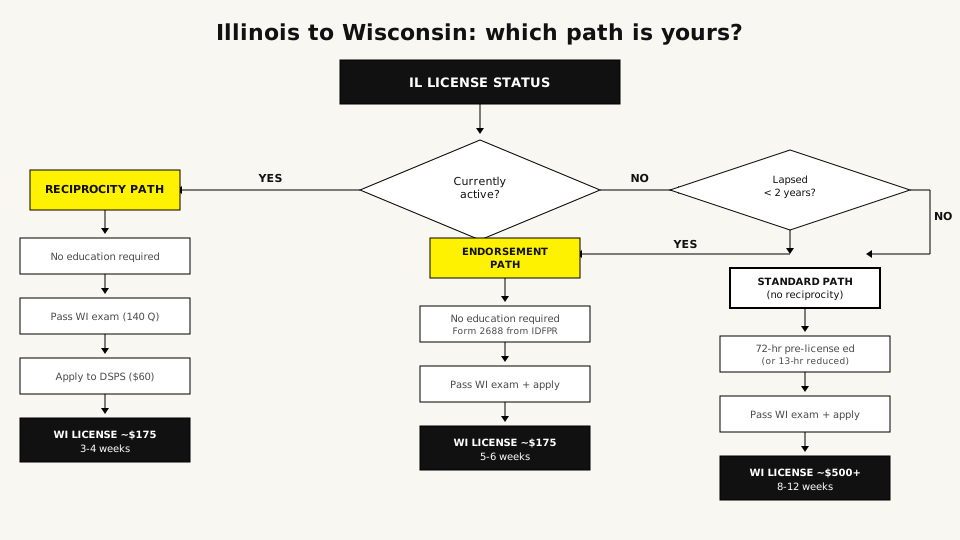
This is the fast lane. If your Illinois license is currently active and in good standing, Wisconsin waives all pre-licensing education requirements under the reciprocity agreement.
Here’s exactly what you need to do:
Step 1: Pass the Wisconsin salesperson exam. The exam is administered by Pearson VUE and consists of 140 questions covering Wisconsin real estate law, agency relationships, property ownership, contracts, fair housing, and disclosure requirements. You need 105 correct answers out of 140 to pass (75%). You get 3.5 hours. The exam fee is $65.
One thing to note: this is not a “state portion only” exam like some reciprocity states offer. You’re taking the full Wisconsin salesperson exam — 140 questions, not 40. Wisconsin’s exam doesn’t split into a national and state section. It’s one unified test, and the Wisconsin-specific content is woven throughout. Study accordingly.
Step 2: Apply to DSPS. Submit your application through the Wisconsin Department of Safety and Professional Services (DSPS) LicensE portal at license.wi.gov. You’ll need:
- Form 3166 (Real Estate Salesperson License Application)
- Form 813 (Irrevocable Consent for Nonresidents) if you’re not a Wisconsin resident
- Proof of passing the Wisconsin exam
- Evidence of your active Illinois license
- $60 initial credentialing fee
Step 3: Get fingerprinted. Wisconsin requires a background check through the Department of Justice. Budget about $50 for the fingerprinting and processing.
Fees at a glance
| Item | Cost |
|---|---|
| Pearson VUE exam fee | $65 |
| DSPS credentialing fee | $60 |
| Background check / fingerprinting | ~$50 |
| Total | ~$175 |
That’s it. No education costs, no course fees, no transcript evaluation fees. Compared to transferring into states without reciprocity — where agents routinely spend $500 to $900 on coursework alone — $175 is a bargain.
Timeline
Week 1: Study for the Wisconsin exam. If you’ve been practicing in Illinois, a lot of the content will feel familiar. Focus your prep time on Wisconsin-specific statutes (Chapter 452), agency disclosure requirements, and Wisconsin’s fair housing protections (which are broader than federal law — Wisconsin adds ancestry, sexual orientation, and several other protected classes).
Week 2: Schedule and take the Pearson VUE exam. Results are immediate.
Week 2-3: Submit your DSPS application with all supporting documents.
Week 3-4: DSPS processes your application. Processing times vary, but two to three weeks is typical for a clean, complete application.
Total: three to four weeks. That’s among the fastest corridor transfers in the country. For comparison, check our state-by-state timeline breakdown to see how Wisconsin stacks up.
Illinois license lapsed within the last two years
If your Illinois license expired or went inactive within the past two years, you can still get a Wisconsin license through endorsement. The education waiver still applies, but you’ll need to provide additional documentation.
DSPS will want Form 2688 (Verification of Examination or Registration), which must be completed by the Illinois Division of Financial and Professional Regulation (IDFPR) confirming your license history and exam passage. This adds a step and some processing time — IDFPR can take two to four weeks to process verification requests during busy periods.
The exam requirement and fees are the same as the active-license path. Budget five to six weeks total when you factor in the IDFPR verification delay.
Illinois license expired more than two years ago
If your Illinois license has been inactive for more than two years, Wisconsin treats you like any other out-of-state applicant without reciprocity. You’ll need to complete the 72-hour pre-licensing education program (or at minimum the 13-hour salesperson course, depending on your prior education credits), pass the exam, and apply.
At that point, you might want to consider whether reactivating your Illinois license first makes more sense. If Illinois lets you reinstate through CE rather than starting over, getting your IL license active again and then using reciprocity could still be faster than doing Wisconsin’s full education requirement from scratch.
What about a Wisconsin broker license?
Here’s where the reciprocity advantage disappears. The education waiver only applies to the salesperson license. If you want a Wisconsin broker license, you need to satisfy the full broker requirements regardless of your Illinois license level.
That means:
- At least two years of experience as a licensed real estate salesperson
- 72 hours of broker pre-licensing education (or the reduced path for out-of-state brokers: 13-hour salesperson course plus 6-hour broker course)
- Pass both the Wisconsin salesperson exam and the Wisconsin broker exam
- $60 DSPS credentialing fee
If you’re an Illinois managing broker, the fastest route into Wisconsin is still to use reciprocity for the salesperson license first, start practicing, and then pursue the broker upgrade while you’re already doing deals. Don’t let the broker license hold you up from entering the market.
For a broader look at how broker upgrades affect portability across state lines, see our piece on broker license reciprocity.
The Wisconsin exam: what to actually study
Since you’re skipping education and going straight to the exam, your study plan matters more than usual. You won’t have a course instructor walking you through Wisconsin law. Here’s where Illinois agents typically get tripped up:
Agency disclosure. Wisconsin uses a specific agency disclosure form (the RECR 48.01) that must be provided at the first substantive contact. The rules differ from Illinois’s agency disclosure requirements. Know the timing, the form, and what happens if you miss it.
Property condition disclosure. Wisconsin’s Real Estate Condition Report is mandatory for most residential sales. Sellers must disclose known defects. The form is more detailed than what most Illinois agents are used to.
Protected classes. Wisconsin’s fair housing law extends beyond the federal Fair Housing Act. The state adds ancestry, sexual orientation, marital status, lawful source of income, age, and status as a victim of domestic abuse as protected classes. Expect exam questions testing whether you know the difference between federal and state protections.
Trust account rules. Wisconsin has specific requirements for earnest money deposits and trust account management under Chapter 452 and REEB 17. The rules differ from Illinois’s handling of earnest money through escrow.
The CE Shop offers Wisconsin-specific exam prep, and PrepAgent has a Wisconsin practice test bank. Budget one to two weeks of focused study if you’re an experienced agent. If you’ve been out of the field for a while, give yourself three weeks.
Why this corridor matters right now
Wisconsin’s housing market is on fire. Seven Wisconsin cities ranked in Realtor.com’s top 20 hottest markets in late 2025, more than any other state. Kenosha — sitting right on the Illinois border — claimed the number one spot, with homes spending a median of just 33 days on the market and a median listing price around $384,000.
The state saw its highest migration numbers in 20 years during 2023-2024, with over 28,000 new residents arriving in a single year. A huge chunk of that migration comes from Illinois. Chicago agents who understand both markets have a real edge, especially in the border communities — Kenosha, Racine, Lake Geneva, and the growing suburbs between Milwaukee and the state line.
And the math works in your favor. Wisconsin’s licensing costs are among the lowest in the country for Illinois agents thanks to reciprocity. Your $175 investment gets you access to a market where median prices are climbing and inventory is tight.
For a broader view of which states make cross-border licensing easy and which ones don’t, check our full reciprocity states breakdown or start with the real estate reciprocity guide. If you want to estimate the full cost of adding Wisconsin to your portfolio, our 50-state fee calculator has the numbers.
Your next step: confirm your Illinois license is active on the IDFPR website. If it shows “Active,” register for the Pearson VUE exam and start studying Wisconsin law this week.