Texas real estate reciprocity: why it doesn't exist (and what to do instead)
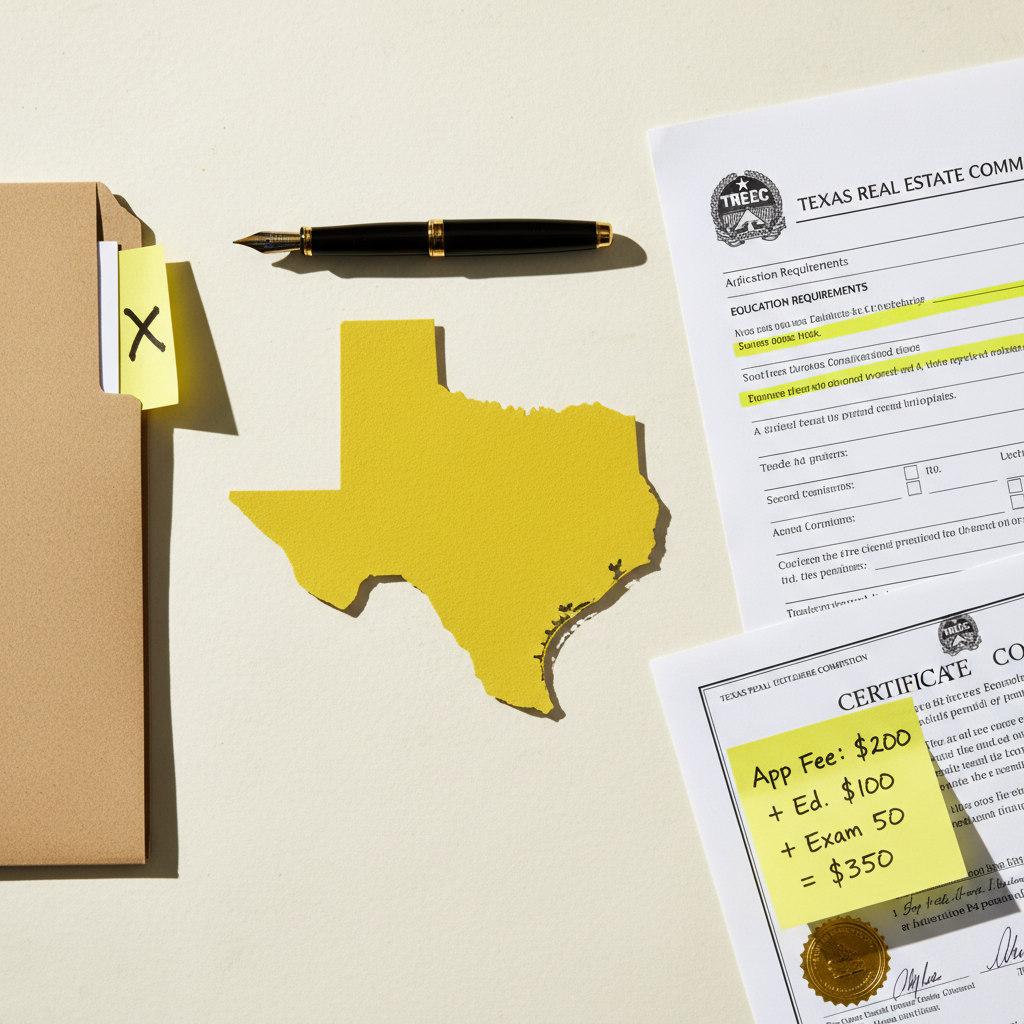
Texas does not have reciprocity agreements with any state. No shortcuts, no handshake deals, no “we’ll honor your California license.” If you want to practice real estate in Texas, you need a Texas license, and TREC (the Texas Real Estate Commission) will make you earn it from scratch. That’s the bad news.
The good news is that the path is predictable, and experienced agents can shave significant time off the education requirement. Here’s exactly how.
What TREC requires from out-of-state agents
Every sales agent applicant — whether you’ve been licensed for 20 years in New York or you’ve never sold a house — faces the same baseline requirements:
- 180 hours of qualifying education (six 30-hour courses)
- Pass the Texas sales agent exam (national + state portions)
- Application fee of $206 plus a $43 exam fee per attempt
- Fingerprinting ($38.25)
- A sponsoring broker in Texas before your license is issued
The six required courses are Principles of Real Estate I, Principles of Real Estate II, Law of Agency, Law of Contracts, Promulgated Contract Forms, and Real Estate Finance. No substitutions. TREC doesn’t care that you took “Real Estate Law” in Florida — they want their specific course titles from a TREC-approved provider.
At typical online course prices ($500-$1,000 for the full 180-hour package), you’re looking at roughly $800 to $1,300 total before you even count study time.
The exam exemption most agents miss
Here’s where your existing license actually helps. If you hold an active real estate license in a state that participates in the ARELLO (Association of Real Estate License Law Officials) national exam accreditation program, TREC may exempt you from the national portion of the exam.
That’s a meaningful advantage. The Texas exam has two sections: a national portion (80 questions) and a state portion (40 questions). The national portion covers general real estate principles, practices, and math — stuff you already know cold if you’ve been practicing. Skipping it means you only sit for the 40-question Texas state law section, which cuts your test day stress roughly in half.
To qualify for this exemption, submit a license history from your current state with your TREC application. TREC evaluates it case by case, so don’t assume — let them confirm.
Can experience reduce the 180-hour education requirement?
This is where expectations need a reality check. Unlike some states that grant blanket education waivers for experienced agents, Texas takes a rigid approach to its qualifying education. TREC requires the specific 180 hours of coursework regardless of how many years you’ve been licensed elsewhere.
There are no experience-based waivers for sales agents. You can’t substitute five years of production for Promulgated Contract Forms. TREC wants you to learn the Texas-specific way of doing things, and they enforce that through coursework, not resume review.
The silver lining: the courses are self-paced through online providers. I’ve seen motivated agents push through all 180 hours in four to six weeks of focused study. You’re not sitting in a classroom for three months. Treat it like a sprint and you’ll be done faster than you expect.
The timeline: how long does this actually take?
Here’s a realistic timeline for an out-of-state agent who treats this as a priority:
Weeks 1-5: Complete the 180 hours of qualifying education online. Most providers let you go as fast as you can read and pass the section quizzes.
Week 6: Submit your TREC application ($206), fingerprints ($38.25), and license history from your current state. TREC processing times vary, but expect two to four weeks for application review.
Weeks 8-10: Schedule and take the exam ($43). If you got the national exemption, you’re only taking the state portion. Pearson VUE administers Texas real estate exams at testing centers across the state and in some other states.
Week 10-12: Get your results, find a sponsoring broker (if you haven’t already), and activate your license.
Best case, you’re licensed in about eight weeks. More realistically, plan for ten to twelve weeks from start to finish. That’s faster than most agents expect when they first hear “no reciprocity.”
Finding a sponsoring broker
You can’t hold an active Texas sales agent license without a sponsoring broker. Period. This isn’t optional — TREC won’t issue your license until a broker files the paperwork to sponsor you.
If you’re relocating, start talking to brokerages before you finish your coursework. Most Texas brokerages are familiar with out-of-state transfers and won’t blink at sponsoring someone who’s already licensed elsewhere. If you’re planning to work remotely or part-time in Texas, make sure the brokerage is set up for that arrangement before you commit.
The first renewal is heavier than you think
One more thing TREC doesn’t advertise loudly: your first license renewal requires 270 total qualifying hours, not just the initial 180. That means an additional 90 hours of Sales Apprentice Education (SAE) courses, plus TREC Legal Update I (4 hours) and Legal Update II (4 hours), plus the 30-hour Real Estate Brokerage course.
After that first renewal, subsequent renewals drop to 18 hours of continuing education every two years. But budget time and money for that first renewal bump.
The bottom line
Texas makes you work for it. No waivers on education, no reciprocity deals, no fast passes. But the path is clear: 180 hours of coursework, one exam (possibly just the state portion), $287 in fees, and a sponsoring broker. An experienced agent who commits to the process can be licensed in two to three months.
If you’re comparing Texas to other “hard” states, check out our reciprocity guide for a full breakdown of which states play nice and which ones make you start over.