Transferring your real estate license to North Carolina (the hard way)
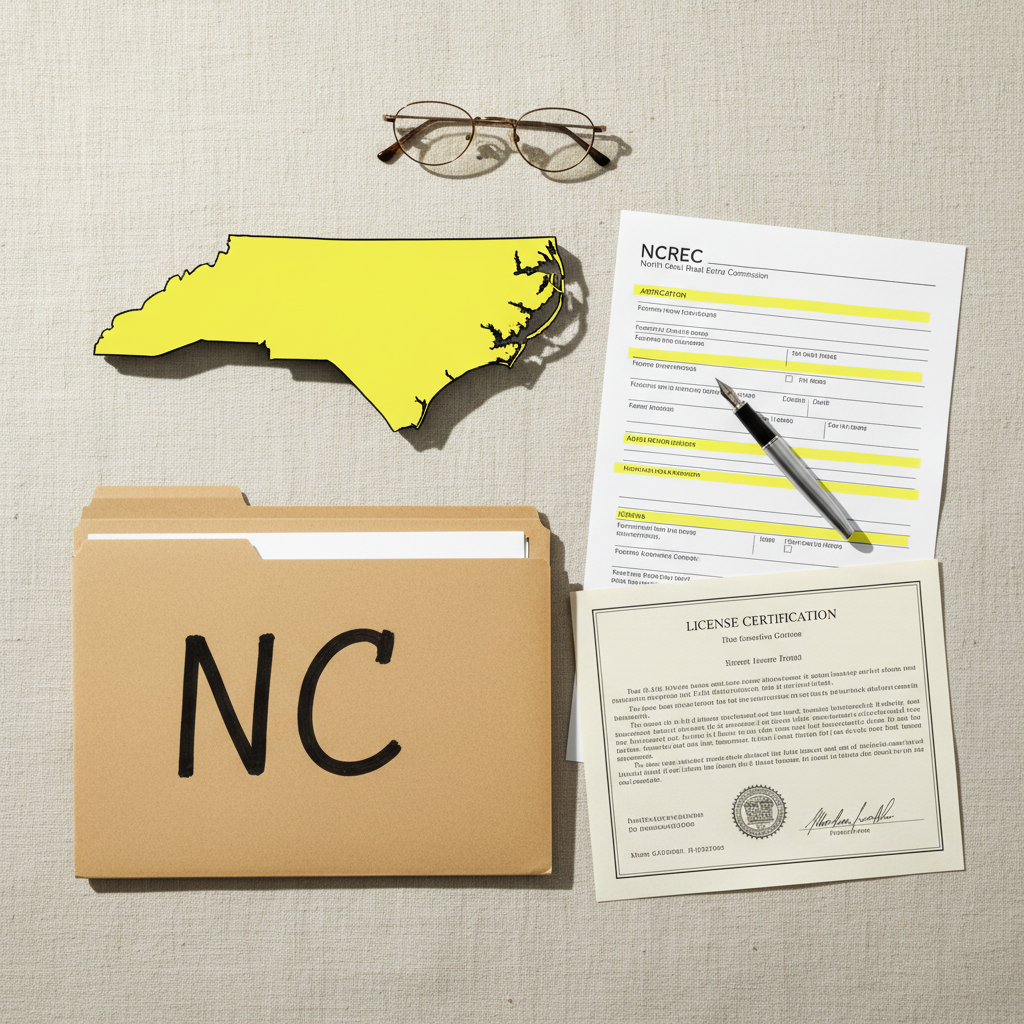
North Carolina does not have real estate license reciprocity with any state. If you’re an out-of-state agent hoping to transfer your license with a quick form and a fee, that’s not how it works here. NC is one of the “hard” states, and the path to a full license means going through the state’s own licensing process from close to scratch.
There are two options depending on what you need: a limited commercial-only license for nonresidents, or the full Provisional Broker license that lets you practice residential and commercial real estate. Most agents relocating to NC need the full license. Here’s what both paths look like.
Option 1: the limited nonresident commercial license
If you’re not moving to North Carolina and only need to handle commercial transactions in the state, there’s a carve-out. The NCREC (North Carolina Real Estate Commission) offers a Limited Nonresident Commercial Real Estate License. It’s narrow, but it exists.
The requirements:
- You hold an active real estate license in good standing in your home state (the state where your primary real estate business is located).
- You do not have an address in North Carolina.
- You affiliate with a resident NC broker who has an active license. This broker essentially sponsors you for commercial transactions in the state.
- You submit an Official Certification of Licensure from your home state (and any other state where you’ve been licensed in the past five years). The certification must be issued within six months of your application.
The limitations are real. You can only work on commercial deals. No residential sales. No residential leasing. And you can’t enter North Carolina to perform any brokerage act until you’ve filed a Declaration of Affiliation and Brokerage Cooperation Agreement with your NC sponsor broker.
This license works for commercial agents who occasionally have deals that touch North Carolina. If you’re relocating to NC and planning to work residential real estate, this isn’t your path.
Option 2: the full provisional broker license
This is what most agents need, and it’s where NC earns its reputation as a “hard” state. North Carolina doesn’t call its entry-level licensees “agents” or “salespersons.” Everyone is a “broker.” The entry-level designation is “Provisional Broker,” and it requires supervision by a Broker-in-Charge (BIC).
Here’s the good news for out-of-state agents: if you hold an active license in another state, you do not have to complete NC’s 75-hour pre-licensing course. You can go straight to the licensing exam. That saves you a few hundred dollars and several weeks of coursework.
Here’s what you do need:
Pass the NC state exam section. The NC broker exam has two parts: a national section (80 questions) and a state-specific section (40 questions). Out-of-state agents with an active license can be exempt from the national section and only need to pass the NC state portion. You need at least 29 out of 40 correct on the state section to pass.
Alternatively, you can waive the state exam entirely and receive a Provisional Broker license — but then you’re subject to NC’s 90-hour post-licensing education program (three 30-hour courses) within 18 months. Most agents find it cleaner to study for and pass the state exam rather than deal with the post-licensing requirements.
Submit the application and fees. The NCREC application fee is $100. The state exam registration is another $100, plus a testing fee of $66 to the exam vendor. Total out-of-pocket for the application and exam: around $266.
Get a Certification of License History. You’ll need an official certification from every state where you’ve held a real estate license in the past five years. Each certifying state may charge its own fee for this document.
Find a Broker-in-Charge. As a Provisional Broker, you must work under the supervision of an active BIC in North Carolina. You can’t hang your license at a firm and operate independently. This is true for all Provisional Brokers in NC, not just out-of-state transfers.
What makes the NC state exam different
The state portion of the NC exam trips up out-of-state agents because NC does things its own way. Here are the topics that will feel unfamiliar even if you’ve been licensed for years in another state:
NC agency law. North Carolina has specific statutes governing the broker-client relationship that differ from most other states. The NC approach to dual agency, designated agency, and disclosure requirements has its own vocabulary and rules. Don’t assume your home state’s agency framework applies.
The Offer to Purchase and Contract. NC uses its own standard form (Form 2-T for residential transactions). The exam tests specific provisions, deadlines, and default terms in this form. If you’ve spent your career using a different state’s standard contract, you’ll need to study the NC version carefully.
NCREC rules and regulations. The exam covers the NC Real Estate License Law (Chapter 93A of the General Statutes) and the Commission’s own rules. Topics include trust account handling, advertising rules specific to NC, and the disciplinary process. These are the questions where out-of-state agents lose points.
NC-specific property concepts. The exam tests North Carolina’s version of property tax assessment, land use regulations, and environmental rules that may differ from your home state.
Study tips for out-of-state agents
You don’t need to take the full 75-hour pre-licensing course, but you do need to study NC-specific material. Here’s my advice:
Buy a NC state exam prep course, not a national one. Companies like Colibri, The CE Shop, and CompuCram offer NC-specific exam prep packages. These isolate the state content and skip the national topics you already know. Budget $50 to $150 for a good prep course.
Focus 80% of your study time on the NC-specific content. The agency law sections, the Offer to Purchase and Contract form, and the NCREC rules are where the exam separates people who studied from people who winged it. General real estate knowledge won’t save you on these questions.
Read the actual NC General Statutes Chapter 93A. It’s dry, but the exam pulls directly from this language. Pay attention to the specific dollar amounts of penalties, the timelines for trust account deposits, and the grounds for license revocation. These are favorite exam topics.
Take at least three full-length practice exams. Not to memorize answers, but to get used to how NC phrases its questions. The state section has a specific style that rewards careful reading. Many questions include two answers that look correct — the NC-specific answer is the right one, not the “general real estate best practice” answer.
Don’t underestimate the time commitment. Plan for 40 to 60 hours of study if you’re an experienced agent from another state. You know real estate, but you don’t know NC real estate law. Most agents who fail the state section admit they studied for a week instead of a month.
The timeline from start to finish
Here’s a realistic timeline for an out-of-state agent getting a full NC license:
- Week 1-2: Request license certifications from your current and past states. Some states process these quickly; others take up to two weeks.
- Week 2-5: Study for the NC state exam. If you’re working full-time, give yourself at least three weeks.
- Week 5-6: Register for and take the exam through PSI (the current exam vendor for NC). Testing centers are available in several NC cities, or you can take it via online proctoring.
- Week 6-7: Submit your NCREC application with your exam score, license certifications, and the $100 application fee.
- Week 7-9: NCREC reviews and processes your application. Typical processing time is one to three weeks.
Total: roughly six to nine weeks from start to finish, assuming you pass the exam on the first attempt.
The silver lining
NC’s exam pass rate is actually reasonable. The overall first-time pass rate sits around 68%, and students from the better pre-licensing schools report pass rates above 80%. For out-of-state agents who take the time to study the NC-specific content, the odds are in your favor. The people who fail are overwhelmingly the ones who assumed their experience in another state was enough preparation.
The other silver lining: NC is a growing market. Charlotte, Raleigh-Durham, and the Asheville corridor are pulling transplants from across the country. If you’re relocating there as an agent, the demand is real. The licensing process is annoying, but the market on the other side of it is worth the effort.
Your next step is to request your license certification from your current state today. That’s the longest lead-time item, and everything else can happen while you wait for it to arrive.