Non-resident insurance licensing: the complete playbook
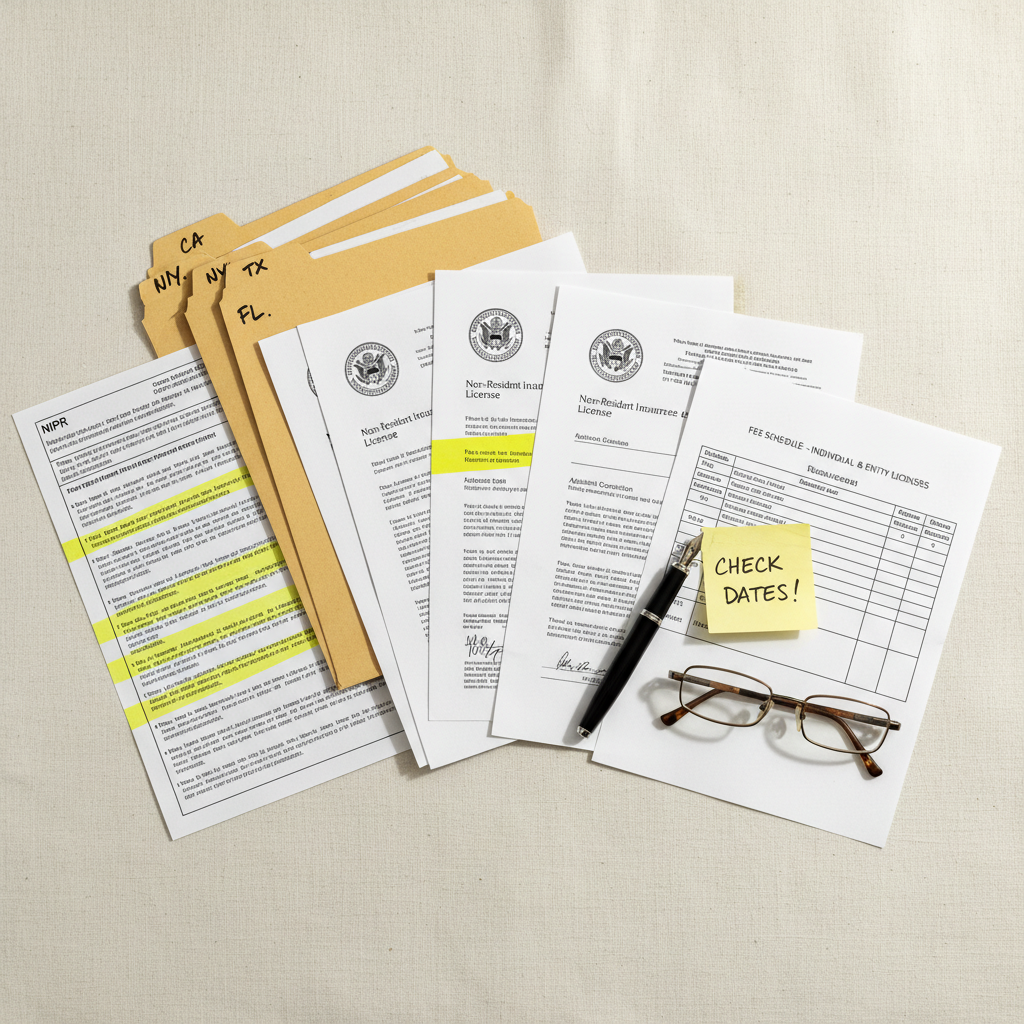
Selling insurance in multiple states is one of the easiest ways to grow your book of business. The regulatory framework for insurance reciprocity is, honestly, way more rational than real estate. There’s a centralized system. There’s a single portal. And in most cases, you can skip the exam entirely if you already hold a home state license.
That said, “easier than real estate” doesn’t mean “easy.” The NIPR system has its own quirks, the fees stack up fast when you’re adding 10 or 15 states, and the order you do things in matters more than most producers realize. I burned $400 in unnecessary fees my first time through because I applied for non-resident licenses before my home state appointment was fully processed. That’s $400 I’m going to save you right now.
Home state vs. non-resident state: the foundation
Before you touch anything else, you need to understand this distinction, because the entire insurance licensing system is built on it.
Your home state is the state where you maintain your legal residence. This is where you hold your resident producer license. Every insurance producer has exactly one home state at any given time. Your home state controls your core licensing — it determines your lines of authority (life, health, property, casualty, etc.), it’s where you complete your continuing education, and it’s the license that everything else hangs on.
A non-resident state is any other state where you want to sell insurance. When you apply for a non-resident license, you’re essentially asking that state to recognize your home state credentials and let you do business there without taking their exam or completing their pre-licensing education.
Here’s the part that matters: almost every state in the country grants non-resident licenses based on your active home state license. You don’t retake the exam. You don’t redo the coursework. You apply, pay the fee, and you’re in. The NIPR system makes this possible.
The order of operations (this saves you money)
Get this sequence wrong and you’ll pay for it. Literally.
Step 1: Get your home state resident license first. This means passing the exam in your home state, completing any pre-licensing education your state requires, and getting your license issued and active. Do not skip ahead.
Step 2: Get appointed by your carrier or agency in your home state. Some non-resident states require proof of appointment before they’ll process your application. Others don’t, but having the appointment on file speeds things up regardless.
Step 3: Apply for non-resident licenses through NIPR. Once your home state license is active and your appointment is on record, you can start stacking non-resident licenses. The non-resident application for most states is a single form through the NIPR gateway. Many states process these in under a week.
Why this order matters: if you apply for a non-resident license before your home state license is fully active in the NIPR system, your application will either be rejected outright or kicked back for additional documentation. Either way, you’ve wasted the application fee. Some states refund rejected application fees. Many don’t.
The NIPR gateway: your command center
NIPR stands for the National Insurance Producer Registry. It’s the electronic system that links state insurance departments and lets you apply for licenses, renew them, and update your information from a single portal at nipr.com.
Think of NIPR as the middleman between you and 50+ state insurance departments. Instead of filling out 15 different state applications on 15 different state websites with 15 different formats, you fill out one application through NIPR and it routes to each state for processing.
Here’s how it works in practice.
Getting your NPN. Every licensed insurance producer in the US gets a National Producer Number (NPN). This is your universal ID across all state systems. If you already have a home state license, you already have an NPN — you just might not know what it is. Log into NIPR and search for yourself, or check your home state’s producer database.
Applying for non-resident licenses. From the NIPR portal, you select which states you want to apply to, choose your lines of authority, upload any required documents, and pay the fees. NIPR routes your application to each state’s insurance department.
The NIPR convenience fee. Here’s the fine print. NIPR charges a convenience fee on top of each state’s application fee. As of 2025, the NIPR processing fee is $25 per state for initial applications. That’s on top of whatever the state itself charges. So when you’re calculating costs for adding 10 states, add $250 just for the NIPR processing fees.
Processing times. Most states process NIPR-submitted non-resident applications within three to seven business days. A few states are slower — California and New York tend to take two to three weeks. Florida is usually fast, often within 48 hours.
How to stack licenses efficiently
If you’re expanding to multiple states, the order and timing of your applications can make a difference.
Batch your applications. NIPR lets you apply to multiple states in a single session. Do them all at once rather than one at a time over several weeks. Each session requires you to re-verify your information, and batching saves you both time and the headache of tracking multiple application timelines.
Start with states where you have immediate business. Prioritize the states where you have clients, referral partners, or carrier appointments waiting. Don’t apply to all 50 states on day one just because you can. Every license comes with renewal fees and CE requirements.
Watch for states that require additional documentation. Most states just need your NIPR application and fee. But a few outliers require things like a certified letter from your home state insurance department, a surety bond, or additional fingerprinting. California, for example, has its own fingerprinting requirement separate from what your home state may have already collected. Check each state’s specific requirements on the NIPR website before you apply.
Track your lines of authority. You might hold a life and health license in your home state but also want property and casualty authority in your non-resident states. Make sure the lines of authority you’re requesting in each non-resident state match what you actually plan to sell. Requesting lines you don’t need adds cost and CE burden.
What it costs: a realistic breakdown
The total cost of adding a non-resident state varies, but here’s the typical range.
| Fee type | Amount | Notes |
|---|---|---|
| State application fee | $50-$200 | Varies by state; FL is $50, CA is $188 |
| NIPR processing fee | $25 | Per state, per application |
| Background check | $0-$75 | Some states include it; others require separate submission |
| Fingerprinting | $0-$50 | Only if the state requires it separately |
| Total per state | $75-$350 |
If you’re adding 10 states, you’re looking at $750 to $3,500 in upfront costs. That’s real money, so plan accordingly.
Renewals add up too. Most states charge $50 to $100 per renewal cycle (usually every two years), and you’ll need to complete the CE requirements for every state you’re licensed in — though many states accept your home state’s CE as sufficient for non-resident renewal.
The home state change trap
If you move to a new state, you need to change your home state designation. This is straightforward in theory but messy in practice.
When you change your home state through NIPR, your old home state license converts to a non-resident license (or terminates, depending on whether you want to keep it), and you need to get a new resident license in your new home state. That might mean taking the licensing exam again, depending on whether your new home state accepts your existing credentials.
The timing matters. You typically have 90 days from the date you establish residency in a new state to change your home state designation. If you miss this window, some states will flag your license and you’ll be dealing with compliance issues.
The worst-case scenario: you move states, don’t update your home state designation, and your non-resident licenses start getting rejected for renewal because they’re tied to a home state address that no longer matches your actual residence. I’ve seen producers lose licenses in five or six states simultaneously because they didn’t handle a home state change properly.
Continuing education across multiple states
This is where multi-state licensing gets genuinely annoying.
Your home state sets your CE requirements, and most non-resident states accept your home state CE completion as proof that you’re current. But “most” isn’t “all.” A handful of states have additional CE requirements for non-resident producers, particularly around state-specific ethics courses or flood insurance certification.
The practical approach: complete your home state CE requirements first, making sure to take courses that are approved in as many of your non-resident states as possible. Providers like Kaplan and ExamFX offer multi-state CE packages designed for exactly this situation. Then check whether any of your non-resident states have additional requirements beyond what your home state mandates.
NIPR’s renewal system will flag upcoming CE deadlines for each state, which helps. But it won’t tell you which specific courses you need — that’s on you to verify with each state’s insurance department.
Common mistakes that cost producers money
Applying for non-resident licenses before the home state license is active in NIPR. I mentioned this already, but it’s the number one mistake. Wait until your home state license shows as “Active” in the NIPR system before you submit non-resident applications.
Not tracking renewal dates across states. Every state has its own renewal cycle. Miss one and your license lapses. Reactivation often costs more than renewal and may require additional CE. Set calendar reminders or use NIPR’s renewal tracking.
Requesting lines of authority you don’t need. Every line of authority you hold in a non-resident state adds CE requirements. If you’re only selling life insurance, don’t request property and casualty authority “just in case.”
Ignoring appointment requirements. Some states require you to be appointed by at least one carrier within a certain period after receiving your license. If you don’t get appointed in time, the license becomes inactive and you’ve wasted the application fee.
Insurance reciprocity vs. real estate reciprocity
If you’re coming from the real estate side, the insurance world will feel almost luxurious by comparison. Real estate reciprocity is a state-by-state patchwork with no centralized system. Some states have full reciprocity, some have partial, some have none at all, and you’re filling out different paper forms for each one.
Insurance licensing, by contrast, has NIPR — a single electronic portal that connects to nearly every state. The concept of non-resident licensing means you almost never retake an exam. And the NAIC (National Association of Insurance Commissioners) actively pushes for uniformity across states, which means the system gets a little more streamlined every year.
That said, the fees are real, the CE requirements multiply with every state you add, and the home state rules create a single point of failure that can cascade across your entire license portfolio if you don’t manage it.
For the real estate equivalent of this guide, see our real estate reciprocity guide, which covers a system that is, frankly, much less organized but still manageable if you know the process.
Your next step
If you already have your home state license, log into NIPR today and verify that your information is current. Check that your NPN is correct, your address is up to date, and your lines of authority match what you actually sell. Then identify the first three states where adding a non-resident license would generate immediate revenue. Apply for those three first, get comfortable with the NIPR workflow, and then expand from there.