New York to New Jersey real estate license transfer: no reciprocity, but a workable waiver
If you hold an active New York salesperson license, New Jersey will usually waive its 75-hour classroom requirement. It will not waive the exam. You still need to pass New Jersey’s full salesperson exam, complete fingerprinting, and get a New Jersey broker to submit your license application before the commission will issue the license. If your New York license dates back to the old 45-hour era, add 30 more hours first.
Need the 50-state version first? Start with our real estate reciprocity guide. If you only expect the occasional Hoboken or Bergen County deal, read reciprocity vs portability before you pay for a second license.
The one date that changes the whole process
New Jersey’s published waiver criteria for New York salespersons splits applicants into two groups.
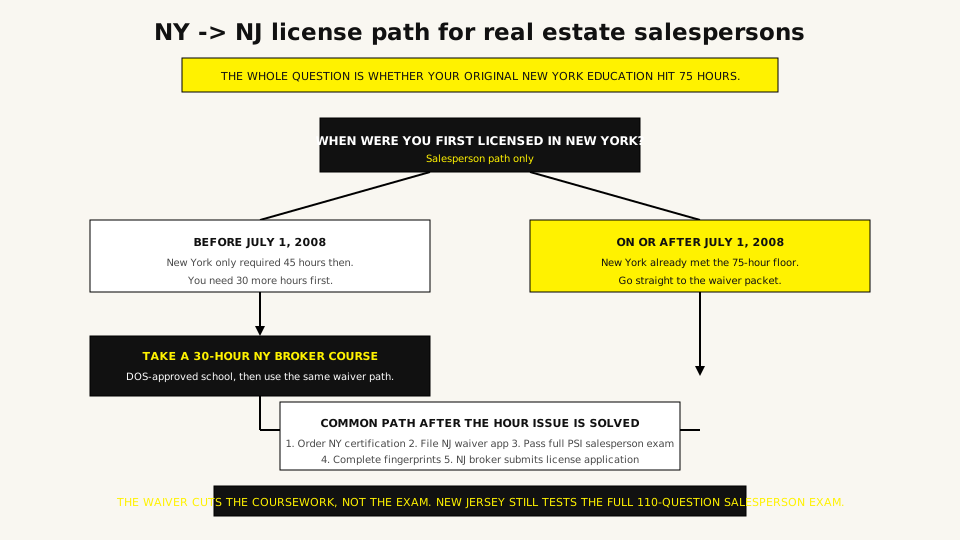
If you were licensed in New York on or after July 1, 2008, you usually get the clean waiver path. That is when New York moved to a 75-hour prelicensing standard, which matches New Jersey’s 75-hour minimum. Today New York requires 77 hours because the state also added 2 hours of fair-housing and implicit-bias training.
If you were licensed before July 1, 2008, New Jersey treats you as short on classroom hours because the older New York requirement was only 45 hours. That does not kill the move. It just means you need an extra 30-hour New York broker course from a DOS-approved school before New Jersey will waive the rest.
The practical takeaway is simple. Newer New York agents get a real shortcut. Older agents still have a path, but it is not the fast lane.
What New Jersey actually waives
New Jersey is not offering reciprocity here. It is offering an education waiver.
That distinction matters because a lot of agents hear “waiver” and assume they are only taking a state-law test. Not here. Waiver candidates still sit for New Jersey’s standard salesperson exam through PSI: 110 questions, four hours, 70% to pass. PSI’s current bulletin also says candidates can test at a center or by remote proctoring.
What the waiver saves you from is the expensive part: sitting through New Jersey’s 75-hour prelicensing course after you already did comparable work in New York.
The exact New York to New Jersey process
1. Order the New York certification first.
New Jersey wants a current original certification of licensure from the New York Department of State. New York’s request form says certifications and certified license-history records cost $25 each, and the document is issued within 30 days of the date on the form. Do this first so the paper clock is already running while you handle the waiver.
2. File New Jersey’s salesperson waiver application.
Mail the waiver packet to the New Jersey Real Estate Commission with the $25 waiver fee and the New York documentation the commission asks for. Once New Jersey approves the waiver, it sends PSI your exam eligibility electronically.
3. Pass the New Jersey salesperson exam.
This is the part that surprises New York agents. You are not taking a trimmed-down reciprocity exam. You are taking New Jersey’s regular salesperson exam. PSI’s February 1, 2026 bulletin lists 110 questions, four hours, and a 70% passing score. Study New Jersey agency disclosures, escrow timing, license-law discipline rules, and state business-practice rules. Our state portion exam prep guide will help, but do not skip national review entirely because New Jersey tests both.
4. Get fingerprinted the New Jersey way.
New Jersey requires a fresh criminal-history check through IDEMIA. The commission’s fingerprint page puts the current fee at $66.05. If you live, work, or go to school in New Jersey, you must use the in-state live-scan process. If you are outside New Jersey and not within ten miles of the border, the commission says to contact the Licensing Bureau for alternate instructions before you book anything.
5. Let the broker submit the actual license application.
This is another place agents lose time. After you pass, your employing New Jersey broker of record submits the original application through the REC online portal and pays the licensing fee. For a salesperson license issued between July 1, 2025 and June 30, 2027, New Jersey’s posted fee is $160. The commission’s instructions are blunt: you cannot conduct any brokerage activity until the commission approves the application and issues the license.
One paperwork trap worth respecting: New Jersey says the exam score report, fingerprint proof, broker-submitted application, and any required supporting documents all need to land before the score-report expiration date. Pass the test and keep moving. Do not let a clean exam result die on your desk.
What it costs
| Item | Cost |
|---|---|
| New York certification or certified license history | $25 |
| New Jersey salesperson waiver application | $25 |
| PSI salesperson exam | $38 |
| IDEMIA fingerprinting | $66.05 |
| New Jersey salesperson license | $160 |
| Fixed total | $314.05 |
If your New York license predates July 1, 2008, add the cost of the 30-hour broker course. If you fail the PSI exam, add another $38 each time. This is not a cheap one-click border hop, but it is still far cheaper than paying for the full 75-hour New Jersey course. For a broader cost comparison, use the 50-state fee calculator.
When a second license is worth it, and when it isn’t
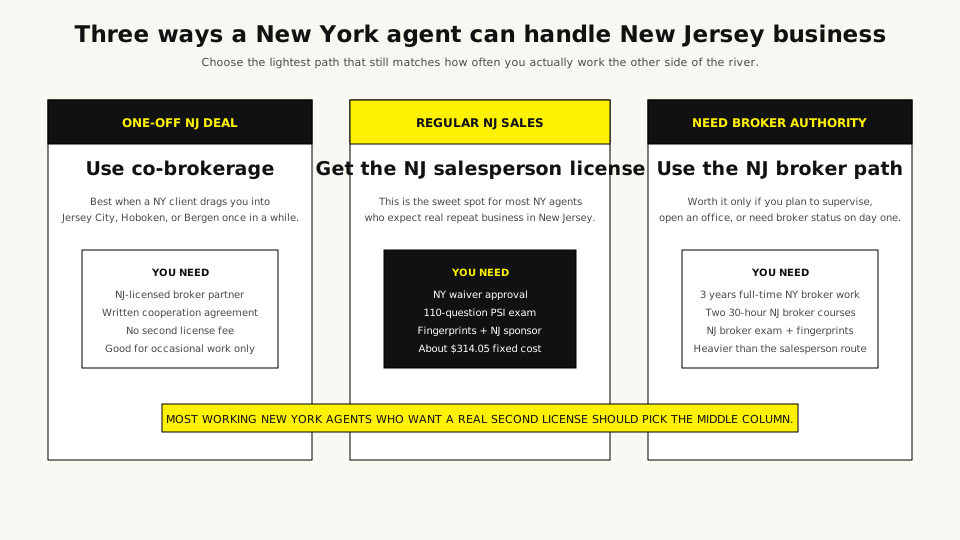
The NY/NJ border is unusual because you do have another option: cooperative practice. A New York agent can work a New Jersey transaction through a New Jersey broker under the state’s portability rules. For the occasional Jersey City condo or Bergen County relocation client, that may be enough.
It stops being enough once New Jersey becomes part of your regular business. If you are touring properties in Hoboken every week, trying to build Hudson or Essex referral relationships, or want your own New Jersey branding and MLS access, get the license. Co-brokerage is a guest pass. A second license is real access.
If you’re already a New York broker
New Jersey does have a broker waiver route for New York brokers, but do not assume it is lighter. In many cases it is heavier.
The commission’s New York broker criteria says you need a current New York broker license, a current license history, and proof that you were a full-time broker for the three years immediately before you apply. If New Jersey approves that waiver, you still have to complete two 30-hour courses in New Jersey law, ethics, and office management before sitting for the broker exam.
My practical take: if your goal is to start selling in New Jersey under another firm, the salesperson waiver path is usually the cleaner move even for a New York broker. Use the broker path only if you actually need broker authority in New Jersey, plan to supervise agents, or intend to open an office.
Why this corridor matters right now
The 2024 American Community Survey estimated that 56,799 people moved from New York to New Jersey in a single year. Another 36,002 moved the other direction. That is a live border market, not a theoretical one.
You see it on the ground too. Manhattan, Brooklyn, and Westchester clients shop Jersey City, Hoboken, Fort Lee, and Bergen County all the time once taxes, square footage, or school districts enter the conversation. If those clients are already calling you, the Jersey license can turn a referral fee into a full commission.
Your next move: order the New York certification today and figure out whether your original license date puts you on the clean 75-hour waiver path. If it does, file the New Jersey waiver packet immediately. If it does not, enroll in the 30-hour course before you waste time looking for a shortcut that New Jersey does not offer.