New Jersey to Pennsylvania real estate license transfer: state exam only, but don't assume clean reciprocity
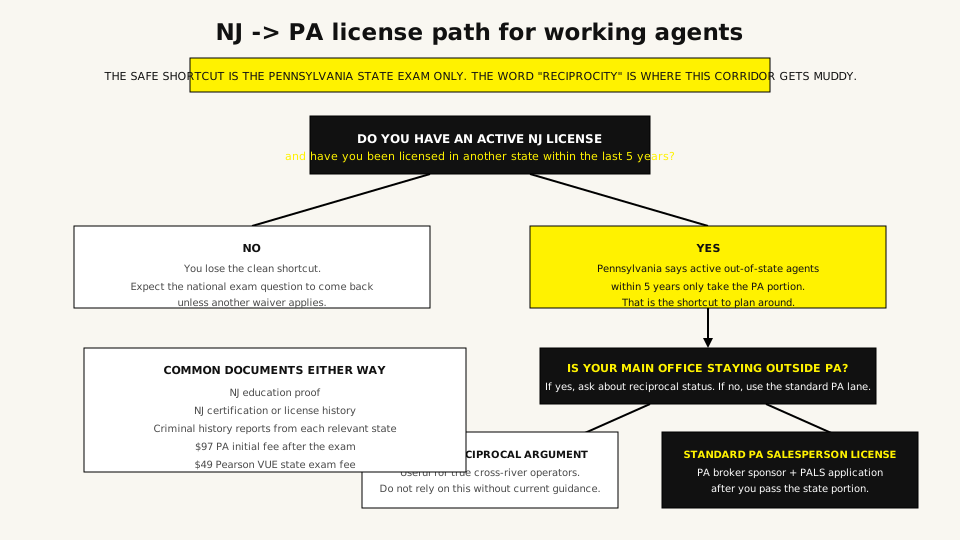
If you hold an active New Jersey real estate license, Pennsylvania’s clearest shortcut is the standard method with the Pennsylvania state exam only. The PA commission says active out-of-state agents licensed within the last five years can skip the national portion. The catch is that New Jersey is not the kind of clean, no-paperwork reciprocity win people assume. You still need Pennsylvania law, Pennsylvania paperwork, a Pennsylvania broker, and proof that your New Jersey file is in order.
That is why I would not plan this move around the word “reciprocity.” Plan it around the state portion. That shortcut is documented clearly, and it is the one that actually saves time.
Need the bigger map first? Start with our real estate reciprocity guide. If you only need the occasional cross-river deal, read reciprocity vs portability before you buy another exam seat. And if Pennsylvania law is the bottleneck, use our state portion exam prep guide.
The shortcut is real, but the reciprocity language is messy
Pennsylvania’s salesperson snapshot says an out-of-state agent can be issued a reciprocal license if that person’s principal place of business stays outside Pennsylvania. The commission’s separate licensure guide is more cautious and lists a shorter reciprocity-agreement group, and New Jersey is not on that list.
That mismatch matters. If you are moving your base from Hoboken, Cherry Hill, or Princeton into Pennsylvania, the safest working assumption is the standard Pennsylvania salesperson license. Do not build your timeline around a theoretical reciprocity argument and then act surprised when the paperwork turns into a phone call marathon.
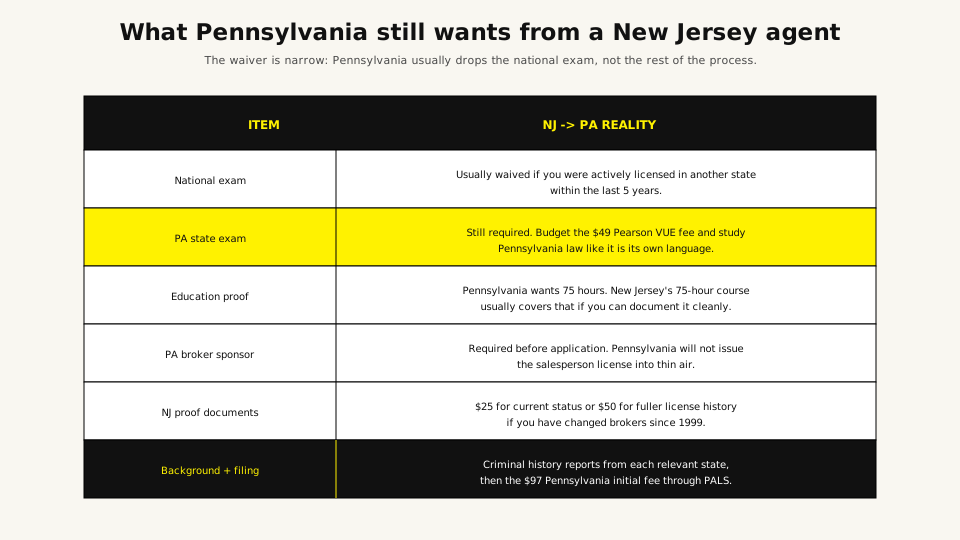
The good news is that the standard lane is still pretty friendly for a working NJ agent. Pennsylvania says an active broker or salesperson from another state within the last five years only has to pass the Pennsylvania portion of the exam. Pennsylvania also accepts 75 hours of prelicensure coursework completed in another jurisdiction if that coursework was approved there, and New Jersey requires a 75-hour prelicensure course for salespeople. In plain English, most properly licensed New Jersey agents already have the education piece they need.
The cleanest New Jersey to Pennsylvania process
- Pull your New Jersey education proof and current license details first. Pennsylvania wants 75 hours of basic real estate education, and New Jersey’s own licensure page says salespeople complete a 75-hour prelicensure course before the exam and sponsorship step.
- Register for the Pennsylvania state portion before you touch the license application. Pennsylvania’s licensure guide tells currently licensed out-of-state agents to contact Pearson VUE first and sit for the Pennsylvania portion only.
- Line up a Pennsylvania employing broker. The commission’s guide is blunt here: you cannot apply for a Pennsylvania salesperson license until you have a PA broker ready to supervise you.
- Order your New Jersey proof package. New Jersey charges $25 for a certification of current status and $50 for a fuller license history if you have had more than one employing broker since 1999.
- Gather criminal history reports for every state where you have lived, worked, or studied in the last five years. Pennsylvania wants those reports dated within 180 days of the application.
- Pass the Pennsylvania portion, file through PALS, and pay the $97 initial fee.
That is the real shortcut. No new national exam. No repeating beginner coursework from scratch. Just Pennsylvania law, Pennsylvania paperwork, and a broker relationship on the other side of the river.
Where New Jersey agents lose time
The first mistake is using “reciprocity” as shorthand for “easy.” Pennsylvania is easier than Texas or North Carolina, but it is not magic.
The second mistake is underestimating the state portion. Pennsylvania tests Pennsylvania. That means RELRA, agency disclosures, escrow rules, transfer tax details, and contract timing that do not line up neatly with New Jersey habits. If you walk in thinking “I’ve been doing deals in Bergen County for eight years, I’ll wing this,” you are setting yourself up for a stupid delay.
The third mistake is leaving the broker question for last. Pennsylvania mails the license to the broker’s main office. If you still have not picked your PA shop, your transfer is not actually ready.
What it costs
Here is the cleanest budget using only fees I could verify from the current state pages:
| Item | Cost |
|---|---|
| Pennsylvania initial fee | $97 |
| Pearson VUE PA exam fee | $49 |
| New Jersey current-status certification | $25 |
| New Jersey full license history | $50 if needed |
| Criminal history reports | Varies by state |
That puts the known floor at $171 if a basic NJ certification works, or $196 if you need the fuller license-history packet, before any criminal history report fees. For broader destination-state budgeting, use the 50-state fee calculator.
Why this corridor keeps showing up
The U.S. Census Bureau’s 2024 ACS migration table estimated 38,467 moves from New Jersey to Pennsylvania in a single year. Another 25,902 people moved the other direction.
That tracks with what agents see in real life. This is not a one-way retirement pipeline like New Jersey to Florida. It is daily business: South Jersey clients buying on the Main Line, Philly households hopping into Camden and Burlington counties, and investors treating the Delaware River like a minor inconvenience instead of a state line.
If that is your book of business, Pennsylvania is worth the second license. If you only need occasional cooperation deals, start with reciprocity vs portability and make sure you actually need the second credential before you pay for more paperwork.
Your next move is simple. Pull your New Jersey course certificate, order the NJ certification or history, and schedule the Pennsylvania state portion. That is the step that turns this corridor from “I should do that someday” into a license you can actually use.