California to Arizona real estate license transfer: the residency catch most agents miss
If you hold an active California real estate license, Arizona can be a pretty friendly landing spot. You do not need Arizona’s full 90 hours of pre-licensing. In the simplest version of the process, you take the Arizona state exam, finish the 6-hour contract-writing course, get an Arizona fingerprint clearance card, and file your application.
Here is the catch most agents miss: Arizona only gives you that clean shortcut after you establish Arizona residency. If you have already moved, the process is straightforward. If you are still living in California, Arizona still gives you credit for your existing license, but it makes you complete 27 hours of Arizona-specific education first.
Need the 50-state version first? Start with our real estate reciprocity guide. Arizona is one of the friendlier destination states, but it is not a true “show up with your California license and get waved through” state.
The one question that decides everything
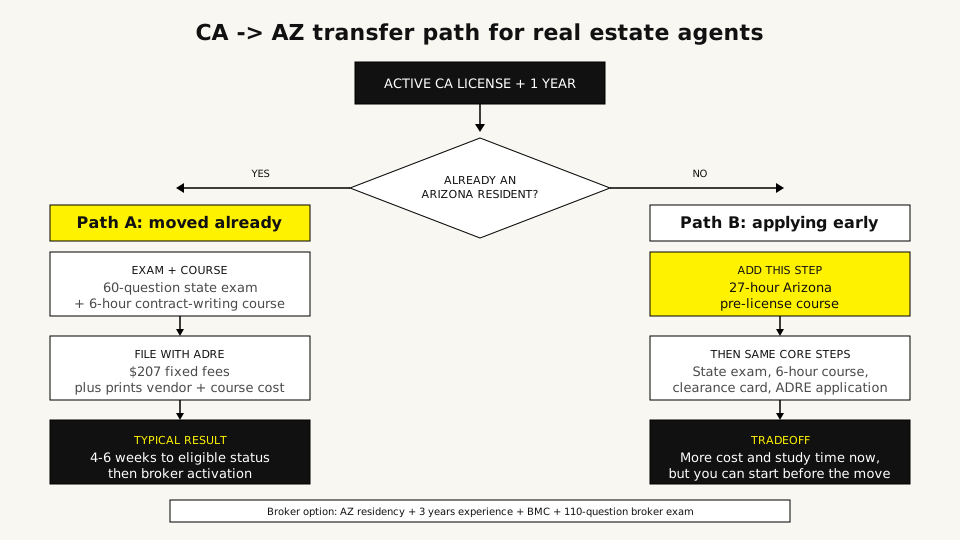
ADRE’s out-of-state recognition rules split the process in two. The state wants at least one year of equivalent licensure from another state either way. The extra question is whether you can prove Arizona residency under Arizona’s tax-law definition.
If you can, you skip the 27-hour pre-license course. If you cannot, you take that course before the same state exam. That is the whole game.
Path A: you already live in Arizona
This is the path most California agents want. Once you can show Arizona residency, the checklist is short:
- Request a certified California license history from DRE. Fee: $20.
- Schedule the Pearson VUE out-of-state salesperson state-specific exam. Fee: $60.
- Complete Arizona’s 6-hour contract-writing course.
- Apply for an Arizona fingerprint clearance card through DPS. The state fee is $67, plus the fingerprinting vendor’s fee.
- File the Arizona salesperson application, proof of legal presence, and residency documentation with ADRE. The license fee is $50 and the Recovery Fund fee is $10.
Arizona’s residency attestation form gives you several ways to prove the move is real: an Arizona driver’s license, Arizona voter registration, a recent Arizona tax filing, a dated rental contract with proof of payment, mortgage documents for a primary Arizona home, or utility setup records. If you just signed a lease in Phoenix or Scottsdale, save every document.
One useful detail from the Pearson handbook: the Arizona salesperson state exam is 60 scored questions plus 5 unscored pretest questions, you get 90 minutes, and you need 75% to pass. This is not an at-home online exam. Arizona real estate exams are administered at Arizona test centers, so plan for an Arizona trip if you have not physically relocated yet.
What it costs
| Item | Already an Arizona resident | Still in California |
|---|---|---|
| Pearson state exam | $60 | $60 |
| ADRE license fee + Recovery Fund | $60 | $60 |
| Arizona fingerprint clearance card | $67 + vendor fee | $67 + vendor fee |
| California certified license history | $20 | $20 |
| 6-hour contract-writing course | Required | Required |
| 27-hour Arizona course | Not required | Required |
| Fixed cost before courses | $207 + vendor fee | $207 + vendor fee |
The variable piece is education. The contract-writing course cost depends on the school you choose. If you are not yet an Arizona resident, the extra 27-hour course is the thing that changes the math.
Timeline for the resident path
If you already live in Arizona and you stay organized, this is a four-to-six-week project. The exam itself is fast. The slower pieces are the fingerprint clearance card, course completion, and waiting until your application packet is clean enough that ADRE does not bounce it back.
There is also one small but important operational detail: ADRE can approve you onto “eligible” status before you are fully activated. Your license becomes active after your Arizona designated broker accepts it in the online system. So yes, you can finish the paperwork before your new broker finishes onboarding.
Path B: you have not moved yet
Arizona still lets you use out-of-state recognition before the move. It just stops being the cheap shortcut that many blog posts promise.
If you cannot prove Arizona residency yet, ADRE requires a 27-hour Arizona pre-licensure certificate before you take the same salesperson state exam. You still need the 6-hour contract-writing course. You still need the fingerprint clearance card. You still need the California certified license history. In other words, the exam and paperwork stay the same. The extra 27 hours is the tax for applying too early.
This is the decision point I would focus on. If your move is already booked for next month, waiting until you can prove residency may save you time and money. If you need the Arizona license lined up before the move because a brokerage wants certainty, pay the 27-hour tax and start now.
One piece of good news: Arizona DPS now allows electronic fingerprinting through Fieldprint, including locations outside Arizona. So even if you are still in Orange County or the Inland Empire, you can start the clearance-card step without flying to Phoenix just to get prints taken. The exam is the part that still forces the Arizona trip.
If you are a California broker
California brokers have a second option: apply for an Arizona broker license instead of an Arizona salesperson license. That path is real, but it is not the fast lane unless you actually need broker authority in Arizona.
Arizona’s broker recognition path requires:
- Proof of Arizona residency
- At least three years of actual licensed experience during the five years immediately before application
- Broker Candidate Experience Verification
- The Arizona out-of-state recognition broker exam
- 9 hours of Broker Management Clinic courses
- Fingerprint clearance card and proof of legal presence
The broker exam is bigger. Pearson lists it as a 110-question state-specific exam with 165 minutes testing time and a $125 fee. ADRE’s current broker application fee is $145 including the Recovery Fund assessment.
My practical take: if you are joining an Arizona brokerage and want to start selling fast, the Arizona salesperson license is usually the simpler play, even if you already hold a California broker license. If you are opening a shop, supervising agents, or you know you need broker authority on day one, do the broker path once your residency paperwork is clean. For the broader strategy on why broker status makes interstate moves easier, read our broker license reciprocity guide.
What to study for the Arizona exam
California agents usually overestimate how much “general real estate knowledge” will carry them here. The Arizona salesperson state exam is not testing whether you can survive a listing appointment in San Diego. It is testing whether you know Arizona’s rules.
According to Pearson’s current content outline, the heavy areas are:
- Arizona’s regulatory framework and ADRE’s powers
- Consumer protection law
- Advertising rules
- Agency relationships
- Disclosure duties and conflicts
- Contracts
- Escrow, title, and lending basics
- Ownership, liens, deeds, and HOA restrictions
- Foreclosure and anti-deficiency rules
If I were studying from California, I would spend extra time on Arizona-specific disclosure timing, consumer-fraud rules, and the way ADRE expects licensees to handle agency and compensation disclosures. That is where “I know real estate” turns into “I know Arizona real estate.” Our state portion exam prep guide will help you attack that efficiently.
Can you keep both licenses?
Yes. Nothing about the Arizona process forces you to give up California.
That matters in this corridor because a lot of agents are not making a clean break. They still have California referral relationships. They still have past clients calling about 1031 exchanges, probate sales, or parents moving to the desert. Dual licensing lets you keep a foot in both markets, which is often the whole point of doing this in the first place.
If the Arizona move is permanent and you know you are done with California, that is a different calculation. But if your business is even partly built on relocation traffic, keeping both licenses active is usually the smarter play.
Why this corridor matters right now
Arizona is still growing. The Census Bureau’s Vintage 2024 population estimates show the state added 109,357 residents between July 2023 and July 2024, and Maricopa County alone reached 4,673,096 people in 2024.
You do not need a white paper to see what that means on the ground. Phoenix, Scottsdale, Mesa, Queen Creek, and the northwest Tucson corridor are full of buyers comparing Arizona prices, taxes, and lot sizes against Southern California. A California agent who already understands relocation psychology has a real advantage once the Arizona license is active.
For a broader look at which states make transfers easy and which ones do not, check our full reciprocity states breakdown. If you want to compare Arizona’s costs against every other state, the 50-state fee calculator is the fastest way to do it.
Your next move: decide whether you are applying before or after the move. If you can wait until you have Arizona residency documents in hand, do that. If you cannot, enroll in the 27-hour Arizona course now, book your fingerprinting, and plan an Arizona trip for the Pearson exam.