California to Oregon Real Estate License Transfer: No Reciprocity Shortcut

If you hold a California real-estate license and are moving to Oregon, plan on qualifying through Oregon’s standard broker path. Oregon does not list California among its reciprocal jurisdictions, and the Oregon Real Estate Agency says active out-of-state licensees still have to meet Oregon’s education and examination requirements. Keep your California license in good standing while you plan, but do not budget for a paperwork-only transfer unless you qualify for the Agency’s separate military authorization.
This is a practical guide, not licensing or legal advice. State requirements and fees can change, so verify every step with the Oregon Real Estate Agency’s current out-of-state guidance before you enroll or apply.
There is no California reciprocity shortcut
Oregon lists reciprocal licensing arrangements with Alabama, Alberta, Georgia, Nebraska, and South Dakota. California is not on that list. For an active California licensee, Oregon’s Agency says there is no waiver of Oregon prelicense education or the Oregon licensing examination.
That distinction matters. “My California license is active” is valuable professional experience, but it is not the same as being licensed in Oregon. Build a timeline that includes the application, education, testing, fingerprints, and the supervising-broker step rather than picking a move date and hoping the license follows you.
The separate military authorization is not reciprocity
Oregon’s Agency separately says an active-duty service member stationed in Oregon, or that member’s spouse or domestic partner, may be eligible for an authorization to conduct professional real-estate activity. The applicant must meet specific conditions, including an active license in good standing in the same category that was active for the two years immediately before the move. This is a distinct authorization pathway, not a California reciprocity agreement. If it may apply, contact the Agency before starting the standard broker process.
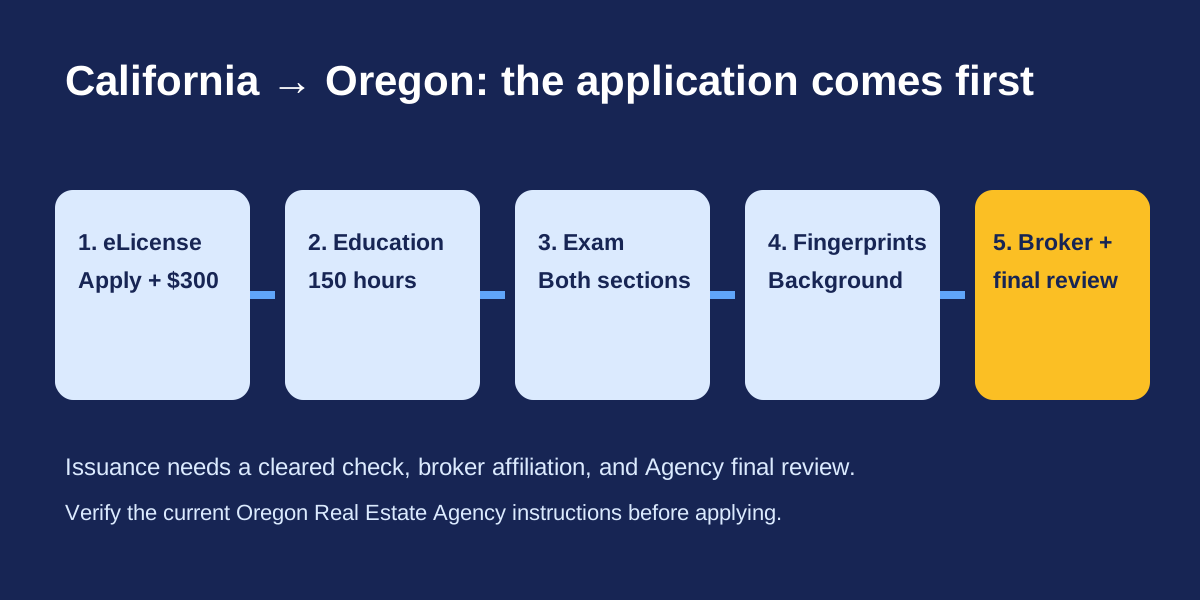
The Oregon broker path, in the Agency’s order
The Agency’s broker licensing instructions start with the application, not the exam:
- Register in eLicense, apply for a broker license, and pay the $300 nonrefundable application fee. The processed application gives you an Applicant ID.
- Complete 150 hours of prelicense education with an Agency-approved school. Give the school your Applicant ID and full name so it can make you exam-eligible.
- Schedule and pay for the PSI exam, then pass both sections.
- Pay for fingerprinting and get fingerprinted at a PSI test center for the background check.
- Have your managing principal broker add your pending license to the business. Issuance also requires a cleared background check and the Agency’s final application review.
Exam scores and background-check clearances are each valid for one year; the Agency can issue only while both remain valid. The $300 application fee is not the whole budget: school, exam, and fingerprinting charges are separate. Arrange the brokerage relationship early, but do not represent yourself as Oregon-licensed before issuance.
What your California experience still does for you
Starting the Oregon licensing process does not erase the skills you built in California. Contract discipline, client communication, prospecting, fair-housing awareness, and transaction management carry over. The state-specific part is learning Oregon law, Oregon forms and agency practice, and the supervision model you will work within.
Use the learning period to map your current business to Oregon. Which clients will remain California clients? Which referral relationships can you maintain? Which Oregon market, brokerage model, and price range are you entering? Licensing is the gate; a relocation business plan is what makes the new license useful.
For context, start with our broader real-estate reciprocity guide. The comparison with California-to-Nevada licensing is useful precisely because each destination state writes its own rules. If North Carolina is also on your list, see transferring a license there—but do not borrow its requirements for Oregon.
Questions to ask an Oregon principal broker before you arrive
Licensing and affiliation are separate decisions, but they should be planned together. Ask a potential principal broker about the supervision process for a newly licensed Oregon broker, the training schedule, the commission plan, desk or technology fees, geographic expectations, and what happens if your Oregon license is not active on the start date you expected. Get the business terms in writing.
Also ask whether the brokerage has a relocation or referral process for clients who remain in California. That conversation protects the client and helps you avoid representing that you can conduct Oregon brokerage activity before the Oregon credential and supervision arrangement are in place. A good brokerage can explain its onboarding process clearly; it cannot waive the regulator’s requirements.
Keep copies of the approved-course completion record, examination result, fingerprint confirmation, application receipt, and final license record in one folder. A simple record like that makes it easier to answer a brokerage’s onboarding request, catch a name mismatch, and prove where the application stands if the moving date moves first.
A pre-move checklist
- Read Oregon’s current out-of-state licensee page and standard broker application instructions.
- If you are an active-duty service member, spouse, or domestic partner moving under orders, ask the Agency whether its separate authorization pathway applies.
- Ask the Agency or an approved education provider which requirements apply to your exact background.
- Keep a written timeline for application, education, examination, fingerprinting, and brokerage affiliation.
- Budget for the full Oregon process rather than a reciprocity endorsement.
- Check your California renewal and brokerage obligations before changing your primary market.
Your next step
Open the Agency’s broker instructions and build your timeline in that order. Confirm your California obligations separately, then discuss affiliation and onboarding with an Oregon principal broker before promising clients a start date.