Does a criminal record stop reciprocity? A candid look at good moral character clauses
Short answer: a criminal record does not automatically stop you from getting a license in another state. But it will trigger extra scrutiny, extra paperwork, and in some cases a flat denial — depending on the state, the offense, and how long ago it happened. The background check happens whether you’re a first-time applicant or a 20-year veteran transferring through reciprocity.
If you’re sitting on a conviction and wondering whether it’s even worth applying, keep reading. The answer is more nuanced than a yes or no, and knowing the rules before you apply can save you months of wasted time.
The background check doesn’t care that you already have a license
Here’s the thing that trips people up: they assume that because State A already approved them, State B will just rubber-stamp the transfer. That’s not how it works.
Most states require a fingerprint-based criminal background check for reciprocity applicants. Colorado runs one even if you have two years of active license experience. Massachusetts makes you submit certified court records for every prior conviction. California can deny a reciprocal license based on a conviction your home state already knew about and approved.
Your existing license proves you passed one state’s character review. It doesn’t guarantee you’ll pass another’s.
For insurance, there’s a small silver lining. The NAIC’s Standard 14 says states should fingerprint resident applicants and defer to the resident state’s decision for non-residents. In practice, that means if your home state approved your insurance license despite your record, most non-resident states will honor that call. But “most” isn’t “all.” Florida and California fingerprint non-resident insurance applicants anyway. And the NIPR system lets every state see your complete licensing history, appointments, and disciplinary actions across all jurisdictions. Nothing is hidden.
What “good moral character” actually means
Every state licensing application has some version of the “good moral character” requirement. The phrase sounds simple. It isn’t.
Some states treat it as a bright-line test. Alabama and Arkansas will deny you for any felony or any crime involving “moral turpitude” — a legal term that covers fraud, theft, forgery, perjury, bribery, embezzlement, and tax evasion, plus serious violent and sexual offenses. Arkansas specifically bars anyone convicted of a crime involving “fraud, violence, dishonesty, or untrustworthiness.”
Other states use a case-by-case approach. New York’s Article 23-A prohibits denying a license unless the offense has a “direct relationship” to the license or granting it would create an “unreasonable risk to property, safety, or welfare.” Michigan evaluates convictions individually. Florida reviews criminal history “on its own merit.”
Then there’s the “substantial relationship” test, used by California and Texas among others. The question isn’t whether you committed a crime — it’s whether the crime is substantially related to the duties of a real estate or insurance licensee. Fraud? Directly related. A bar fight in college 15 years ago? Probably not.
The practical difference between these approaches is enormous. The same conviction that gets you denied in Alabama might get you approved in California or New York with adequate documentation.
The offense matters more than the conviction itself
Not all criminal records create equal problems. Here’s how the severity breaks down in practice.
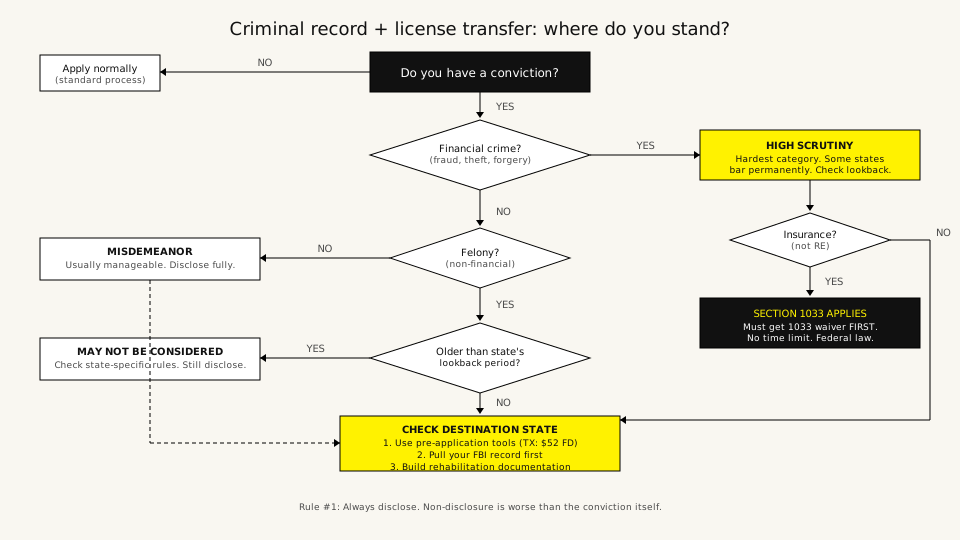
Financial crimes are the worst. Fraud, embezzlement, forgery, identity theft, money laundering, securities fraud, tax evasion, bribery, and kickbacks. These offenses go directly to the trust that real estate and insurance clients place in you. You’re handling escrow deposits, insurance premiums, client funds. A fraud conviction tells a licensing board you’ve already violated that trust once. Every state treats financial crimes as the most serious barrier to licensure.
Non-financial felonies are evaluated on specifics. Violent crimes are serious but may not be “substantially related” to a real estate license in states using that test. Drug offenses vary widely — simple possession is less problematic than distribution. Sexual offenses are a severe barrier in most states regardless of whether they relate to the profession.
Misdemeanors are generally manageable. In Texas, most misdemeanors won’t trigger denial except for moral turpitude offenses and those involving fraud. A single DUI typically won’t stop you. Colorado, Texas, and most other states don’t consider a single DUI conviction to be related to real estate duties. But repeat DWI offenses can trigger denial, and Maryland weighs DUIs more heavily than most states.
The age of the conviction matters a lot. States are moving toward fixed lookback periods:
| State | Lookback period | What it means |
|---|---|---|
| California | 7 years | Most convictions older than 7 years can’t be considered (financial felonies and sex offenses excepted) |
| New Jersey | 5 years | Bars licensure for forgery, burglary, robbery, and theft within 5 years |
| Pennsylvania | 5 years | Offenses with a “presumption of unfitness” limited to 5-year consideration |
| Nevada | 3 years | Cannot issue until 3 years after restitution is paid or sentence/parole expires |
A fraud conviction from 2015 that would block you in New Jersey might not even come up in California’s review. Timing matters.
The insurance industry’s federal wildcard: Section 1033
If you work in insurance or plan to, there’s a federal law you need to know about. 18 U.S.C. Section 1033 makes it a federal crime to work in the business of insurance if you’ve ever been convicted of a state or federal felony involving dishonesty or breach of trust.
Read that again. Ever. There is no time limitation. No lookback period. No grandfather clause. A fraud conviction from 1998 triggers Section 1033 the same as one from last year.
The crimes that trigger it include perjury, fraud, embezzlement, theft, and bribery — anything with an element of deceit or violation of a fiduciary relationship. If your conviction falls in this category, you need a “1033 waiver” from the state Commissioner of Insurance before you can legally work in insurance in any capacity, not just as a licensed agent.
The waiver process requires certified criminal history records, certified court documents, two recent photos, and a case that you can safely engage in the insurance business. The commissioner reviews it individually and the decision becomes a permanent part of your licensing record.
This is one area where real estate licensees have it easier. There’s no federal equivalent for real estate — your exposure is state-by-state only.
Expunged records: not as clean as you think
If you’ve had a conviction expunged or sealed, you might assume it’s invisible to licensing boards. It’s more complicated than that.
The legal rule in most reform states is clear: licensing agencies cannot consider expunged convictions. California’s AB 2138 explicitly bars the Department of Real Estate from denying a license based on an expunged record. Florida says you don’t need to disclose expunged crimes at all.
The practical problem: fingerprint-based background checks pull from FBI databases, and the FBI doesn’t automatically update or remove records when a state court orders expungement. Your state court sealed the file. Nobody told the FBI. So when the fingerprint check runs, the old record surfaces anyway.
If you’ve had a record expunged, request your own FBI Identity History Summary (form 1-783) before applying for any license. See what’s actually in the federal database. If the expunged record still appears, you’ll need to proactively request its removal from the FBI system. This takes time, which is exactly why you check early.
The states where it’s hardest and where it’s getting easier
The strictest states for criminal records:
- Alabama and Arkansas: Near-automatic bars for felonies and crimes of moral turpitude.
- Florida: Lenient process overall, but embezzlement, fraud, and racketeering convictions can permanently bar you. And if you fail to report a conviction within 30 days, the fines start at $500 and go up to $5,000 with possible license revocation.
- California: Strict scrutiny through the substantial relationship test, but the 7-year lookback and protections for expunged records actually make it more navigable than it looks on paper.
The reform wave:
The trend line is moving in your favor. Since 2017, 44 states and D.C. have passed 86 separate fair chance licensing laws limiting the power to deny licenses based on criminal history. In 2024 alone, Colorado overhauled its licensing scheme, South Dakota passed SB 57 (boards can only disqualify for crimes that “directly relate” to the license), Nebraska strengthened its protections, and Pennsylvania finalized regulations limiting consideration of most offenses to a 5-year window.
The emerging standard in reform states: licensing boards generally cannot consider non-conviction records, non-violent misdemeanors, pardoned convictions, or felonies more than 3 years old (except serious violent crimes and sex offenses). When they do consider a record, they must show a specific public safety interest that outweighs your right to the license, and the conviction must “specifically and directly relate” to the duties of the profession.
The one thing that’s worse than a conviction: lying about it
The number one reason insurance license applications get denied is not the underlying conviction. It’s failure to accurately disclose the conviction on the application.
Every licensing application asks about criminal history. Texas TREC requires you to disclose “all criminal offenses, no matter how old they may be, even if they were dismissed or if you were placed on parole, probation, and community supervision.” California will deny an application for non-disclosure even if the underlying conviction wouldn’t have been disqualifying. Florida’s reporting penalties for licensed agents who fail to report within 30 days: $500 to $3,000 for a first offense, $1,000 to $5,000 plus suspension or revocation for multiple failures.
And remember — they’re running your fingerprints. They will find it. The question is whether they find it because you told them, or because their background check revealed something you tried to hide.
A disclosed conviction with documentation of rehabilitation gives a licensing board a reason to approve you. A hidden conviction that surfaces on a background check gives them two reasons to deny you: the conviction itself and the dishonesty of concealing it. The concealment is often the bigger problem, because dishonesty is exactly the character trait licensing boards are screening for.
What to do before you apply
If you have a criminal record and want to transfer your license to a new state, here’s the playbook:
1. Pull your own FBI record first. Request your FBI Identity History Summary so you know exactly what any state will see. No surprises.
2. Check if expungement or sealing is available. If eligible, pursue it before applying. But verify the FBI database has been updated — don’t assume.
3. Use pre-application determination tools. Texas offers a TREC Fitness Determination for $52 that gives you a preliminary answer on whether your record will be disqualifying. Multiple states offer similar preliminary review processes. Use them. Getting a “probably no” answer before you spend $1,500 on pre-licensing education is far better than getting a denial after.
4. Build your rehabilitation file. Gather letters of recommendation, employment history, community service records, treatment or education completion records, and evidence of restitution paid. A thick rehabilitation file changes the conversation from “should we deny this person” to “this person has clearly moved past this.”
5. Research the specific destination state. Lookback periods, directly-related-offense lists, and application procedures vary wildly. What blocks you in Alabama might not even come up in Pennsylvania. The full reciprocity states list covers which states have the most generous transfer policies, but you’ll also need to check each state’s character requirements specifically.
6. For insurance: determine if Section 1033 applies. If your conviction involved dishonesty or breach of trust, you must obtain a 1033 waiver before applying for licensure. Full stop. Working in insurance without one is a federal crime.
7. Disclose everything. Every conviction, every state, every time. Even dismissed charges if the application asks about them. Even ancient history. Let the licensing board decide what matters. Your job is to be transparent and let your rehabilitation record speak for itself.
The path from a criminal record to a multi-state license isn’t a straight line. But the states that denied people automatically 10 years ago are increasingly moving toward individualized review, lookback limits, and pre-application tools that give you an answer before you invest your time and money. The system is imperfect, but it’s more navigable than most people assume.
If you’re planning a cross-state move and your record is part of the equation, start the research early. Way early. The reciprocity guide covers which states accept transfers and what the baseline requirements look like. The $5,000 mistake article covers the financial traps that catch agents who don’t plan ahead. A criminal record adds complexity to that transfer process, but it doesn’t necessarily end it.