The adjuster's advantage: reciprocity for insurance adjusters explained
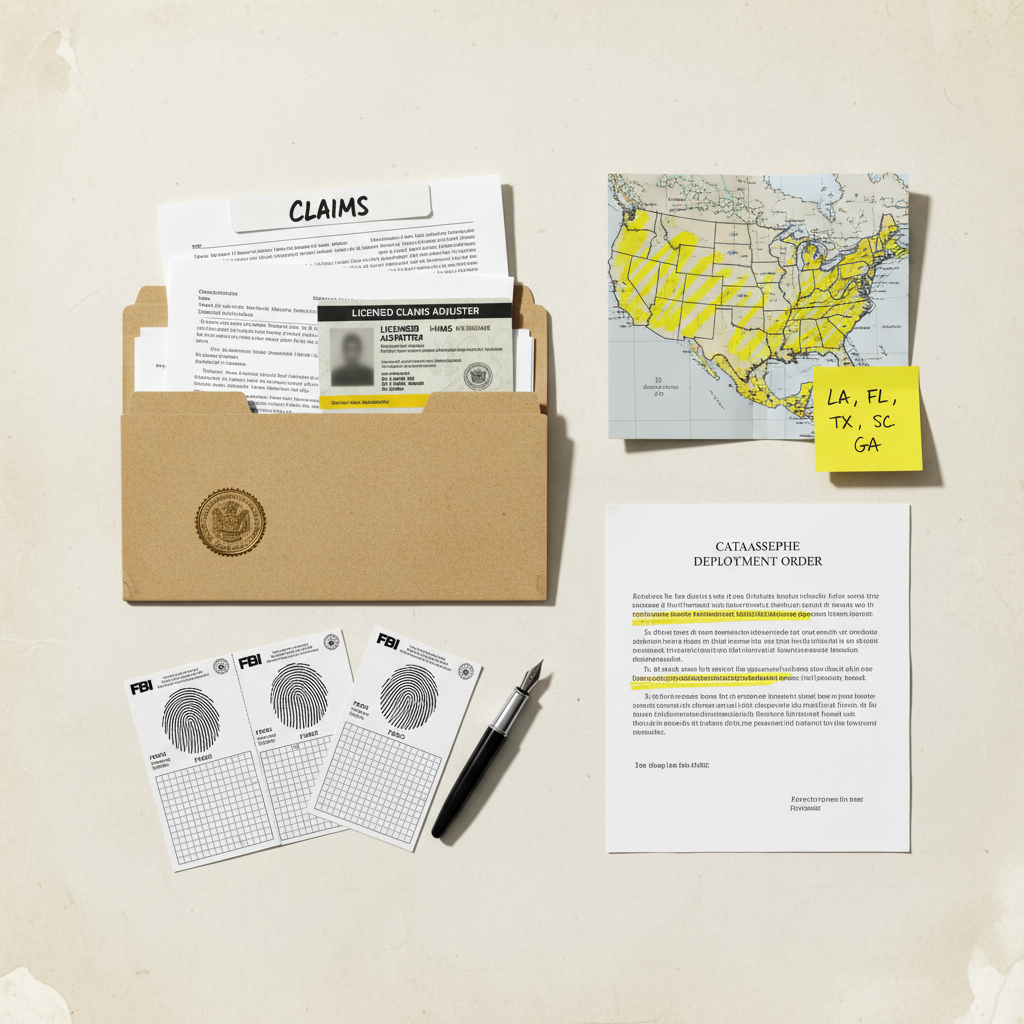
Insurance adjusters don’t sit in one state and wait for business to come to them. They go where the storms go. A hurricane hits the Gulf Coast, and within 48 hours, adjusters from across the country are driving toward the damage. That business model only works if your license can travel as fast as you can.
The good news: adjusters have one of the best reciprocity frameworks in all of professional licensing. The bad news: almost nobody explains it clearly. Here’s how the system actually works, including the “Designated Home State” strategy that experienced cat adjusters use to maximize their reach.
The Designated Home State explained
Most insurance licensing works on a simple model: you get a resident license in the state where you live, and then you apply for non-resident licenses in other states. Your home state is wherever you reside.
Adjusters get a better deal. Three states — Florida, Indiana, and Texas — allow out-of-state adjusters to claim them as a “Designated Home State” (DHS). You don’t have to live there. You don’t have to have an office there. You pass their exam, pay their fee, and that state becomes your licensing home base for reciprocity purposes.
Why does this matter? Because the reciprocity agreements attached to your home state determine which other states you can get licensed in without taking additional exams. And Florida and Texas have the most reciprocal agreements of any states in the country.
Think of it like choosing your airline hub. You could fly out of a small regional airport (your actual home state), or you could hub through Dallas or Miami and reach twice as many destinations. The DHS lets you pick your hub.
Why Florida and Texas are the gold standard
Not all DHS options are created equal. Here’s why the industry treats Florida and Texas as the two best choices:
Texas (All Lines Adjuster License)
Texas offers an All Lines adjuster license that covers property, casualty, and workers’ compensation. Once you hold a Texas resident or DHS license, you can apply for reciprocal non-resident licenses in 30+ states by filing through NIPR — no additional exams required. The Texas exam itself is 150 questions, and the license costs about $50 to apply.
Texas also has a relatively straightforward exam. It’s not easy, but the study materials are well-documented and the pass rates are reasonable for anyone who puts in two to three weeks of focused prep.
Florida (All Lines Adjuster License / 6-20 License)
Florida’s adjuster license is often called the 6-20 license (its classification number). It’s all-lines, covering property, casualty, health, and more. Florida’s reciprocal reach is comparable to Texas — 30+ states accept a Florida DHS license for non-resident applications.
Florida’s exam is 200 questions and has a reputation for being slightly harder than Texas. The application fee is about $55. Florida also requires a 40-hour pre-licensing course (or equivalent), which Texas does not mandate.
So which one? If you want the faster path with fewer prerequisites, Texas. If you want the broadest lines of authority and you don’t mind a pre-licensing course, Florida. Many experienced adjusters hold both, which gives them maximum flexibility. But if you’re starting fresh, pick one, get it done, and start stacking non-resident licenses.
States that don’t license adjusters at all
Here’s something that surprises a lot of new adjusters: not every state requires an adjuster license. As of 2025, sixteen states and D.C. don’t require independent adjusters to hold a state license:
Colorado, Illinois, Iowa, Kansas, Maryland, Massachusetts, Missouri, Nebraska, New Jersey, North Dakota, Ohio, Pennsylvania, South Dakota, Tennessee, Virginia, Wisconsin, and the District of Columbia.
In these states, you can adjust claims without a state-issued license. But — and this is a big “but” — most carriers and IA firms still require you to hold a license from somewhere before they’ll deploy you. Having no license in a non-licensing state technically means you can work there, but having a Texas or Florida DHS license on your resume means you’ll actually get the call.
The non-licensing states also mean you don’t need to file non-resident applications for them. That saves you fees and paperwork. Your Texas or Florida DHS license effectively covers you everywhere: licensed states through reciprocity, and non-licensing states by default.
The NIPR process for adjusters
The National Insurance Producer Registry (NIPR) is the portal for filing non-resident license applications. For adjusters, the process works like this:
-
Get your home state or DHS license first. Everything else builds on this. NIPR won’t let you apply for non-resident licenses without an active home-state license on file.
-
Log into NIPR and find the Non-Resident License Application. Select the state you want to add, choose the adjuster license type, and NIPR will tell you the fee and any state-specific requirements.
-
Pay the fee. Non-resident adjuster license fees range from $20 to $200 per state. Most fall in the $50-$100 range. NIPR collects the fee and passes it to the state.
-
Wait for processing. Some states issue non-resident licenses within 24-48 hours through NIPR. Others take one to three weeks. States that still rely on paper processing (yes, they exist) can take longer.
-
Repeat. Each state is a separate application. If you’re planning to be a cat adjuster who deploys nationally, budget $1,500-$3,000 to get licensed in all the states that require it, plus the time to file 30+ individual applications.
One tip that saves hours: file your non-resident applications in batches. Log into NIPR on a Saturday morning, open tabs for each state, and work through them assembly-line style. Each application takes about 10 minutes once you have your information ready.
Emergency licensing during catastrophes
After a major disaster — a Category 4 hurricane, a wildfire that burns through an entire county — states need adjusters fast. They don’t have time to process thousands of non-resident applications through normal channels.
Most states have emergency licensing provisions that kick in after a declared disaster. These typically work in one of three ways:
Temporary permits. The state issues a temporary adjuster permit (often 90-180 days) with a simplified application. Florida does this regularly after hurricanes. You still need a home-state license, but the state waives the non-resident application process and fee during the emergency period.
License extensions. If your non-resident license was about to expire and a disaster hits, the state may automatically extend all active adjuster licenses for 60-90 days.
Blanket waivers. In extreme cases, a state will issue a blanket waiver allowing any licensed adjuster from any state to operate temporarily without filing a non-resident application at all. This happened in Louisiana after Hurricane Ida and in Florida after Hurricane Ian.
The catch: emergency provisions are unpredictable. You can’t build a business model around them. They’re a safety net for the rare event where normal licensing can’t keep up with demand. The right strategy is to get your non-resident licenses in place before storm season, so you’re ready to deploy without waiting for emergency waivers that may or may not materialize.
The cost breakdown
Here’s what a typical multi-state adjuster licensing portfolio looks like financially:
| Item | Cost |
|---|---|
| Texas DHS license (exam + application) | ~$150-$250 (including study materials) |
| Florida DHS license (course + exam + application) | ~$300-$400 |
| Non-resident licenses (per state, 25-30 states) | $50-$100 each |
| NIPR processing fees | Included in state fees |
| Total for national coverage | $2,000-$4,000 |
That sounds like a lot until you compare it to what a single catastrophe deployment pays. One good storm season can generate $30,000-$80,000+ in adjuster fees. The licensing investment pays for itself on your first deployment.
Building your licensing strategy
If you’re starting from zero, here’s the order of operations:
Step 1: Pass the Texas All Lines exam and get your DHS license. Texas is the faster path with fewer prerequisites.
Step 2: File non-resident applications through NIPR for the states where you’re most likely to deploy. Start with hurricane-prone states (Louisiana, Mississippi, Alabama, the Carolinas) and tornado alley (Oklahoma, Kansas, Missouri — though some of these don’t require licenses).
Step 3: Consider adding the Florida 6-20 license as your second DHS. Some states that don’t have reciprocity with Texas do have it with Florida, and vice versa.
Step 4: Fill in the remaining states as your budget allows. Prioritize states where you have carrier relationships or where your IA firm is likely to send you.
For more on how the insurance license compact fits into this picture, and for a full walkthrough of the NIPR system, check our NIPR guide. The compact doesn’t replace the DHS strategy, but it does streamline the non-resident application process in member states.