The insurance license compact: which states are in and what it means for you
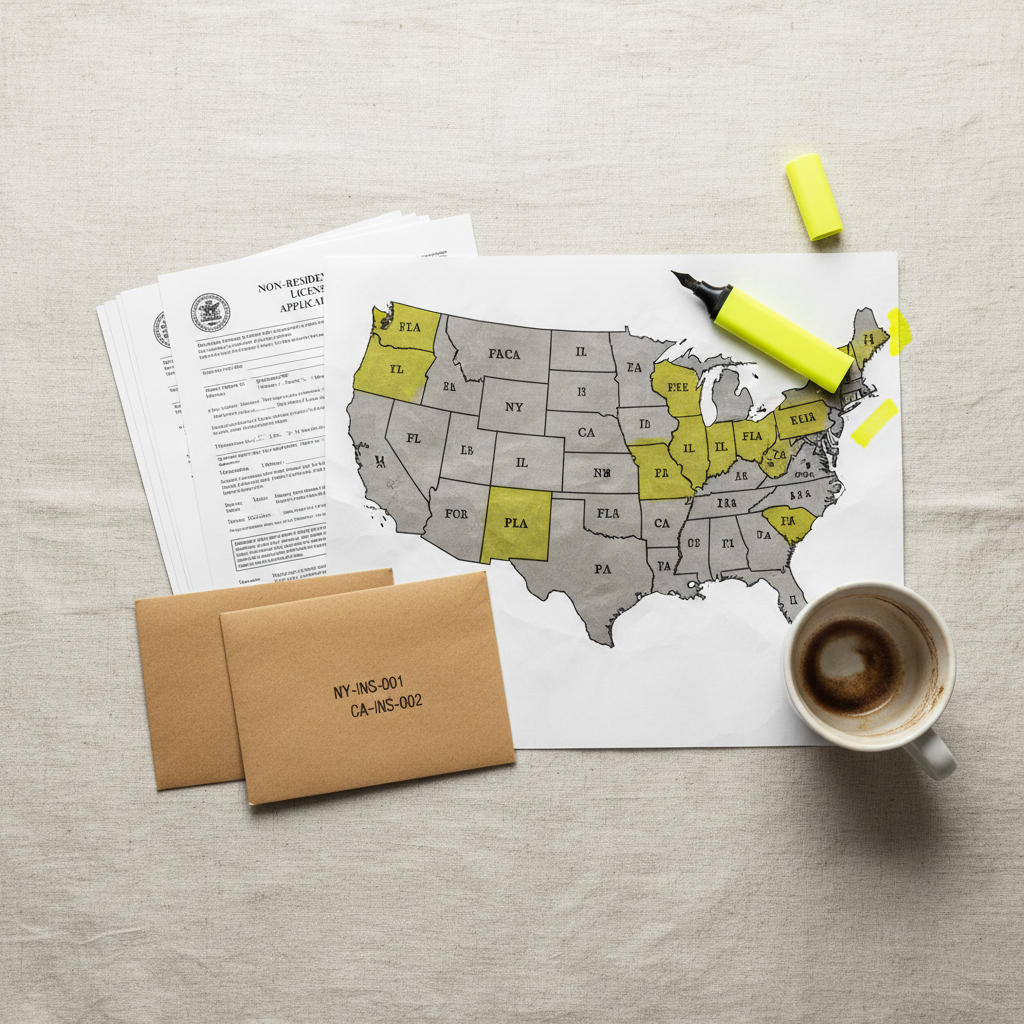
The insurance license compact doesn’t give you automatic licenses in other states. What it does give you is a faster, more predictable path to non-resident licensing — fewer hoops, standardized requirements, and electronic processing through NIPR instead of paper applications mailed to each state individually.
That distinction matters, because I’ve seen producers assume “compact” means “just show up and sell.” It doesn’t. You still apply, you still pay fees, and you still need your home-state license in good standing. The compact just makes the process less painful.
What the NIPL actually is
The National Insurance Producer License (NIPL) compact is an interstate agreement adopted through the NAIC (National Association of Insurance Commissioners). States that join the compact agree to follow uniform licensing standards for non-resident producers. The core idea: if your home state is a compact member and you meet the compact’s baseline requirements, other compact states must accept your non-resident application without imposing extra state-specific hurdles.
In practice, this means compact states won’t make you pass their state-specific exam for a non-resident license. They won’t require additional education beyond what your home state already demanded. And they process applications electronically through NIPR rather than requiring paper forms.
Which states are in the compact
As of early 2026, the following states and territories have enacted the compact:
Alabama, Alaska, Arizona, Arkansas, Colorado, Connecticut, Delaware, Georgia, Guam, Hawaii, Idaho, Illinois, Indiana, Iowa, Kansas, Kentucky, Louisiana, Maine, Maryland, Massachusetts, Michigan, Minnesota, Mississippi, Missouri, Montana, Nebraska, Nevada, New Hampshire, New Jersey, New Mexico, North Carolina, North Dakota, Ohio, Oklahoma, Oregon, Pennsylvania, Puerto Rico, Rhode Island, South Carolina, South Dakota, Tennessee, Texas, Utah, Vermont, Virginia, Washington, West Virginia, Wisconsin, and Wyoming.
That’s over 40 jurisdictions. The notable holdouts are California, Florida, and New York — three of the largest insurance markets in the country. If you need non-resident licenses in those states, you’re dealing with their individual application processes regardless of the compact.
What the compact does for you
Standardized background check requirements. Compact states agree on what triggers a license denial (felony convictions, fraud, prior revocations). This means you won’t get approved in one state and denied in another for the same background issue.
Simpler non-resident applications. If your home state is in the compact, applying for a non-resident license in another compact state through NIPR is about as simple as this process gets. Select the state, pick your lines of authority, pay the fee, submit.
No extra exams for non-resident licenses. This is the real win. Non-compact states can (and sometimes do) require additional testing for non-resident applicants. Compact states can’t. Your home-state exam is sufficient.
Faster processing. Compact states commit to processing non-resident applications within a defined timeline. In my experience, most compact states approve NIPR applications in 1 to 5 business days. Non-compact states can take weeks.
What the compact doesn’t do
It doesn’t eliminate fees. Every state still charges its own application fee, and NIPR still charges its $25 processing fee per state. Joining the compact didn’t make anyone cheaper.
It doesn’t cover every license type. The compact applies to producer licenses — the people selling policies. It doesn’t cover adjusters, surplus lines brokers, or certain specialty licenses. If you’re an adjuster chasing storm work across state lines, the compact won’t help you. That’s a separate set of rules entirely.
It doesn’t override continuing education. Each state still sets its own CE requirements for maintaining a non-resident license. You might need 24 hours of CE in one state and 30 in another, with different approved course lists. The compact doesn’t standardize CE.
And it doesn’t mean your license is “portable” in the physical sense. You still hold a separate license in each state. The compact just makes getting those licenses less bureaucratic.
The practical upside
For producers expanding to multiple states, the compact is the reason a multi-state strategy is even feasible. Before the compact, adding 10 states to your book meant 10 separate paper applications, potentially 10 different sets of additional requirements, and months of waiting. Now it’s a single NIPR session, one set of background questions, and 10 approvals landing in your inbox over the next week.
If you’re planning a multi-state expansion, start by confirming your home state is in the compact, then batch your applications through NIPR. Budget $25 in NIPR fees plus each state’s individual licensing fee per state, and set calendar reminders for every renewal date. The compact made getting licensed easier. Staying licensed is still on you.