Can I sell life insurance in another state? The 50-state rule explained
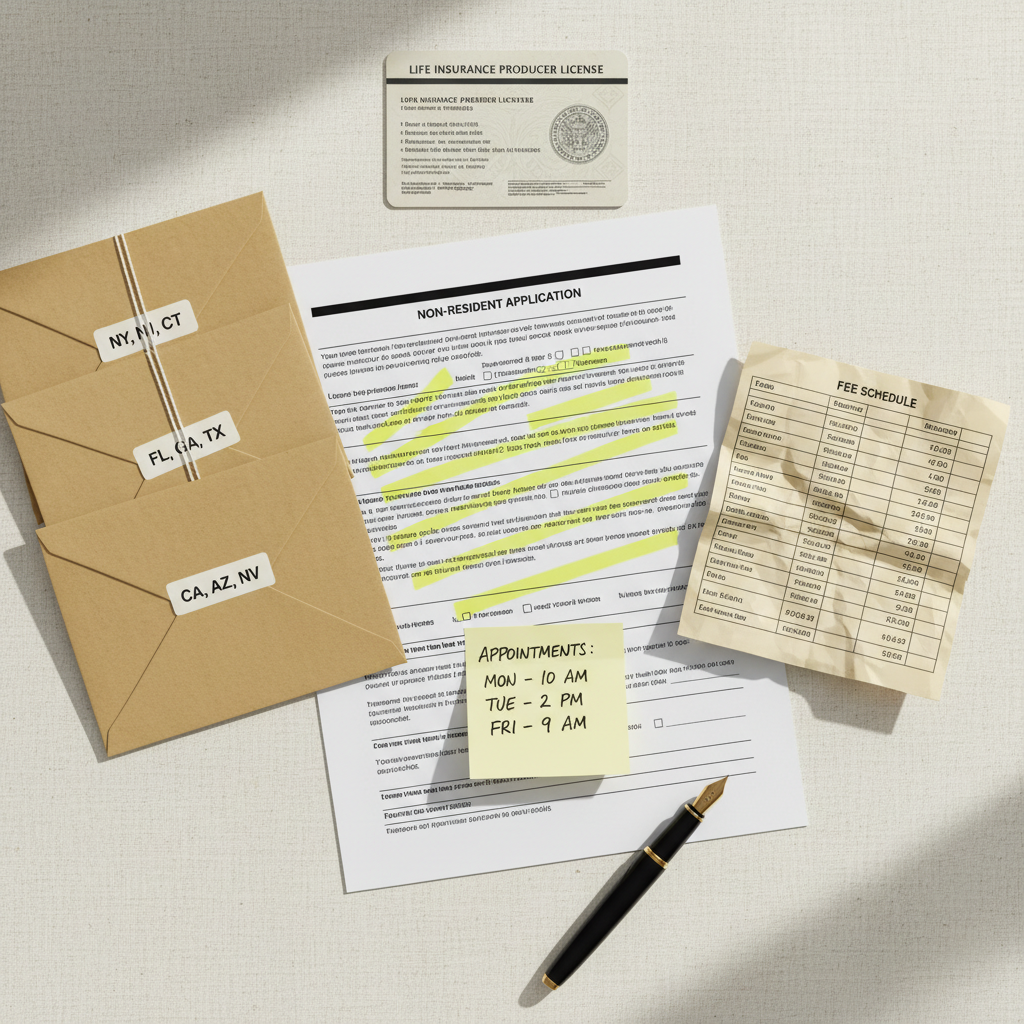
Yes, you can sell life insurance in another state. But you need a non-resident license for every state where you want to do business. There’s no federal insurance license, no blanket authorization, and no shortcut. Each state runs its own insurance regulatory system, and each one requires its own application and fee.
The good news: you don’t have to sit for another exam. If you hold an active home-state life insurance license, virtually every state will issue you a non-resident license without additional testing. The process runs through a single portal, and you can batch multiple states in one session.
How non-resident licensing works
The system is straightforward once you understand the concept. Your “home state” is the state where you reside and hold your primary (resident) license. Every other state where you want to sell is a “non-resident state.” To sell there, you apply for a non-resident license through that state’s Department of Insurance — or, more practically, through NIPR.
The National Insurance Producer Registry is the centralized electronic gateway that connects you to almost every state’s licensing system. Instead of mailing paper applications to 49 different DOI offices, you log into NIPR and file everything online. It’s not pretty, but it works.
When you apply for a non-resident life insurance license, NIPR verifies that your home-state license is active and in good standing, then forwards your application to the target state. Most states approve non-resident applications within a few days to a few weeks. Some states (California, I’m looking at you) can take six weeks.
What each application costs
Every non-resident license application has two layers of fees:
The state application fee. This varies wildly. Kansas charges as little as $15. California charges $235. Most states fall in the $50 to $200 range for a life insurance non-resident license. The average is somewhere around $75 to $100.
The NIPR processing fee. NIPR charges a flat fee per state per transaction on top of the state fee. This covers the electronic processing and routing.
So for a single state, you’re typically looking at $75 to $225 total. Multiply that across all 50 states (plus DC and any territories you care about), and you’re in the $5,000 to $8,000 range for the full set. That number shocks people, but it’s the reality of a state-by-state regulatory system.
Questions everyone asks
Do I need a physical office or address in each state? No. That’s the whole point of a non-resident license. You operate from your home state and sell into other states remotely. You don’t need a brick-and-mortar presence.
Do I need a carrier appointment in each state? For most states, yes. Having the license gives you the legal right to sell in that state, but you still need an appointment (a formal relationship) with a carrier that’s authorized to do business there. Your carrier handles this on their end, and most will file the appointment once you show them your active non-resident license. Some carriers will actually file your non-resident license applications for you as part of the onboarding process. Ask.
Do I need to take an exam? No. Non-resident licenses are issued based on your active home-state license. You already passed your exam. The only exception is if your home-state license doesn’t cover the line of authority you’re applying for in the new state — for example, if your home state license is Life-only and you try to add Health in a non-resident state.
Do non-resident licenses expire? Yes. Most states tie your non-resident license renewal to your home-state license renewal date. If your home-state license lapses, your non-resident licenses in other states can fall like dominoes. Keep your home-state license current and set calendar reminders for renewals.
The NIPR application process step by step
If you haven’t used NIPR before, read the full NIPR walkthrough first. Here’s the abbreviated version for non-resident life insurance applications:
- Log into your NIPR PDB account (or create one if you haven’t already).
- Select “Apply for a License” under Producer Licensing.
- Confirm your resident state and verify your home-state license is showing as active.
- Select the non-resident state or states you want. You can batch multiple states in a single transaction.
- Choose “Life” as your line of authority for each state.
- Answer the background disclosure questions (consistent answers across all states — NIPR cross-references them).
- Pay the combined state fees and NIPR processing fees.
- Submit and wait.
Approval timelines vary. Some states process applications within 24 to 48 hours. Others take two to four weeks. California and a handful of other states can push past six weeks.
Which states to add first
If you’re planning to go national, don’t apply for all 50 at once. Stack them strategically.
Start with the highest-population states that have the lowest fees. Texas, Florida, and Ohio all have large markets and reasonable non-resident application fees. That’s where the policyholders are. A non-resident license in Wyoming isn’t useless, but it’s not going to move the needle the way Florida will.
Then add states where your carrier has the strongest presence. There’s no point holding a license in a state where your carrier doesn’t write business. Check with your carrier or agency about which states they’re actively selling in and prioritize those.
Save the expensive states for when you actually need them. California’s $235 application fee is worth it if you have California prospects. It’s wasted money if you don’t. Same for any high-fee state. Get licensed there when you have a reason to sell there, not just to check a box.
Consider the states where your current book has referral potential. If your existing clients have family, business partners, or colleagues in specific states, those are your next-highest-priority licenses. Warm introductions close faster than cold outreach, and you need the license in hand before you can write the policy.
The real cost of going national
Here’s a rough budget for getting licensed in all 50 states plus DC:
- State application fees: $3,500 to $6,000 (depends on your lines of authority)
- NIPR processing fees: $1,275 to $1,500 (51 states/territories at $25 each)
- Total: roughly $5,000 to $8,000
That doesn’t include renewal fees, which you’ll pay every one to two years depending on the state. Budget another $3,000 to $5,000 per renewal cycle to keep everything active.
It’s a real investment. But if you’re a life insurance producer with a phone-based or digital sales model, the math works. One closed policy in a new state can pay for 10 non-resident license fees. The cost isn’t the barrier. The paperwork is. And NIPR makes the paperwork manageable.
Your next step: if you haven’t set up your NIPR account yet, start with the NIPR walkthrough. Get your home-state license verified in the system, then batch your first five or six highest-priority states in a single application session.