Military spouse real estate license reciprocity: your federal rights explained
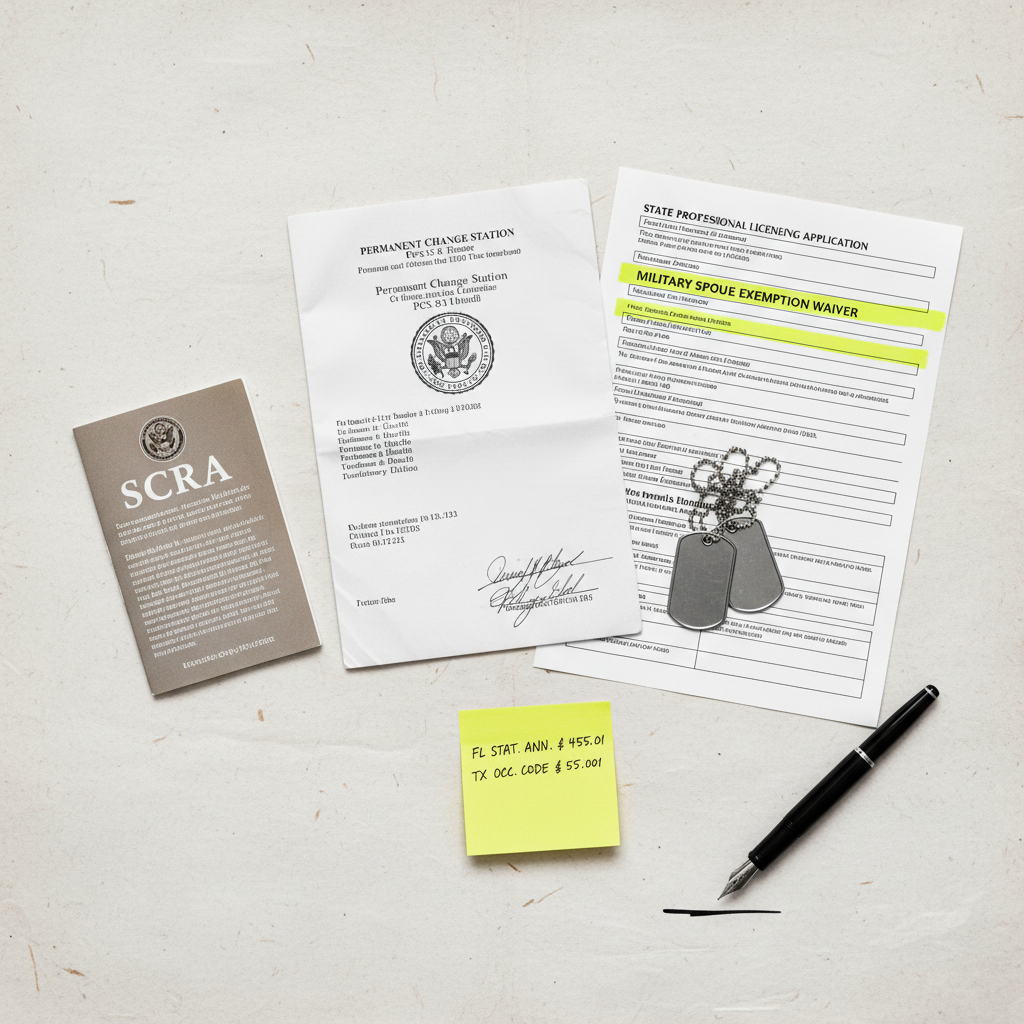
If you’re a military spouse with a real estate or insurance license, federal law now requires states to recognize your credentials when you relocate due to a PCS (permanent change of station) order. You don’t have to start over from scratch every time the military moves you. The specifics of what “recognition” means vary by state — from automatic license issuance to expedited processing to fee waivers — but the baseline federal requirement is real, and it has teeth.
Two pieces of federal law matter here: the Servicemembers Civil Relief Act (SCRA) and the Military Spouse Licensing Relief Act of 2023. Together, they create the strongest professional license portability protections that exist in the US for any group.
The SCRA: where it started
The Servicemembers Civil Relief Act has been around for decades, primarily protecting active-duty military members from certain civil obligations while deployed. But amendments over the years expanded its scope to cover professional licensing for both servicemembers and their spouses.
Under SCRA, a military spouse who holds a professional license in one state and moves to a new state due to military orders is entitled to use that license in the new state. The key provision: states cannot require a military spouse to re-establish residency, retake exams, or pay additional fees solely because of a military-related relocation — as long as the spouse holds a valid license from another state, the license is in good standing, and the spouse meets the qualifications for the equivalent license in the new state.
In practice, SCRA created the framework but left states with a lot of wiggle room in implementation. Some states embraced it. Others dragged their feet.
The 2023 Military Spouse Licensing Relief Act
On January 5, 2023, President Biden signed the Military Spouse Licensing Relief Act into law as part of the Veterans Auto and Education Improvement Act. This was the game changer.
The law amended the SCRA to explicitly require states to issue a license or authorization to practice to a military spouse who meets three conditions:
- The spouse holds a valid license from another state. The license must be current and in good standing.
- The license is substantially similar in scope. The new state’s license must cover the same type of work. A real estate license in State A qualifies you for a real estate license in State B.
- The spouse has actively used the license within the two years before relocating. This prevents someone from dusting off a decade-old inactive license.
The 2023 law was the first time a federal statute explicitly required reciprocity for military spouse professional licenses. Before this, states were encouraged but not compelled. Now they have to comply.
One exclusion: the law specifically does not apply to the practice of law. Attorneys are carved out. But real estate agents, insurance producers, and dozens of other licensed professions are covered.
What “accommodation” actually means state by state
Here’s where it gets messy. The federal law requires states to recognize military spouse licenses, but states have implemented this requirement differently. The spectrum runs from full automatic recognition to expedited applications to fee waivers combined with standard processing.
Automatic or temporary license issuance. Some states will issue a temporary license almost immediately upon proof of military spouse status and an active out-of-state license. You submit your documentation and get a license that’s valid for one to three years (depending on the state), during which you can practice without completing any state-specific requirements. Florida, Texas, and Virginia are among the states with the most straightforward automatic recognition programs.
Expedited processing. Other states run your application through the same process as any other applicant, but they move it to the front of the line. Processing that normally takes four to six weeks might take one to two weeks. You still pay the fees and submit the same paperwork, but the timeline shrinks.
Fee waivers. Several states waive application fees, licensing fees, or both for military spouses. Colorado, for instance, has been a leader on fee waivers for military families. Some states waive fees for the initial license and for renewals during the period of military assignment.
Combination approaches. Many states combine elements. Texas waives fees and expedites processing. Florida issues a temporary license and waives exam requirements. Virginia has a dedicated military licensing coordinator who shepherds applications through the system.
States with the best programs
Not all states are created equal here. These consistently rank as the most military-spouse-friendly for professional license transfers:
Texas waives both the application and examination fees for military spouses who hold an equivalent license from another state. The Texas Real Estate Commission (TREC) also expedites the review process. If your out-of-state license meets substantially equivalent requirements, you can be practicing in Texas within weeks.
Florida has one of the most generous programs in the country. Military spouses can receive a professional license without passing the Florida state exam and without completing Florida-specific pre-licensing education, as long as they hold a valid license from another state. The Florida Department of Business and Professional Regulation (DBPR) processes military spouse applications on a priority basis.
Virginia dedicates staff specifically to military spouse licensing. Given the massive military presence in Hampton Roads and Northern Virginia, this makes practical sense. Virginia offers temporary licenses for military spouses that are valid for the duration of the servicemember’s assignment in the state.
Colorado has been a national leader on occupational license reform for military families. Colorado waives fees, expedites processing, and issues temporary authorizations that let military spouses begin working while their permanent license application is being reviewed.
The process: how to actually get your license transferred
The typical steps for a military spouse license transfer:
Gather your documentation. You’ll need proof of your military spouse status (a copy of military orders or a military dependent ID), your current professional license in good standing from your previous state, and a certification of license history from that state’s licensing authority.
Contact the new state’s licensing board. Before filing anything, call or email the licensing board in your new state and specifically ask about their military spouse licensing program. Every state handles this differently, and the person on the phone can tell you exactly which forms to file and which fees (if any) to pay. Many state boards now have a dedicated military affairs liaison.
File through the expedited channel. Don’t just submit a standard application and hope they notice you’re a military spouse. Most states have a separate application form or a checkbox on the standard form for military spouse applicants. Use it. It routes your application to the right queue.
Keep copies of everything. Your approval timeline depends on bureaucrats processing paper. If something gets lost, having a complete copy of your submission with a date stamp saves you from starting over.
Typical timeline: two to eight weeks from submission to license in hand, depending on the state. States with automatic recognition can be as fast as a few days. States with standard processing that offer only expedited review may take the full eight weeks.
Resources worth bookmarking
Military OneSource maintains the most complete and current guide to military spouse license portability. They track state-by-state programs and can connect you with a counselor who helps with the application process. This service is free.
Your state’s military affairs office. Every state has one (often housed within the governor’s office or the Department of Veterans Affairs). They can intervene if your licensing application gets stuck or if the licensing board isn’t complying with federal requirements.
The Department of Labor’s License Recognition page tracks which states have implemented military spouse licensing laws and provides links to each state’s specific program.
Your installation’s legal assistance office. JAG officers can help you understand your rights under SCRA if a state licensing board is giving you the runaround. Having a JAG officer send a letter to a state board citing the federal statute tends to speed things up considerably.
If a state isn’t cooperating
The 2023 law is federal. States are required to comply. If a state licensing board denies your application or refuses to accommodate your military spouse status, you have options. Start with your installation’s legal assistance office. The complaint can also be escalated through the Department of Defense’s State Liaison Office, which works directly with state governments on military family issues.
The reality is that most states are now on board. The political dynamics of opposing military spouse employment rights are terrible, and state legislatures have moved quickly to implement these programs. But bureaucracies are slow, and individual licensing boards don’t always get the memo. If you hit a wall, push back. The law is on your side.